Where to See Dolphins in Scotland: Shore Spots and Tides
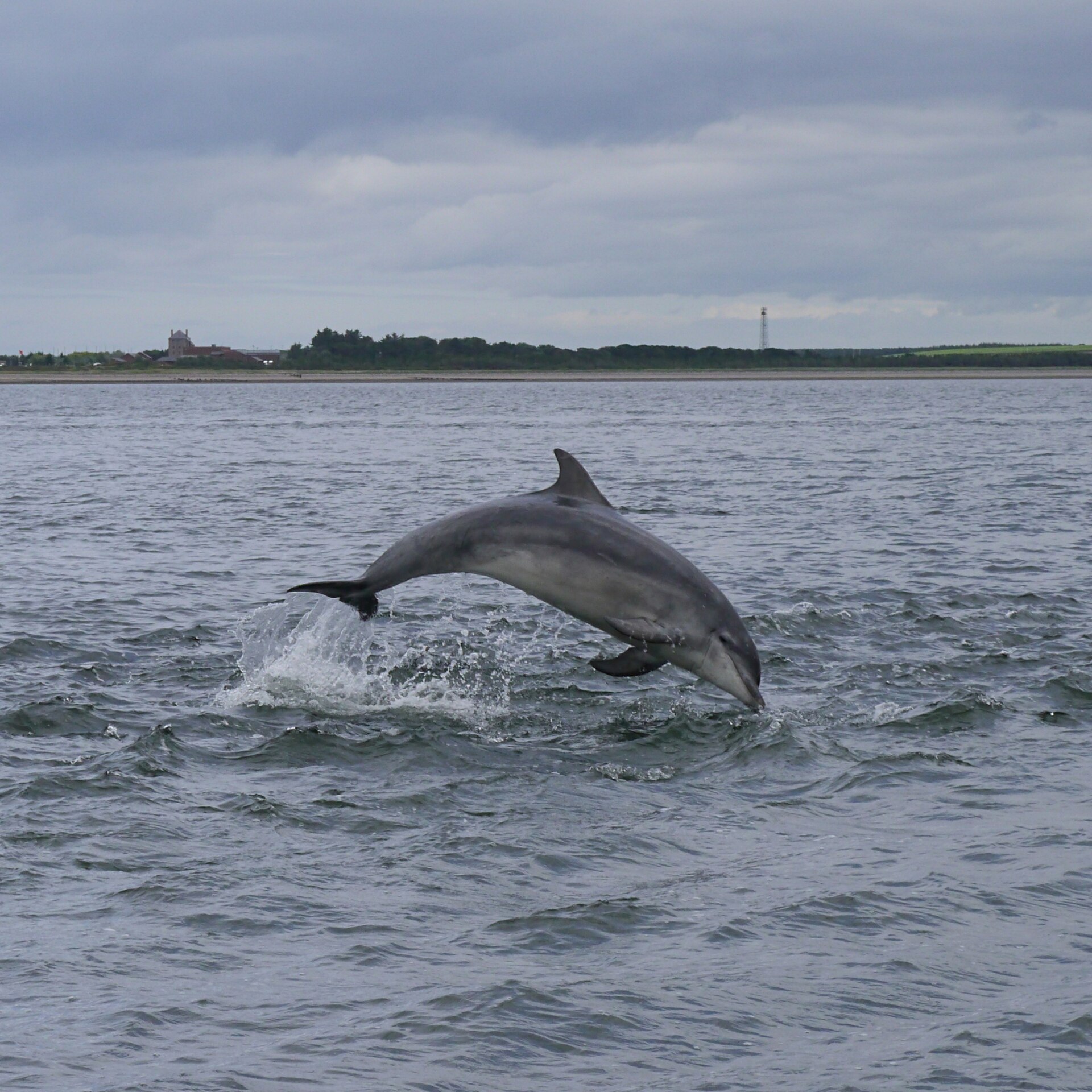
Scotland’s best-known dolphins can be watched from dry land. Common bottlenose dolphins (Tursiops truncatus) hunt off a spit of land on the Black Isle and in the mouth of Aberdeen’s harbour, and researchers have photographed and counted their population since 1989. The west coast has more species and longer distances, and you can watch there from boats or from the shore.
The east coast bottlenose dolphins
The latest count comes from NatureScot Research Report 1360, written by researchers at the University of Aberdeen and the Sea Mammal Research Unit at St Andrews and published in 2024. It puts the east coast of Scotland population at 226 dolphins (95% confidence interval 214 to 239), a weighted mean of the yearly estimates for 2020 to 2022. Dolphins are recognised from photographs of the nicks in their dorsal fins, and the report says the population is still increasing.
The core protected area is the Moray Firth Special Area of Conservation, designated in 2005 under the European Habitats Directive for bottlenose dolphins. It runs from the inner firths out to Helmsdale on the firth’s north shore and Lossiemouth on its south shore. More than half the population uses it in most years, and the report recommends keeping its condition at Favourable (maintained).
The dolphins also range well beyond it. The number using Tayside and nearby waters rose from an estimated 111 in 2019 to 195 in 2022, and survey boats now follow them into the Firth of Forth.
They are large animals. The Hebridean Whale and Dolphin Trust says Scottish bottlenose dolphins reach 4 metres, and the Port of Aberdeen wildlife guide puts the Aberdeen animals at over 500 kg. Our common bottlenose dolphin profile covers the species as a whole.
Chanonry Point and the Moray Firth
Chanonry Point sits at the end of Chanonry Ness, a spit reaching into the Moray Firth between Fortrose and Rosemarkie on the Black Isle. The local Black Isle Info guide calls it the best spot in the UK to watch bottlenose dolphins from land.
Plan around the tide. The local guide and the Wikipedia entry for the point both say the dolphins are most likely to show on an incoming tide. Neither promises a sighting, so check a tide table and be ready to wait.
An underwater sound logger moored off Chanonry for the University of Aberdeen’s monitoring detected dolphins on an average of 94% of summer days (May to September) from 2017 to 2022, for a median of 4.5 hours a day. A logger hears clicks under water, so it shows dolphins passing on most days. It says nothing about how long they stay in view from the beach.
The same logger heard dolphins in every month of the year, pooling 2017 to 2022. July was the best month, with dolphins detected on every day sampled. From October to December they were detected on about two thirds of days, and February and March were the weakest months, at roughly one day in three.
The car park at the point is small, and the Black Isle guide says motorhomes, caravans, trailers and coaches may not park there at any time. Parking in the villages is free, and the guide encourages walking out to the point.
The second logger in the protected area sits at the Sutors of Cromarty, the headlands at the mouth of the Cromarty Firth, where dolphins were detected on 95% of summer days for about 7 hours a day. I have found no reliable guide to shore viewing there.
Aberdeen: Torry Battery and the harbour mouth
In Aberdeen the dolphins hunt in a working port. The Port of Aberdeen wildlife guide, written by the East Grampian Coastal Partnership, explains the attraction. Salmon returning to the River Dee must pass through the harbour channel, and at the North Harbour entrance river and sea water are slow to mix. That boundary can bring a sudden temperature change that shocks the fish and makes them easy prey.
The guide says seeing more than 30 bottlenose dolphins in the port is not unusual, and scientists have identified individuals there from photographs since the late 1990s. It names Torry Battery and the car parks below it as the best place to watch, with a wide view and often other watchers sharing sightings. Much of the harbour is out of bounds, so stay behind the fences and off the breakwaters. On a calm day the headland at Girdle Ness offers a wider range of species, and harbour porpoise, minke whale and even humpback whale have been seen in the port, though rarely.
The west coast and the Hebrides
The Hebridean Whale and Dolphin Trust counts 24 cetacean species recorded in Scotland’s seas. Its 18.5 m research vessel Silurian surveyed the coastal waters of western Scotland from April 2021 to March 2024 and logged 3,089 sightings of ten mammal and two fish species, set out in NatureScot Research Report 1364. Between that report and the Trust’s species notes, this is what to expect:
- Harbour porpoise (Phocoena phocoena): the most recorded species, with 801 sightings, and seen all year in the Hebrides. It is not a dolphin; see how to tell dolphins and porpoises apart.
- Short-beaked common dolphin (Delphinus delphis): 587 sightings, most often in the Little Minch and the Sea of the Hebrides. Summer sighting rates in 2022 and 2023 were the highest in the programme’s 20 years. The Trust says it was once a rare summer visitor and is now reported in every month.
- Risso’s dolphin (Grampus griseus): the Trust says it is present all year, though the survey met it only on summer trips, 11 times, usually in deep water close to shore. The survey met a group of 20 with two young calves west of Lewis in 2023, and the North-east Lewis Marine Protected Area was designated for the species in 2020. See our Risso’s dolphin guide.
- White-beaked dolphin (Lagenorhynchus albirostris): a cold-water species, present year-round and most often seen around the Outer Hebrides, mainly in the north Minch and west of Harris in summer. Our North Atlantic species guide shows how to tell it from its neighbours.
- Common bottlenose dolphin (Tursiops truncatus): two small groups. The Barra Boys, up to 20 animals, stay almost entirely around Barra and South Uist, and the Inner Hebrides group of around 30 to 40 ranges from Skye to Arran. Silurian met bottlenose dolphins only 12 times, mostly around Barra.
Every minke whale sighting in the survey fell between April and November. For a boat trip, NatureScot recommends an operator accredited by the Wildlife Safe (WiSe) Scheme.
Watching rules: the Scottish Marine Wildlife Watching Code
NatureScot’s Scottish Marine Wildlife Watching Code applies on the shore and at sea. It was first published in 2006 and revised in 2017, and it is guidance rather than law. The 2017 Code booklet also sets out the law, which makes it an offence to deliberately or recklessly disturb or harass any whale, dolphin or porpoise. The points that matter most for dolphin watchers:
- From the shore, use binoculars or a telescope rather than getting closer, let the animals decide how close they come, and never chase or surround them.
- In a boat, slow to the safest minimum speed and approach at an angle. Never cut across a group’s path or come up from behind.
- If dolphins come to bow ride, keep a steady speed and course, and switch off your echo sounder if it is safe to do so.
- Jet skis are not recommended for watching wildlife. If you meet wildlife unexpectedly on one, slow down and move steadily away to 100 metres or more.
- Swimming or snorkelling with marine mammals is not recommended.
If you see dolphins being harassed and there is no threat to people or property, the Code says to call Police Scotland on 101 and ask for a Wildlife Crime Liaison Officer.
Recording what you see
Public sightings help the researchers. The Hebridean Whale and Dolphin Trust takes reports through its free Whale Track app or an online form. The Sea Watch Foundation takes UK sightings through its Sea Watcher app and runs National Whale and Dolphin Watch. The Hebridean report names these networks, with the Shorewatch programme run by Whale and Dolphin Conservation (WDC), as the way to fill gaps its boat surveys cannot, such as minke whales in winter.
For dolphin watching beyond Scotland, see our where to see dolphins hub.
Sources
- NatureScot Research Report 1360, Moray Firth SAC monitoring 2017 to 2022 (Cheney et al., 2024)
- NatureScot Research Report 1364, Hebridean Cetacean Research Programme 2021 to 2024
- Hebridean Whale and Dolphin Trust: 24 cetaceans of Scotland
- Hebridean Whale and Dolphin Trust: Whale Track
- Port of Aberdeen wildlife guide, 2025
- Black Isle Info: Chanonry Point
- Wikipedia: Chanonry Point
- NatureScot: Scottish Marine Wildlife Watching Code
- The Scottish Marine Wildlife Watching Code, 2017 (archived PDF)
- Sea Watch Foundation
Have you watched dolphins at Chanonry, Torry Battery or off the islands? Tell us when you went and what the tide was doing in the comments.
Photo: Craig Wallace, CC BY-SA 2.0, via commons.wikimedia.org.