
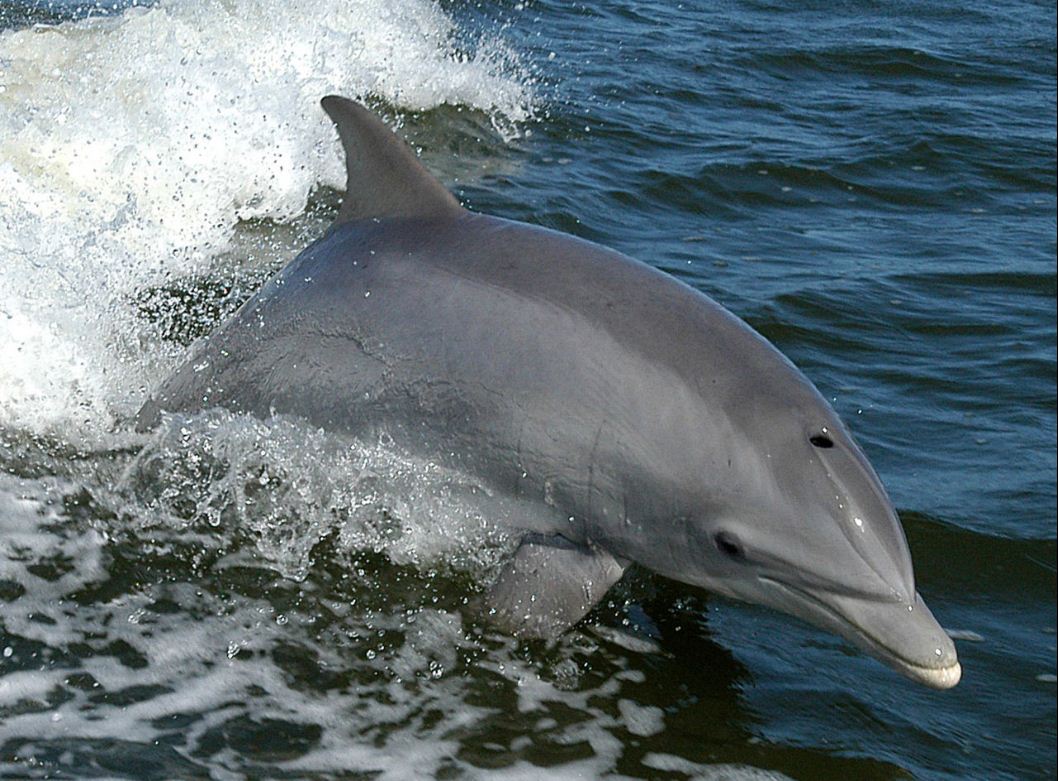
Common Bottlenose Dolphin: Facts, Diet, Habitat Guide
The common bottlenose dolphin is the dolphin most people picture when they think of dolphins. Sleek, grey, and intensely social, it is the species behind Flipper, the species in most marine parks, and the species used in a large share of the dolphin behaviour studies published in the last 60 years. It is also, despite that fame, stranger and more capable than the cartoon version suggests.
Key facts at a glance
| Common name | Common bottlenose dolphin |
| Scientific name | Tursiops truncatus |
| Max length | 4.0 m |
| Max weight | 650 kg |
| Diet | Carnivore: fish, squid, crustaceans |
| Habitat | Temperate and tropical seas worldwide: coastal, offshore, estuarine |
| Lifespan | Males around 40 to 45 years, females often past 50 |
| Population | Around 600,000 globally |
| IUCN status | Least Concern |
| Taxonomy | Artiodactyla | Delphinidae | Tursiops |
Range and the two ecotypes
Bottlenose dolphins live in temperate and tropical seas all over the world, from the Black Sea to the Gulf of Mexico, from South Africa to the coasts of Japan. Two broad ecotypes exist: coastal animals that live in shallow water and feed on bottom-dwelling fish, and offshore animals that are larger, darker, and hunt squid and pelagic fish far from land. In the western North Atlantic the split has gone further: since 2022 the coastal form there has been treated as a separate species, Tamanend’s bottlenose dolphin (Tursiops erebennus).
That split matters for conservation. A coastal population tied to one bay can be small, genetically isolated, and in trouble long before anything shows up in a global figure. Several regional groups are recognised as distinct subspecies, including the Black Sea bottlenose dolphin, Tursiops truncatus ponticus. Our piece on the new bottlenose dolphin subspecies covers the newest, T. t. nuuanu of the eastern tropical Pacific.
Diet and hunting
Bottlenose dolphins eat roughly 15 to 30 pounds of fish a day, mostly mullet, mackerel, herring, and whatever local prey is abundant. They hunt cooperatively in coordinated formations. In South Carolina, coastal dolphins now classed as Tamanend’s bottlenose dolphins use a technique called strand feeding, where two to six animals push a bow wave that drives fish clean out of the water onto a mud bank, then throw themselves half onto the bank to grab them before twisting back into the channel.
In Shark Bay, Western Australia, some dolphins of a close relative, the Indo-Pacific bottlenose dolphin, carry marine sponges on the beak to protect it while probing the rough seafloor for prey. The behaviour was first described in 1997, is practised mainly by females, and passes from mother to daughter rather than through the population at large. Tool use of this kind is rare in marine mammals, which is why one bay in Australia has absorbed so much research attention.
Social structure and intelligence
Bottlenose dolphins pass the mirror mark test, develop individual signature whistles that work much like names, and can learn arbitrary symbolic languages in captivity. Their encephalisation quotient, a measure of brain mass relative to body mass, is around 5.26, higher than a chimpanzee’s.
What makes the species interesting is less raw brainpower than what the populations do with it. Wild groups have local cultures. Across the bottlenose dolphin genus, sponge carrying in Shark Bay, strand feeding in South Carolina, and trawler following in the Gulf of Mexico are all learned techniques, held by particular communities, and absent from neighbouring populations that have access to the same prey. Two bottlenose dolphins of the same species can live very different lives depending on which mother taught them.
Reproduction and lifespan
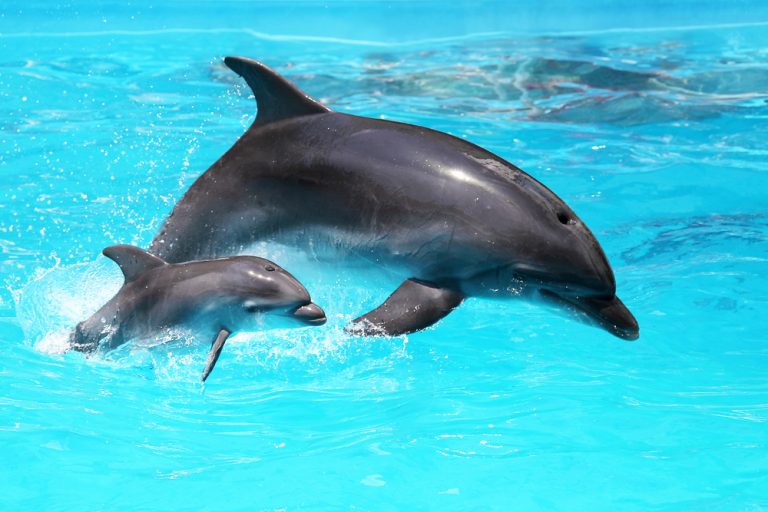
Gestation runs around 12 months and produces a single calf, born tail first and pushed to the surface for its first breath. Calving intervals are typically three to six years and nursing can continue for two to three. A female may raise fewer than ten calves in her life, which is why a population that loses adults to nets or boats takes decades to recover rather than years.
In the wild, males live around 40 to 45 years and females often past 50. In Sarasota Bay, the oldest known females have reached about 67 and the oldest males about 52. Age is estimated from growth layers in the teeth, which read a little like tree rings, and from photo identification of known individuals followed across decades.
Threats and conservation
The IUCN Red List classifies the common bottlenose dolphin as Least Concern, and the global population is estimated at around 600,000. That headline hides a lot. Bycatch in fishing gear kills thousands a year. Coastal populations carry heavy loads of PCBs, mercury, and other persistent pollutants that suppress immune function. Boat strikes injure resident animals around Sarasota and Tampa Bay. Noise from shipping and seismic surveys interferes with foraging and with the contact calls that keep mothers and calves together.
The Black Sea population was hit hardest of all. Commercial dolphin hunting there ran into the twentieth century on an industrial scale until the Soviet Union, Bulgaria, and Romania banned it in 1966. Turkey continued until 1983. The subspecies has never recovered to its former numbers, and since 2022 it has faced a rise in Black Sea dolphin deaths during the war in Ukraine.
How you can help
Three things actually move the needle. Support the organisations working on the species directly, including the IUCN SSC Cetacean Specialist Group, Whale and Dolphin Conservation, and the NOAA Office of Protected Resources for United States waters. Skip attractions that keep dolphins in tanks, because every ticket is a demand signal. And press on bycatch, which is the single biggest killer: dolphin-safe labels vary a lot in rigour, and the coastal gillnets that take the most animals are rarely covered by any label scheme at all.
Frequently asked questions
What is the scientific name of the common bottlenose dolphin?
Tursiops truncatus, in the family Delphinidae and the order Artiodactyla.
How big does a common bottlenose dolphin get?
Up to 4.0 m and around 650 kg at the extreme. Most adults are 2.5 to 3.5 m and 200 to 500 kg, with offshore animals larger than coastal ones.
How long does a common bottlenose dolphin live?
Males live around 40 to 45 years in the wild and females often past 50, so females typically outlive males by a decade or more.
How many common bottlenose dolphins are left?
Around 600,000 globally. At-sea counts carry wide error bars, and most rely on line transect surveys and photo identification of dorsal fins.
Is the common bottlenose dolphin endangered?
Not globally: the IUCN lists it as Least Concern. Individual populations are a different story, and the Black Sea subspecies is assessed separately and far more seriously.
Sources and further reading
- IUCN Red List entry for Tursiops truncatus
- NOAA Fisheries common bottlenose dolphin species page
- Sarasota Dolphin Research Program
- Society for Marine Mammalogy
Updated 25 October 2026: corrected the lifespan figures, credited Shark Bay sponge use to the Indo-Pacific bottlenose dolphin, and updated the ecotype section for the 2022 recognition of Tamanend’s bottlenose dolphin.



Didn’t know the coastal and offshore types were so different. Bigger and darker offshore makes sense if they’re out chasing squid.
Any chance the offshore ones get split off as their own species too? The taxonomy seems to change every few years.