Whales and dolphins have so many similarities that people often mix them up. But, there are clear differences between them.A Pod Of Dolphins At Sea. They Are Smaller And Faster Than Whales Whales and dolphins are both sea mammals that belong in the order Cetacea, along with the porpoise. These three creatures have so many similarities that people often mix them up, especially as regards whales and dolphins. Take for instance the case of the orca or killer whale, which is genetically a dolphin though it has ‘whale’ attached to its name. While whales and dolphins have many features in common, there are also clear differences between each of these creatures. Let’s take a look at the major ones.
Physiological Structure
Teeth
The Cetacea group is divided into two groups: the toothed whales and the baleen whales. Dolphins, porpoises and some whales, like the sperm whale, belong to the toothed category. The baleen whales are the filter-feeders. They don’t have teeth but rather baleen plates that they use to filter food out of water. Some of the largest whales belong to the baleen category e.g. the humpback whale, and the blue whale (the largest whale on earth). Tooth shape separates the toothed whales from each other, too. Dolphins have fine conical teeth for gripping and dragging prey into the mouth, and so do sperm whales. Porpoises are the odd ones out, with flattened spade-shaped teeth. If you can see the teeth clearly enough to tell, you are far too close.
To make it easier to understand: baleen whales are usually larger and slower than toothed whales.
Size
The most obvious difference is body size. Whales include the largest animals that have ever lived: a blue whale can reach close to 100 feet. Dolphins typically grow to between 6 and 12 feet long with the largest dolphin being the fearsome orca or killer whale.
Other Features
Most dolphins have an elongated beak that the whales do not have. In addition, baleen whales have two blowholes but toothed whales have just the one.
Preferred Habitat And Other Characteristics
Preferred Habitat
Their location is also varied. Whales tend to have a more cosmopolitan distribution though they only live in saltwater. They cannot stay for long periods in fresh water. Dolphins also live in saltwater, but a few river dolphins can make ‘special appearances’ in freshwater. Such dolphins include the pink Amazon River dolphin.
Swimming Speed
Dolphins are fast swimmers and more agile in water compared to whales. Obviously, the larger bodies of the whales translates to a slower pace. One exception is the fin whale which swims quite fast at speeds of up to 25 miles an hour (40 km/h). That has earned it the nickname ‘greyhound of the sea.’
Bottlenose dolphin males live around 40 to 45 years, and females often live past 50. Large whales go further: bowheads have been aged at over 200.
Intelligence
Dolphins get the reputation, but the comparison does not hold up well. Both groups are intelligent, and sperm whales and humpbacks have social and vocal complexity that matches anything in the dolphin family. What dolphins have is proximity: they come close to boats and people, which makes them easier to study and far easier to like.
Social Interactions
A Solitary Humpback Whale (Author: Whit Welles/Wikimedia Commons cc 3.0) Dolphins are also more social than whales in the wild. You’ll find dolphins swimming in large groups together, and they enjoy living like this. Other than for breeding purposes, migrating, or a mother whale with its calf, you’ll rarely see a group of whales swimming together.
How Whales And Dolphins Use Sound
Sound is very important to baleen and toothed whales as they use it for navigating and communicating, or for locating prey. However, the way they use sound differs. In the case of dolphins, they have a distinctive clicking/whistling sound they make. Researchers have observed that dolphins can use these sounds to call each other from afar. Almost like how humans use names to call one another. Dolphins also use sound for echolocation while hunting. Echolocation works as a sonar system and lets the dolphin interpret information about objects (prey, predators, etc.) in the water around it. Whales also make a variety of sounds like roars, groans, squeals, and moans. A 2024 study showed that baleen whales make their calls with a specialised larynx, using structures found only in their group.
Some of these whales produce sounds that last for up to 10 minutes at a time. Hence they’ve earned the term ‘whale song.’
Baleen whales use sound more for communication and navigation. Differentiating between dolphins and whales can be confusing but as a rule-of-thumb remember, all dolphins are a type of whale, but not all whales can be classified as dolphins.
Collapsed fins, worn teeth, repetitive swimming and raking: the signs that show up again and again in captive dolphins and orcas, and what each one is really telling you.
Bering Sea orcas have learned to recognise individual longline boats and strip the halibut and black cod off their gear. What it costs the fleet, and why pots may be the only answer.
Iceberg, the white male orca photographed near the Commander Islands in 2010 and seen again in 2016, plus Chimo the albino orca of 1970 and why white colouring in orcas is not just a curiosity.
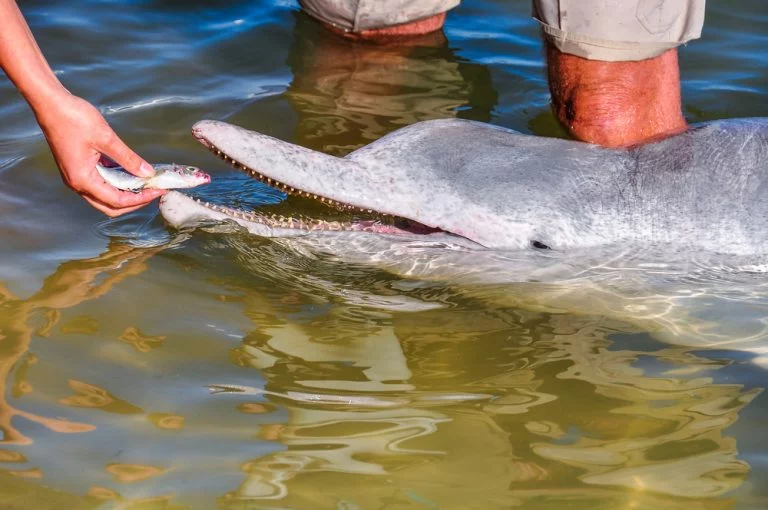
Feeding wild dolphins injures them, and the 2016 Sarasota Bay study shows the habit spreads between animals. What goes wrong, and why it is illegal in the US.
6 Comments
Very interesting, didn’t know Dolphins live up to 60 years and whales up to 110 years.









Very interesting, didn’t know Dolphins live up to 60 years and whales up to 110 years.
Such a great blog. Thanks for wonderful information. I absolutely love all these beautiful creatures. They are just so amazing!!
I enjoyed learning about the differences. Great post!
Interesting facts about the differences. Thanks for the info.
So many interesting facts . Always loved dolphins
Wow I didn’t know most of this and there seems to be so much to learn!