
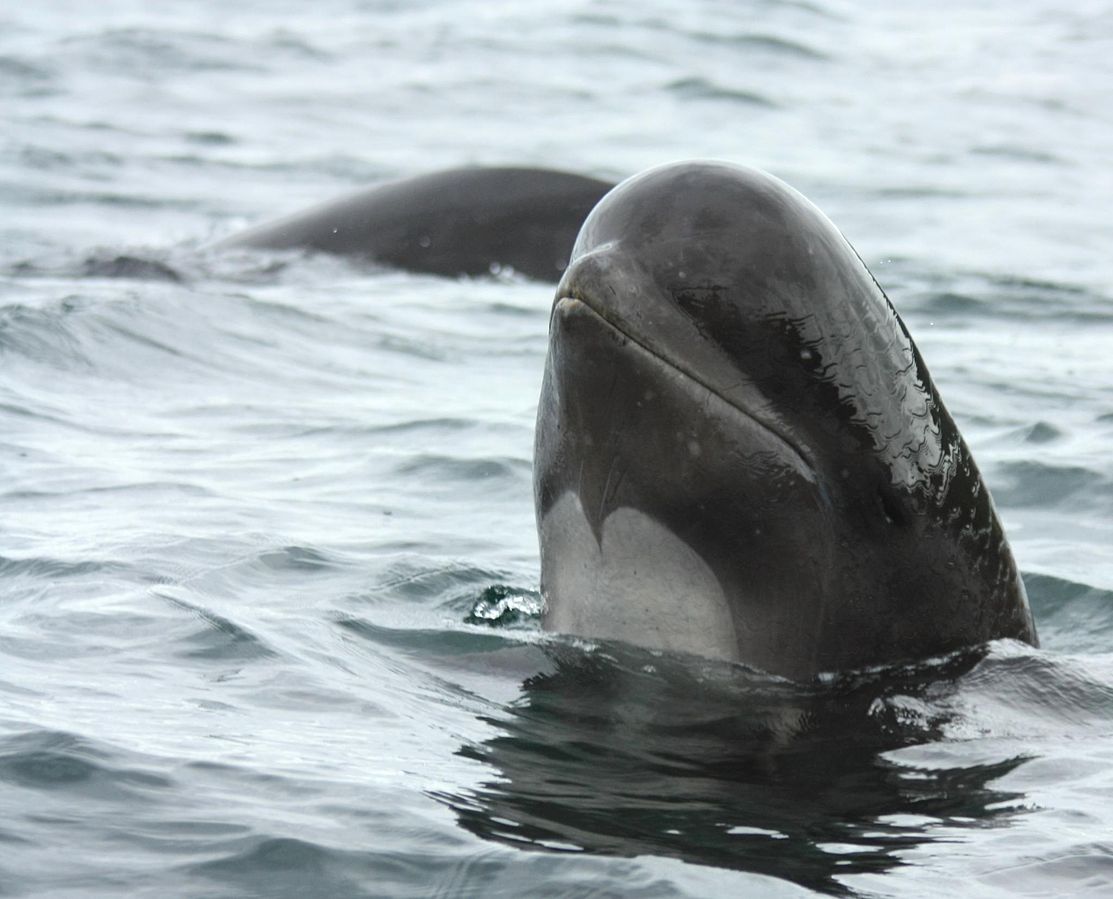
Pilot Whale: Facts, Species, Diet & Conservation Guide
Pilot whales are the second largest members of the dolphin family, after the orca. Despite the name, they are dolphins. Two species exist: the long-finned pilot whale of cold seas and the short-finned pilot whale of warm ones. Both are deeply social, live in matrilineal pods that can run to hundreds of animals, and hold one of the more surprising records in mammal neuroscience.
Key facts at a glance
| Common name | Pilot whale |
| Scientific names | Globicephala melas (long-finned), Globicephala macrorhynchus (short-finned) |
| Max length | 7.6 m (long-finned males); 7.2 m (short-finned) |
| Max weight | About 2,300 kg (long-finned); about 3,000 kg (short-finned) |
| Diet | Carnivore: mainly squid, some fish |
| Habitat | Long-finned: temperate North Atlantic and Southern Ocean. Short-finned: tropical and subtropical worldwide |
| Lifespan | 60 years and beyond |
| Population | Around 780,000 in the central and eastern North Atlantic (1989 survey, which could not fully separate the two species); no global estimate for short-finned |
| IUCN status | Least Concern (both species) |
| Taxonomy | Artiodactyla | Delphinidae | Globicephala |
Where they live
Pilot whales are animals of deep water. They follow squid along the edge of continental shelves and into the open ocean, rest at the surface in tight rafts, and rarely come close inshore except when something goes wrong. The long-finned species holds the cold ends of the range, the North Atlantic and the Southern Ocean; the short-finned species holds the warm middle. The two overlap only narrowly, which is one reason survey teams struggle to tell their numbers apart at sea.
Long-finned or short-finned: how to tell them apart
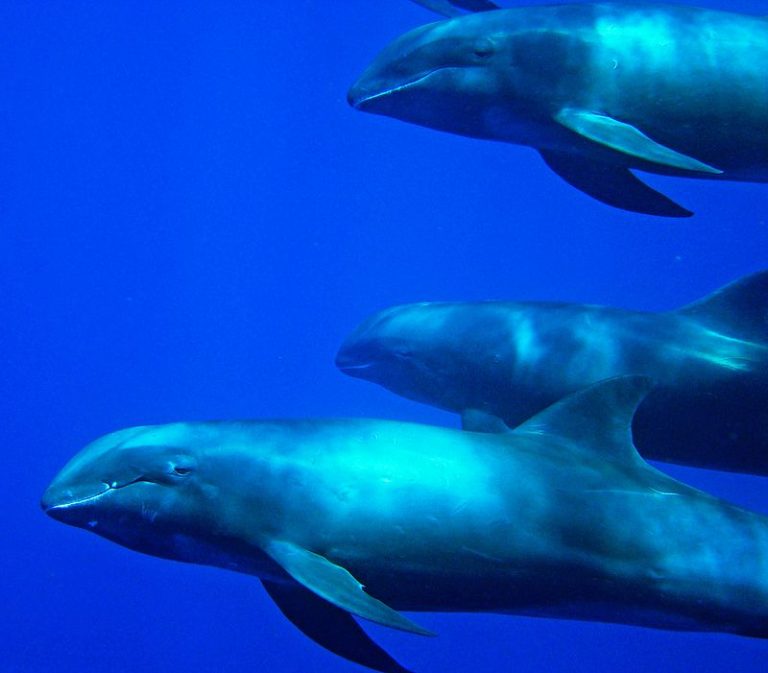
At sea the two look almost the same. The flipper is the best field mark if you get close: long-finned pilot whales have longer flippers, around a fifth of body length, with a sharp bend like an elbow, while short-finned flippers are shorter, around a sixth, and curve gently. The ranges overlap, so specialists confirm the species from skull shape and tooth counts. In practice location settles most sightings, because the two species barely meet.
There are no long-finned pilot whales in the North Pacific today. The species once lived there and is known only from skulls found in Japan and around the Sea of Japan, one of them dated to the Jōmon period, thousands of years ago.
Short-finned pilot whales vary more than one name suggests. Japanese whalers have long told apart a southern form (naisa) and a northern form (shiho), and a 2019 genetic study of 735 samples from around the world found two lineages that may be subspecies: one in the eastern Pacific and northern Japan, the other across the rest of the range (Van Cise and colleagues, Molecular Ecology).
Their habits differ in ways that matter for conservation. Around the Faroes, long-finned pilot whales feed mostly on the European flying squid, Todarodes sagittatus, and turn to Gonatus squid in years when it is scarce. Short-finned pilot whales are the main animals taking bait and catch off the hooks in the Atlantic pelagic longline fishery, a habit called depredation, which also gets them hooked and entangled.
Diet and diving
Squid is the staple, particularly oceanic squid that rise towards the surface after dark, so most feeding happens at night. Short-finned pilot whales tagged off Tenerife in the Canary Islands dived as deep as 1,018 m, for up to 21 minutes. NOAA gives about 600 m for long-finned pilot whales. The Tenerife whales also finished deep dives with a sprint after prey of up to about 9 m a second, which earned them the nickname cheetahs of the deep sea.
Pods that never break up
Genetic work on long-finned pilot whales, much of it drawn from animals killed in the Faroese hunt, points to lifelong natal philopatry: females stay in the group they were born into, and the evidence suggests males mostly do too, mating with other pods without leaving their own. In mammals that arrangement is unusual. It also explains a lot about how the species behaves under stress.
The brain is the headline. Counts published in 2014 found that the long-finned pilot whale has more neocortical neurons than any mammal yet measured, close to twice the number in a human brain. Nobody claims that settles what the animal experiences. It does mean the standard shorthand about primates having the most elaborate cortex needs a footnote.
Short-finned pilot whale females go through menopause. They typically stop reproducing around 40 while living past 60, spending decades in the pod after their last calf. Outside humans, that pattern is known in only a handful of toothed whales, including orca, narwhal, beluga, and false killer whale.
Threats and conservation
Both species are listed as Least Concern, and neither is thought to be in global decline. The pressures are regional and specific.
Long-finned pilot whales are still taken in the Faroe Islands drive hunt, the grindadrap, which has averaged roughly 700 animals a year with wide swings between seasons. Short-finned pilot whales are hunted in Japan. Both species drown in driftnets and on longlines. And pilot whales mass strand more readily than any other cetacean, sometimes more than a hundred animals at once, an outcome the pod structure makes worse: healthy animals follow a sick relative onto the sand rather than abandon it. Naval sonar has been implicated in some events, though not all. Cape Cod is one of the worst places for it, as our piece on pilot whale strandings on Cape Cod explains.
Frequently asked questions
Is a pilot whale a whale or a dolphin?
A dolphin. Both species sit in the family Delphinidae. The name is a historical one, based on size and on the belief that the pod follows a leader, or pilot. Our piece on the largest dolphins also called whales covers the others.
How big does a pilot whale get?
Long-finned pilot whales reach about 7.6 m and 2,300 kg, with females considerably smaller than males. Short-finned pilot whales reach about 7.2 m and, according to NOAA Fisheries, up to about 3,000 kg.
How deep can a pilot whale dive?
Short-finned pilot whales tagged off Tenerife reached 1,018 m. NOAA gives about 600 m for long-finned pilot whales.
Why do pilot whales mass strand?
Because the pod will not split. If one animal is sick or disoriented and heads for shore, the rest follow, which turns a single stranding into a group one and defeats most rescue attempts.
Are pilot whales endangered?
No. The IUCN lists both species as Least Concern. That does not make the drive hunts or the mass strandings any less costly to the individual pods involved.
Sources and further reading
- IUCN Red List entries for Globicephala melas and Globicephala macrorhynchus
- NOAA Fisheries pilot whale species pages
- Mortensen and colleagues, 2014, on neocortical neuron counts in the long-finned pilot whale
- Society for Marine Mammalogy
Updated 25 October 2026: corrected the weight figures, separated the dive records of the two species, and dated the North Atlantic population estimate, and merged our post on telling long-finned and short-finned pilot whales apart into this profile.


I didn’t know that. Very interesting!
If the pods stay together for life, then a drive hunt takes out whole families at once. Grim to think about.