Signature Whistles: Do Dolphins Have Names?
EODMU 1 conducts mine countermeasure training with a bottlenose dolphin 140719-N-FN215-308, by Petty Officer 2nd Class Joshua Scott, Public domain, via Wikimedia Commons.
Every bottlenose dolphin develops a unique signature whistle in its first year of life and keeps using it for the rest of that life. Other dolphins copy that whistle to address the individual it belongs to. This is the closest documented animal equivalent of personal names.
What a signature whistle is
A signature whistle is a stereotyped, narrow-band, frequency-modulated call, typically lasting one to four seconds. The frequency contour is what carries the identity, and it is unique to the individual.
Crucially, identity is encoded in the shape of the whistle rather than in voice quality. That is what makes copying possible: another dolphin can reproduce the contour without sounding like the animal it belongs to, which is exactly what a name has to do.
The whistle usually develops fully within the first year, and once formed it is remarkably stable, documented as unchanged over at least twelve years.
Discovery and key research
Melba and David Caldwell identified individually distinctive whistle contours in bottlenose dolphins in a paper published in Nature in July 1965. That is the origin of the whole field.
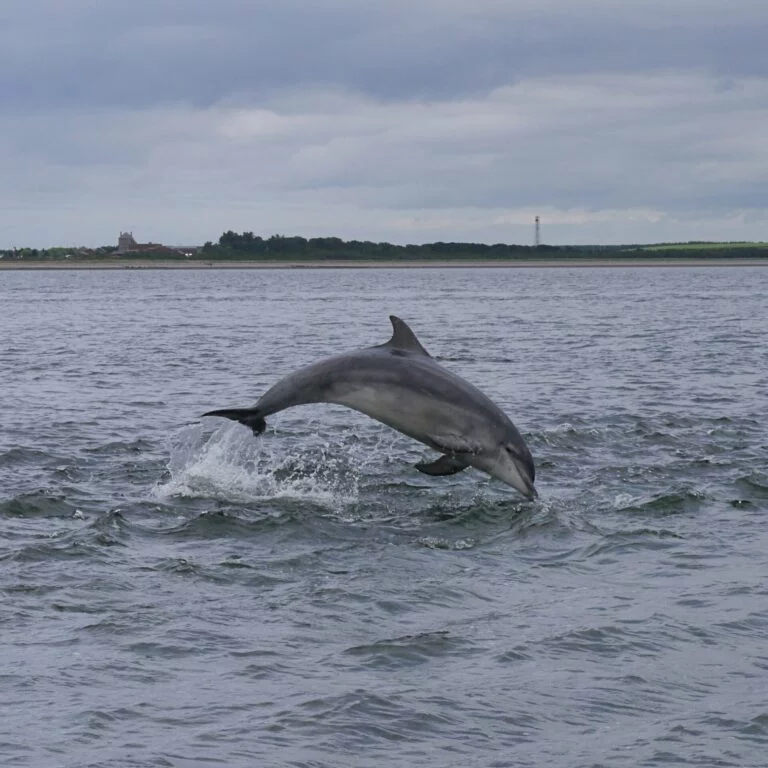
The experiment that made the case for names came much later. In 2013, Stephanie King and Vincent Janik published “Bottlenose dolphins can use learned vocal labels to address each other” in PNAS. Working with wild, free-ranging bottlenose dolphins off the east coast of Scotland, in the Moray Firth and St Andrews Bay, they recorded animals’ signature whistles in the field and then played back either a synthesised copy of the animal’s own whistle, stripped of voice features, or a control whistle belonging to a different dolphin.
The dolphins called back when they heard their own signature. They did not respond to whistles that were not theirs. Being addressed by name produced an answer.
Two other pieces of work fill in the picture. Quick and Janik showed in 2012 that bottlenose dolphins exchange signature whistles when groups meet at sea, which looks a great deal like introductions. And in 2018, King and colleagues published work on male dolphin alliances in Shark Bay, Western Australia, showing that allied males retain their own individual vocal labels rather than converging on a shared group call, which is the opposite of what happens in many other social animals.
Why this is significant
Personal names are extremely rare in animal communication. The closest parallels reported so far are in some parrots and, since 2024, wild African elephants and marmosets, which appear to address each other with individual calls.
What makes the dolphin case interesting is that the use is symbolic. The whistle stands for the individual regardless of who produces it, and that kind of reference is normally treated as a step toward language.
What signature whistles are not
They are not a language. There is no evidence that dolphins combine signature whistles syntactically to convey relationships between individuals, which is the gap between having names and having grammar.
They are also not uniform across the species. Different bottlenose populations have culturally distinct whistle traditions, even though the underlying mechanism is consistent.
Open questions
Whether dolphins use signature-whistle copying to coordinate group movement is still debated.
Whether other dolphin species, such as spinner, striped and Atlantic spotted dolphins, have equivalent structures is under study, and the preliminary evidence is mixed. Bottlenose dolphins are the species this has been properly established in.
Read next
- dolphin facts guide
- dolphin vs porpoise differences
- dolphin intelligence evidence
- how dolphin echolocation works
- dolphins and the mirror test
Frequently asked questions
Do dolphins have names?
Effectively yes. Each bottlenose dolphin develops a unique signature whistle, and other dolphins copy that whistle to address that individual.
Who discovered dolphin signature whistles?
Melba and David Caldwell, in a 1965 paper in Nature. Stephanie King and Vincent Janik later demonstrated, in wild dolphins off the east coast of Scotland, that animals reply when they hear a copy of their own signature whistle.
When do dolphins learn their signature whistle?
Usually within the first year of life. Once formed it stays stable, in documented cases for at least twelve years.
Do dolphins use signature whistles like language?
They use them as personal references. They do not appear to combine them syntactically to convey relational meaning, and that is the key gap between names and language.
Do all dolphin species have signature whistles?
Bottlenose dolphins definitely do. Evidence for other species is preliminary and mixed.
Sources
- Caldwell and Caldwell, Individualized Whistle Contours in Bottle-nosed Dolphins (Tursiops truncatus), Nature, 1965
- King and Janik, Bottlenose dolphins can use learned vocal labels to address each other, PNAS, 2013
- Quick and Janik, Bottlenose dolphins exchange signature whistles when meeting at sea, Proceedings of the Royal Society B, 2012
- King et al., Bottlenose Dolphins Retain Individual Vocal Labels in Multi-level Alliances, Current Biology, 2018
Updated 25 October 2026: added the 2024 elephant and marmoset studies on name-like calls.