
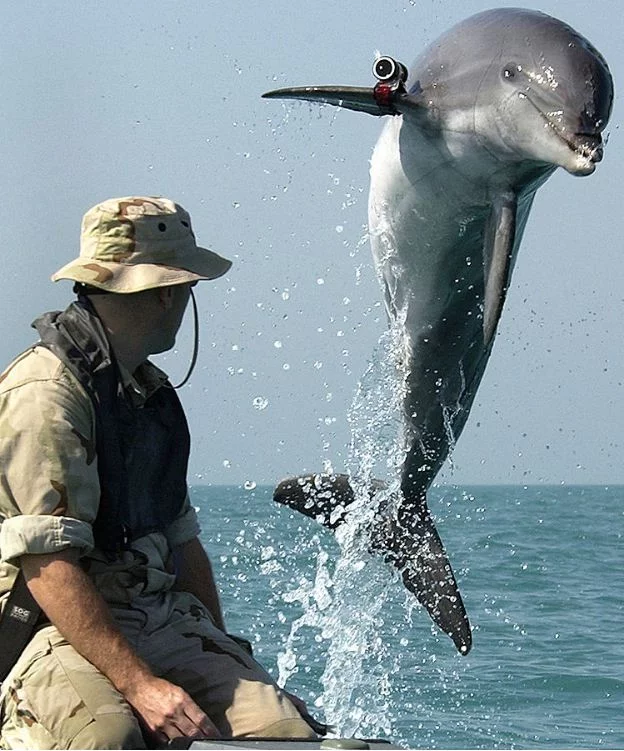
What Are Military Dolphins And What Do They Do?
Militaries have used dogs for centuries. Rather fewer people know that navies have been training dolphins since 1960, and that the US and Russian programmes are still running.
Why dolphins
Biosonar. A bottlenose dolphin can find a metal object buried in silt, in murky water, in a cluttered harbour, and tell it apart from the rubbish around it. Man-made sonar struggles badly in exactly those conditions, which is why the US Navy has never fully replaced the animals despite decades of work on machines to do it.
They also train reliably, work close to people without much fuss, and can be moved by aircraft to wherever they are needed.
Which countries have done it
The United States and the Soviet Union are the two documented programmes. The Soviet unit at Sevastopol passed to Ukraine, then came under the Russian Navy after Russia annexed Crimea in 2014. In 2022 satellite images showed Russian dolphin pens at the entrance to Sevastopol harbour. Israel has been suspected of running dolphins for military purposes, but that has never been confirmed.
The US Navy Marine Mammal Program traces back to 1960, when a Pacific white-sided dolphin was acquired to study how dolphins move through water. The interest was hydrodynamics, not soldiering. The training possibilities became obvious quickly.
The first research facility was built at Point Mugu, California, in the early 1960s, and by 1967 the programme had moved to Point Loma in San Diego, where it is still based. Dolphins were never the only animals. From the mid-1970s the Navy trained California sea lions to find and recover equipment on the seabed, and it tested belugas, which cope with colder and deeper water than dolphins do.
The Soviet Navy set up its own facility at Kazachya Bukhta near Sevastopol during the 1960s. Most of what went on there remains classified. After the collapse of the Soviet Union the site passed to Ukraine, which could not fund it, and in March 2000 the BBC reported that the Ukrainian navy had transferred its military dolphin project from Sevastopol to Iran.
That report is hard to square with the later Russian takeover of the Sevastopol unit, and neither government has published a full account of what happened to the animals. The war has also hit the wild dolphins of the Black Sea, as our piece on the rise in dolphin deaths due to war sets out.
In April 2019 fishermen near Hammerfest in northern Norway met a tame beluga wearing a harness with a camera mount, its clasps marked “Equipment St. Petersburg”. Norwegians called him Hvaldimir, and he was widely taken to be an escaped Russian navy animal, though Russia never commented. He was found dead in Risavika Bay on 31 August 2024.
What they actually do
- Locate underwater mines so that human divers can deal with them
- Detect and mark enemy divers approaching a ship or harbour
- Find and recover lost or damaged equipment from the seabed
- Act as underwater sentries around a defined area
Speculation about kamikaze dolphins carrying explosives, or poisoned darts, has followed these programmes since the Cold War. The US Navy’s position is that it has never trained marine mammals to harm people or to attack ships, and there is no confirmed evidence otherwise. Soviet-era claims are harder to assess for the obvious reason.
Where they have been used
The clearest documented deployment is the Iraq War in 2003. US Navy mine-clearance dolphins worked the port of Umm Qasr and helped detect more than 100 antiship mines and underwater booby traps, opening the port for aid shipments.
Earlier deployments are on the record in outline. In Vietnam the Navy sent five dolphins to Cam Ranh Bay to guard the harbour against enemy swimmers. From 1986 to 1988 six dolphins patrolled the harbour in Bahrain and escorted Kuwaiti tankers during the tanker war in the Persian Gulf; one of them, Skippy, died there of a bacterial infection. The programme’s Mk 6 swimmer-defence system was first deployed operationally with dolphins during the Vietnam War.
Robots and the future
In 2012 the Navy said it would start replacing its mine-hunting dolphins and sea lions with Knifefish, an unmanned underwater vehicle, from 2017. Knifefish went into production, but the animals were not retired. A Pentagon inspector general review found Knifefish struggling to meet its main mine-detection requirements, and the Defense Department was still publishing photographs of Navy dolphins at work with their trainers in 2023.
The objection
These are captive animals, held for human purposes, in an environment they did not choose, and taken into places where things are actively exploding. Animal welfare organisations have opposed the programmes for decades on exactly those grounds.
The Navy’s counter is that its animals are well fed, well housed, given veterinary care most captive dolphins never see, and are not sent into direct danger. Both of those things can be true at once, which is why the argument has not moved much in fifty years.
For the broader picture, see our dolphin facts guide.
Updated 25 October 2026: updated the history of the Soviet programme to cover the 2014 Russian takeover and the 2022 Sevastopol pens, and merged our post on the history of military dolphins into this guide, adding the Point Mugu and San Diego bases, the Vietnam and Bahrain deployments, sea lions and belugas, Hvaldimir and the move to underwater drones.



This is so interesting! I had no idea that there are militaries that use dolphins.
In WW 2, various militaries tried to train animals already for combat.
I didn’t know that Military Dolphins existed! Dolphins are awesome!