
Melon-Headed Whale: Facts, Behaviour & Habitat Guide
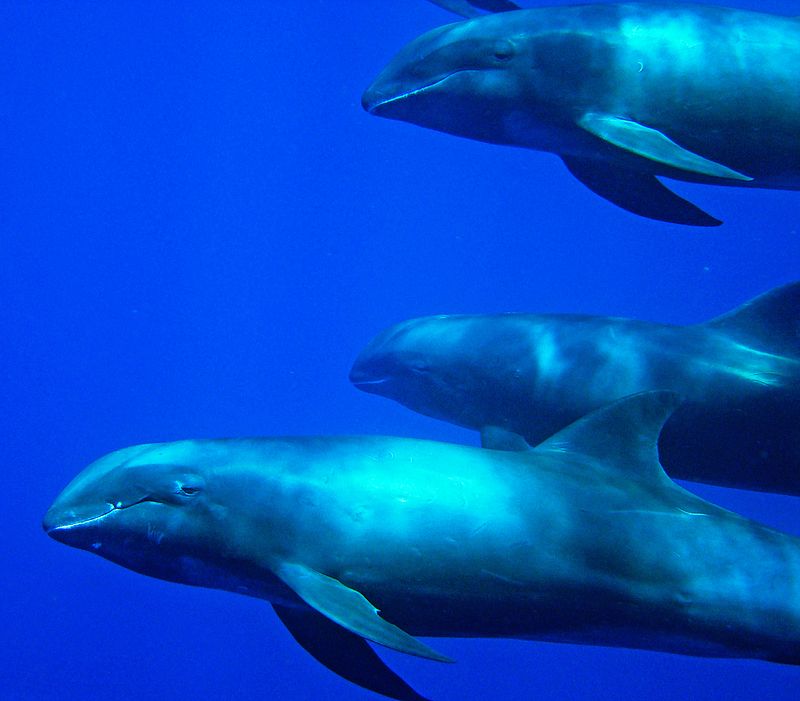
The melon-headed whale is a deep-water tropical dolphin most people will never see. Despite the name it is a dolphin, not a whale. It belongs to the group informally called blackfish, which also takes in the false killer whale, the pygmy killer whale, and the pilot whales: large, dark, white-lipped dolphins that travel in enormous pods.
Key facts at a glance
| Common name | Melon-headed whale |
| Scientific name | Peponocephala electra |
| Length | Up to 2.75 m |
| Weight | Up to about 225 kg |
| Diet | Squid, small mesopelagic fish, crustaceans |
| Habitat | Deep tropical waters worldwide |
| Lifespan | Up to about 45 years |
| Population | No global total; regional estimates only |
| IUCN status | Least Concern |
| Taxonomy | Artiodactyla, Delphinidae, Peponocephala |
Range and habitat
Melon-headed whales live in deep oceanic water across the tropics, and rarely come inshore except around oceanic islands such as Hawaii, where deep water sits close to land. They travel in pods of 100 to 500 animals, with herds of 1,000 to 2,000 recorded. They are often found alongside Fraser’s dolphins and false killer whales.
Nobody knows how many there are globally. What exists instead is a patchwork of regional estimates: about 45,000 in the eastern tropical Pacific from ship surveys in 1986 to 1990, and, from photo identification in the 2000s, about 5,800 in a population that ranges across the main Hawaiian Islands plus about 450 residents off Hawaii Island. Anyone quoting a single worldwide figure for this species is guessing.
Diet and hunting
The diet is squid, lanternfish and other small mesopelagic fish, and crustaceans, taken from the deep scattering layer. Feeding happens mostly at night, when that layer of prey rises toward the surface and the dolphins do not have to dive as far to reach it.
The teeth match the menu. Adults carry 20 to 25 pairs in each jaw, slender and closely set, which is the toothed-whale arrangement for gripping small slippery prey rather than tearing chunks off something large.
Social structure
Pod cohesion in this species is extreme even by dolphin standards. Melon-headed whales travel shoulder to shoulder in tight formation and often move fast, which is part of why a pod at the surface can look like a single dark mass rather than a group of individuals.
That togetherness has a cost. When something goes wrong, it goes wrong for the whole pod at once, which is why this species turns up repeatedly in mass stranding records.
Hanalei Bay, 2004
The best-documented event involving this species happened at Hanalei Bay on Kauai in July 2004, when more than 150 melon-headed whales moved into the shallow bay and milled there. The timing coincided with a US Navy sonar exercise offshore, and that link has been argued over ever since.
What is not argued over is the outcome. Volunteers and responders worked for more than a day to herd the pod back out to deeper water, and only a single calf is known to have died. For a mass stranding, that is close to the best possible result.
Threats and conservation
The IUCN lists the species as Least Concern, which reflects a wide global range rather than good news everywhere. Japan’s drive hunts take this species, with annual takes reported in the range of tens to a couple of hundred animals. Drive fisheries in Indonesia and the Solomon Islands take small numbers too, and bycatch in tuna longlines is a problem in some regions.
The threat with the clearest paper trail is naval mid-frequency sonar, which has been linked to mass strandings of this species and other blackfish. Noise is the pressure that acts on a deep-water animal nobody is watching, which is exactly what makes it hard to measure and easy to ignore.
Frequently asked questions
Is the melon-headed whale a whale or a dolphin?
A dolphin. It sits in the family Delphinidae as Peponocephala electra. The name is a description of its blunt head, not a statement about its taxonomy.
How big does a melon-headed whale get?
Up to about 2.75 m and 225 kg.
How many melon-headed whales are there?
There is no global estimate. Regional studies give about 45,000 in the eastern tropical Pacific (ship surveys, 1986 to 1990) and, around Hawaii, about 5,800 plus a resident group of about 450 (photo identification, 2000s).
What do they eat?
Squid, small deep-water fish such as lanternfish, and crustaceans, mostly taken at night.
Are melon-headed whales endangered?
No. The IUCN lists them as Least Concern. Local populations still face hunting, bycatch, and sonar-linked strandings.
We do not have a lot of information on this species compared with the coastal dolphins, simply because it lives so far offshore. If you have seen one, or work on a survey that has, leave a comment and tell us what you saw.
Updated 25 October 2026: corrected the regional population figures and added their survey dates.


Surprised there’s no global count at all. I guess they’re just hard to find that far offshore?
so blackfish is the melon-headed whale, false killer, pygmy killer and the pilot whales? had no idea that group had a name.