
Hourglass Dolphin: Facts, Antarctic Range & Behaviour
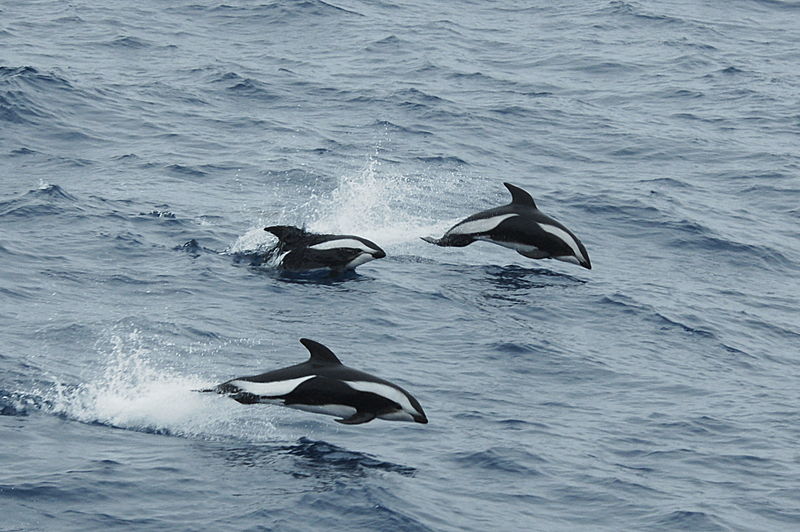
Almost everything known about the hourglass dolphin comes from people leaning over the rail of a ship in the Southern Ocean. It is the only small dolphin found regularly south of the Antarctic Convergence, it lives far from any coast, and very few specimens have ever been examined. What it does have is a paint job nobody forgets: two white panels along each flank, pinched thin below the dorsal fin, drawing an hourglass down a black body.
Key facts at a glance
- Common name: hourglass dolphin
- Scientific name: Cephalorhynchus cruciger, long listed as Lagenorhynchus cruciger
- Max length: around 1.9 m
- Weight: upwards of 90 kg
- Diet: small fish including lanternfish, plus squid and crustaceans
- Habitat: circumpolar Southern Ocean, mostly south of the Antarctic Convergence
- Lifespan: not directly measured, estimated by comparison with related dolphins
- Population: about 144,300, from shipboard line-transect surveys in January 1977 and January 1988
- IUCN status: Least Concern
- Taxonomy: Artiodactyla, Delphinidae, Cephalorhynchus
Range and habitat
Sightings ring the Southern Ocean, from roughly 45 degrees south down to the ice edge, with most records in water deeper than 200 m and well away from land. The Antarctic Convergence, where cold polar surface water sinks beneath warmer subantarctic water, is the rough northern boundary of the core range.
The population figure above deserves a footnote. It comes from two summer survey seasons, 1977 and 1988, and has not been repeated since. Nobody knows whether the number has moved. That is a fair summary of the state of knowledge on this species generally: a lot of sightings, very little demography.
Diet
Stomach contents point to small schooling fish, particularly lanternfish, alongside squid and crustaceans. Feeding appears to happen near the surface and at moderate depth, and mostly in daylight, when the deep scattering layer these prey belong to is still concentrated below.
Behaviour at sea
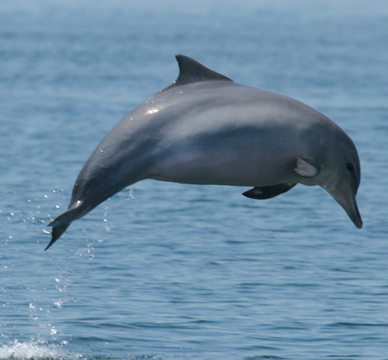
Hourglass dolphins are fast and conspicuous. They bow-ride ships in weather that keeps everything else out of sight, breach repeatedly, and throw up a rooster tail when running at speed. Groups are usually small, up to about 10 to 15 animals, though gatherings of around 100 have been recorded.
They are also sociable across species lines. Observers have logged them alongside fin whales, minke whales, pilot whales, southern right whale dolphins, southern bottlenose whales, Arnoux’s beaked whales and orcas, usually at the same feeding grounds rather than in mixed travelling groups.
A moving name
This species has been shuffled between genera. It sat in Lagenorhynchus for over a century, but molecular work showed that genus was a grab bag of unrelated animals, and the Society for Marine Mammalogy now places the hourglass dolphin in Cephalorhynchus. Older field guides, papers and the IUCN listing still carry the Lagenorhynchus name, so expect to meet both.
Threats and conservation
Distance has protected this dolphin. There has been no meaningful hunt and only incidental bycatch in distant-water fisheries, and the IUCN lists it as Least Concern. The pressures that matter are indirect: the Southern Ocean is warming, which moves prey, and the krill fishery around the Convergence is expanding into the same productive water the dolphins use.
The honest position is that a Least Concern listing here rests on a large range and an absence of known threats rather than on monitoring. There is no recent abundance estimate and no trend data at all.
Frequently asked questions
Where does the hourglass dolphin live?
Right around the Southern Ocean, mostly south of the Antarctic Convergence and in deep water offshore. It is the only small dolphin regularly seen that far south.
How big is it?
Around 1.9 m at most, weighing upwards of 90 kg. It is a compact, powerfully built animal for its length.
How many are there?
About 144,300, based on surveys from January 1977 and January 1988. No newer estimate exists, so treat the figure as a historical baseline rather than a current count.
Why is it called the hourglass dolphin?
Two white flank panels, front and rear, join in a narrow waist under the dorsal fin. Whalers called it the sea skunk for the same markings.
Is it endangered?
No. The IUCN lists it as Least Concern, largely because it is remote and rarely encounters fishing gear.
Sources
- IUCN Red List assessment for the hourglass dolphin
- Society for Marine Mammalogy taxonomy list
- Kasamatsu and Joyce, Southern Ocean line-transect abundance estimates
Updated 25 October 2026: corrected the survey method behind the population estimate.


So neat especially that they travel in such large groups!
Saw a small group bow riding on a trip down to South Georgia years ago. About a minute and then gone. Every photo I took was a blur.
That sounds about right for this species. They are fast, and most sightings come from ships well away from land, so a minute of bow riding is a good day.