
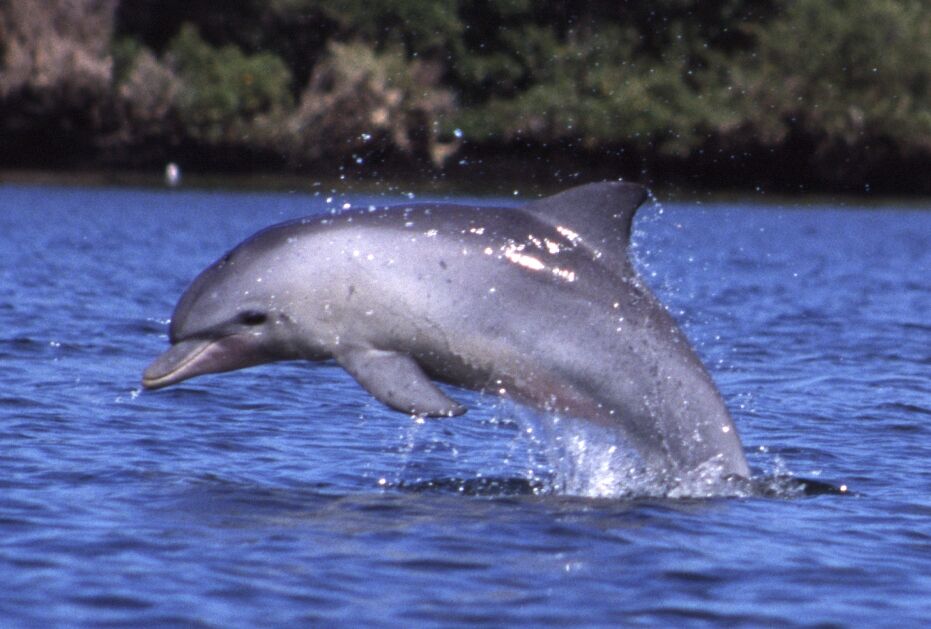
Indo-Pacific Bottlenose Dolphin: Facts, Range, Behaviour
Until 1998 the Indo-Pacific bottlenose dolphin was filed as a regional form of the common bottlenose. Genetic work split it off as its own species, Tursiops aduncus, and once you know what to look for the two are separable: this one is smaller and slimmer, has a proportionally longer beak, and most adults develop dark speckling on the belly and flanks that the common bottlenose never gets. It also stays close to shore. Where Tursiops truncatus ranges into deep offshore water, aduncus keeps to shallow coastal shelves, reefs and seagrass.
Key facts at a glance
- Common name: Indo-Pacific bottlenose dolphin
- Scientific name: Tursiops aduncus
- Max length: around 2.6 m
- Max weight: around 230 kg
- Diet: mostly fish, with squid and some crustaceans
- Habitat: shallow coastal waters of the Indian Ocean and western Pacific
- Lifespan: over 40 years
- Population: no global estimate
- IUCN status: Near Threatened (assessed 2019)
- Taxonomy: Artiodactyla, Delphinidae, Tursiops
Range and habitat
The species runs from the eastern coast of South Africa up through the Red Sea and the Arabian Sea, across India and Southeast Asia, north to southern Japan and south to Australia, including Shark Bay on the west coast. It is a shelf animal. Most sightings are in water under 30 m deep, over reef, sand or seagrass, and often within sight of land.
That coastal habit shapes the whole population structure. Instead of one continuous stock there are dozens of small resident communities, each tied to a stretch of coast, each partly genetically separate from its neighbours. Local groups often number in the low hundreds. Shark Bay in Western Australia holds the best studied of them, followed continuously since the 1980s.
Diet and hunting
Stomach-content studies put fish at roughly 87 percent of prey items and cephalopods at about 13 percent, with crustaceans taken occasionally. The fish are mostly reef and seagrass species rather than the schooling pelagics that offshore dolphins chase.
The famous behaviour is sponging. In Shark Bay a subset of females break a conical marine sponge off the seabed, wear it over the beak, and use it to root through coarse sediment for fish that do not carry swim bladders and so give no echo. The sponge takes the punishment that the rostrum would otherwise take from rock, coral rubble and stingray spines. It is one of the few undisputed cases of tool use in a wild non-primate, and it is almost entirely a female tradition: daughters of spongers nearly always sponge, sons rarely do. Our piece on six clever ways dolphins hunt for food sets sponging beside the other techniques.
Male alliances
Shark Bay is also where researchers described the layered male alliance system. Pairs and trios of males cooperate to herd individual females. Those small units then combine into larger teams that take females from other teams and defend against the same. The nesting of one alliance inside another, held together over years, is a structure with very few parallels outside human societies.
Around that male politics sits an ordinary fission-fusion society: individuals recognise each other by signature whistle, associations shift daily, and long-term bonds persist underneath the churn. Calves stay with their mothers for three to five years, which is when the local foraging tradition, sponging or otherwise, gets passed on.
Threats and conservation
Living in the shallows puts this species in the same water as almost everything people do at the coast. Gillnet bycatch is the biggest killer. Shark control nets off beaches in Australia and South Africa take a steady toll. Coastal development removes seagrass and mangrove nursery habitat, dredging and port traffic add noise and turbidity, and live capture for aquariums has hit populations in Asia. Dolphin-watching pressure is a chronic disturbance where boat numbers are unmanaged.
The IUCN listed the species as Near Threatened in 2019. There is no global population figure, which is itself part of the problem: a species made of many small, semi-isolated communities can lose several of them without the global number moving at all, because nobody is counting.
How you can help
The practical levers are gear and demand. Gillnets kill more of these dolphins than anything else, so pressure on national fisheries agencies to require deterrents or close hot spots is the highest-value thing most readers can back. Skip aquarium swim-with programmes, which are still supplied by wild capture in parts of the species range. If you take a dolphin-watching trip in the Indian Ocean or off Australia, pick an operator that keeps its distance and submits photo-identification images to a research database.
Frequently asked questions
What is the scientific name of the Indo-Pacific bottlenose dolphin?
Tursiops aduncus, in the family Delphinidae. It was separated from the common bottlenose dolphin in 1998.
How big does it get?
Around 2.6 m and up to about 230 kg, noticeably slighter than a common bottlenose of the same length.
How can I tell it apart from a common bottlenose dolphin?
Look for belly spotting on adults, a slimmer body, a longer beak, and shallow water. Overlap zones exist, and juveniles are genuinely hard to call.
Is it endangered?
The global listing is Near Threatened. Several local communities are in worse shape than that suggests, because the species is divided into many small resident groups and most have never been surveyed.
Do they really use tools?
Yes. Sponging in Shark Bay is documented, is learned from the mother, and runs almost entirely down the female line.
Sources
- IUCN Red List assessment for Tursiops aduncus (2019)
- NOAA Fisheries species directory
- Society for Marine Mammalogy taxonomy list
Updated 25 October 2026: corrected the southern limit of the range.

Great info. I didn’t know there were so many dolphin species.
So the Shark Bay sponge dolphins are this species and not the common bottlenose? I always thought it was the regular one.