
Irrawaddy Dolphin: Facts, Mekong Range, Threats Guide
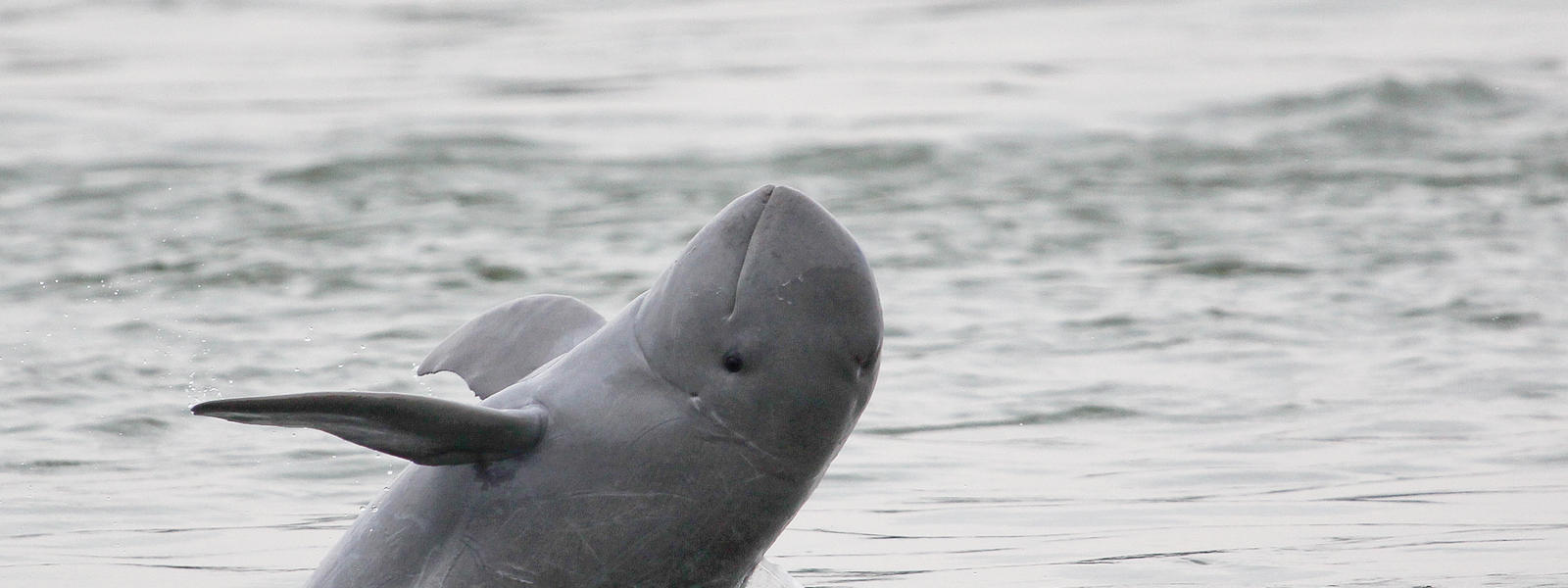
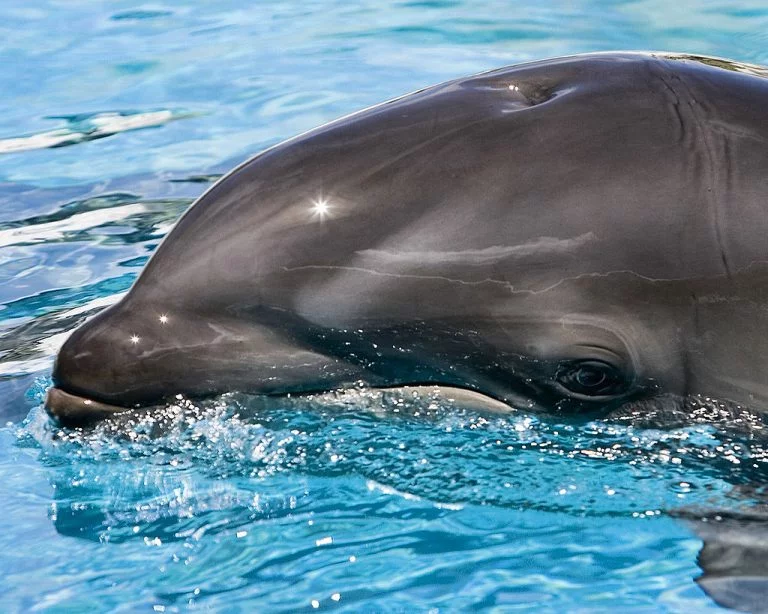
The Irrawaddy dolphin looks more like a small beluga than a typical dolphin. Rounded forehead, no beak, a flexible neck, and a stubby triangular fin set well back. It lives in shallow coastal water across Southeast Asia and in a handful of river populations so small that each one is counted individual by individual.
Key facts at a glance
| Common name | Irrawaddy dolphin |
| Scientific name | Orcaella brevirostris |
| Max length | 2.75 m (a male recorded in Thailand) |
| Weight | Typically 90 to 200 kg when mature |
| Diet | Carnivore: fish, squid, crustaceans |
| Habitat | Coastal Southeast Asia, plus the Mekong, Ayeyarwady and Mahakam rivers |
| Lifespan | Around 30 years |
| Population | No reliable global total. Mekong tally: 118 (April 2026) |
| IUCN status | Endangered (2017 assessment, 2018 errata) |
| Taxonomy | Artiodactyla | Delphinidae | Orcaella |
Where it lives
Marine and estuarine groups run from the Bay of Bengal through Southeast Asia to the Philippines. The similar dolphins of northern Australia are a separate species, the Australian snubfin dolphin (Orcaella heinsohni), described in 2005. Those animals are not the ones in trouble first. The urgent cases are the five subpopulations that the IUCN lists separately as Critically Endangered: the Mekong, the Mahakam in Indonesian Borneo, the Ayeyarwady in Myanmar, Malampaya Sound in the Philippines, and Songkhla Lake in Thailand.
The numbers behind those listings are small. The Mekong dolphins now live along a stretch of river in Cambodia’s Kratie and Stung Treng provinces. According to Mongabay, the last dolphin in the pool on the Laos border was reported dead in February 2022. Cambodia’s Fisheries Administration and WWF keep a running tally of known animals, adding each new calf and removing confirmed deaths. That tally reached 118 in April 2026, when the sixth calf of the year was confirmed at Kampi pool, according to Cambodia’s state news agency AKP.
A running tally is not a census, and it moves both ways. In July 2026 the Fisheries Administration confirmed that a male, ID No. 18, had drowned in fishing gear in Kandal province, so the 118 figure will be revised down. The last full survey, a photo identification study in 2020, estimated 89, with a 95 percent confidence range of 78 to 102. The same method gave 80 in 2015, according to the IUCN SSC Cetacean Specialist Group.
Elsewhere, a Wildlife Conservation Society survey counted 79 on the Ayeyarwady in February 2020, including seven calves (The Irrawaddy, via Open Development Mekong). On the Mahakam in Indonesian Borneo, photo identification monitoring by the RASI foundation estimated 66 in 2025 (RASI 2025 survey report). Each group is reproductively isolated from the others, so a loss in one is not replaced from anywhere else.
Two lake populations are tracked closely as well. Songkhla Lake in Thailand is down to about 14, the figure from a 2022 survey that Thairath reported in April 2026. Chilika Lake in India held 159 in Odisha’s census of 20 January 2026, the same number as in 2025, according to Down To Earth.
Bangladesh holds the largest known numbers. In April 2009 the Wildlife Conservation Society reported nearly 6,000 Irrawaddy dolphins in the channels of the Sundarbans mangrove forest and the adjacent waters of the Bay of Bengal (WCS announcement).
The fishery that works both ways
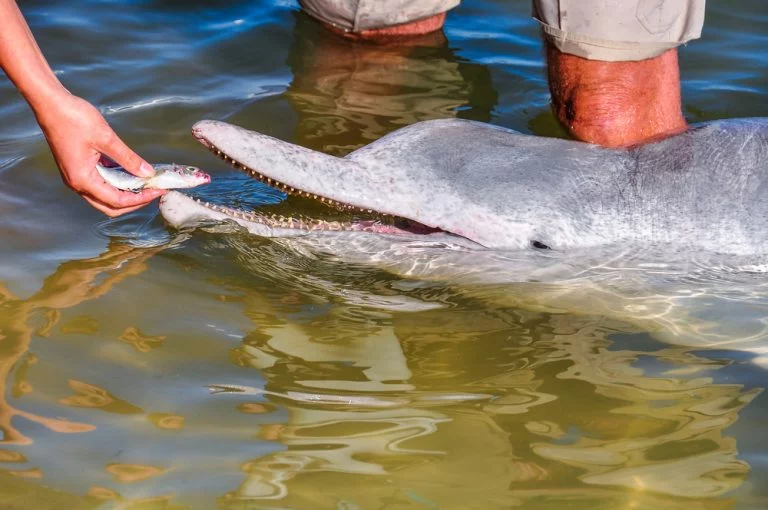
On the Ayeyarwady in Myanmar, cast-net fishermen and dolphins hunt together. The fisherman signals, the dolphins drive fish toward the boat, the net goes over them, and the dolphins take what escapes or gets released. The technique passes down on both sides, dolphin mother to calf and fisherman to apprentice, and it has been recorded for more than a century. Our piece on the Irrawaddy dolphins of Myanmar covers the threats they face now.
It is worth being precise about where this happens, because it is often misreported. The cooperative fishery is an Ayeyarwady tradition, not a Mekong one.
The fishermen call the dolphins by tapping the side of the boat with a wooden stick, and the dolphins drive the fish into a tight group within casting range. Only a handful of fisheries like this, shared by wild cetaceans and people, have been documented. The other well-studied case is at Laguna in southern Brazil, where bottlenose dolphins work with net fishermen.
Behaviour
Groups are small, usually two to eight animals. Irrawaddy dolphins are slow, undemonstrative and curious, surfacing quietly rather than bow-riding or leaping. Very little cognitive work has been done on them compared with bottlenose dolphins, largely because they are hard to observe and there are so few left to observe. Their unhurried habits are also part of the problem: a dolphin that approaches a boat instead of avoiding it is an easy animal to net, harass or strike.
At a distance it can be mistaken for a finless porpoise, which shares much of its coastal range. Look at the back: the Irrawaddy dolphin has a small triangular dorsal fin, and finless porpoises have none.
Diet and breeding
Irrawaddy dolphins eat fish, including catfish, glass perch and mullet, along with squid, octopus and crustaceans. River groups take more freshwater fish and coastal groups more marine fish and squid. Dives are short and shallow, usually under 12 m.
Gestation runs about 14 months. A calf is roughly a metre long and about 10 kg at birth and is weaned at around two years, and sexual maturity comes at seven to nine years. With one slow-growing calf at a time, a river group of around a hundred animals cannot quickly replace the adults it loses.
Threats
- Gillnet entanglement, which is the single largest direct killer in every river population and in most coastal areas.
- Electrofishing, still practised illegally in parts of the Mekong basin.
- Mercury from illegal gold mining, which accumulates in long-lived predators.
- Dam building on the Mekong, which fragments the river and changes the flow and sediment regime the fish depend on.
None of these is exotic or hard to understand, and none of them requires new science to fix. Removing gillnets from a defined stretch of river is a management decision, not a research problem. That is why the Mekong protected-area patrols matter more to this species than almost anything else on the conservation agenda.
Cambodia has expanded freshwater protected zones along the Mekong since 2012 and trains former fishermen as river guards.
How you can help
The useful money here is regional. WWF runs Mekong dolphin work with the Cambodian authorities, and the IUCN SSC Cetacean Specialist Group tracks the subpopulation assessments. Avoid facilities anywhere in Southeast Asia that display Irrawaddy dolphins. And if you take a dolphin-watching trip on the Mekong, pick an operator that keeps its distance and reports sightings to the monitoring programme, since photo-identification of a population this small genuinely adds to the record.
Our other species profiles cover the rest of the family, and the dolphin conservation guide sets out how the global picture fits together.
Frequently asked questions
Is the Irrawaddy dolphin a river dolphin?
Not in the taxonomic sense. It belongs to the Delphinidae, the same family as bottlenose dolphins and orcas, and most of the species lives in coastal saltwater. Only a few subpopulations live permanently in fresh water.
How many Irrawaddy dolphins are left?
There is no reliable global total. The largest known group, in the Sundarbans and Bay of Bengal off Bangladesh, was put at nearly 6,000 in 2009. The river and lake groups are counted one animal at a time: 118 on the Mekong (April 2026 tally), 79 on the Ayeyarwady (2020), 66 on the Mahakam (2025) and about 14 in Songkhla Lake (2022).
How many Irrawaddy dolphins are left in the Mekong?
The running tally kept by Cambodia’s Fisheries Administration and WWF reached 118 in April 2026. It counts known animals, adding calves and removing confirmed deaths, so it is not a census, and a death in July 2026 will lower it. The last full survey estimated 89 in 2020.
Why does it look like a beluga?
Convergence rather than close kinship. A rounded melon, no beak and a mobile neck all suit an animal that manoeuvres in shallow, cluttered, low-visibility water, which is what belugas and Irrawaddy dolphins both do.
Is the Irrawaddy dolphin endangered?
Yes. The species is Endangered globally, and five of its subpopulations are separately listed as Critically Endangered.
Sources and further reading
- IUCN Red List entry for Orcaella brevirostris (2017 assessment, 2018 errata)
- WWF-Cambodia Mekong dolphin programme
- IUCN SSC Cetacean Specialist Group, Mekong dolphin population estimates
- Yayasan Konservasi RASI, Pesut Mahakam monitoring surveys 2025
Updated 25 October 2026: corrected the range, which wrongly included northern Australia, and the number of Critically Endangered subpopulations, and updated the Mekong, Ayeyarwady and Mahakam counts with their survey years. We also merged our Irrawaddy dolphin guide into this profile, adding the lake and Bangladesh populations, diet and breeding.
Updated 16 November 2026: added the April 2026 Mekong tally of 118 and explained that it is a running tally rather than a census, updated the Mahakam, Chilika, Songkhla and Bangladesh figures, and linked every population figure to its source.

Oh my I learned so many neat things it’s so interesting how they help catch fish and I would love to see a slate blue one they sound so beautiful I hope the thrive.
Sad to hear that they are endangered in many places!