
5 Of The Largest Dolphins That Are Also Called Whales
Five of the largest members of the dolphin family are called whales. The names stuck long before anyone looked at the skulls properly, and they have confused people ever since. Here they are, smallest to largest, with what the name actually tells you and what it does not.
5. Pygmy killer whale
| Scientific name | Feresa attenuata |
| Length | Around 2.6 m |
| Weight | Up to about 225 kg |
| IUCN status | Least Concern (2018) |
| Other names | Slender blackfish |
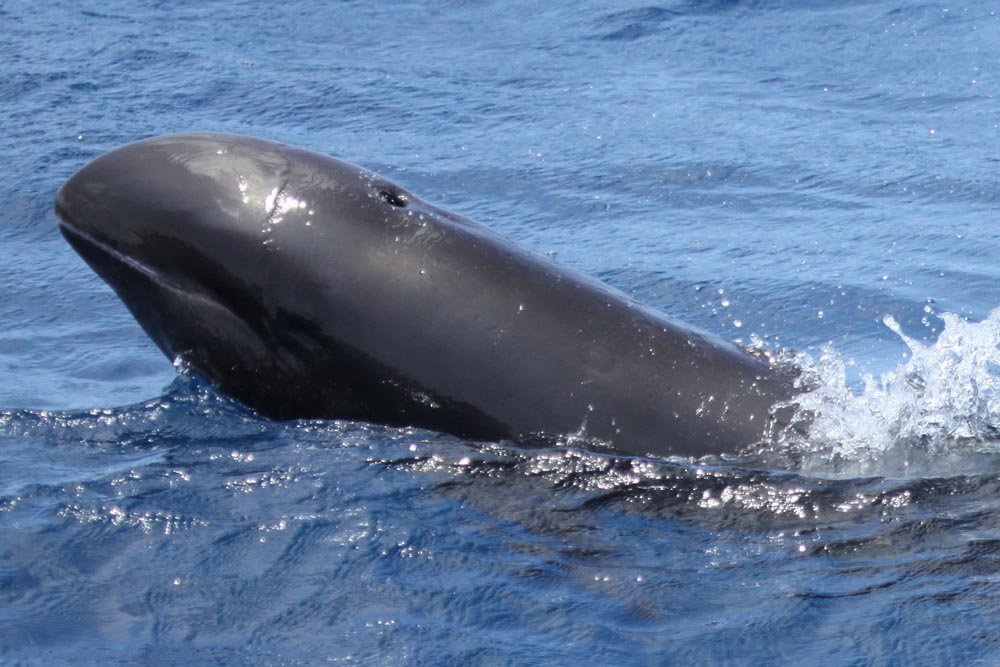
The smallest animal on this list and the one you are least likely to see. Pygmy killer whales live in deep tropical and subtropical water worldwide and are rarely encountered at sea. The body is dark grey to black with a pale chin and lips, and the flippers have rounded tips.
Pods usually run from about 12 to 50 animals, occasionally into the hundreds. They have a reputation for aggression, but that reputation comes almost entirely from captive animals. It has not been documented in the wild, where they have been seen associating peacefully with false killer whales, pilot whales and bottlenose dolphins around Hawaii.
4. Melon-headed whale
| Scientific name | Peponocephala electra |
| Length | Around 2.75 m |
| Weight | Up to about 210 kg |
| Lifespan | Around 45 years |
| IUCN status | Least Concern |
| Other names | Electra dolphin, many-toothed blackfish |
Named for the rounded cone of its forehead, with no beak and a slender dark grey body. It is easy to confuse with the false killer whale at a distance, though the false killer is more than twice the length.
Melon-headed whales are deep-water animals that come close to shore mainly around oceanic islands, which is why Hawaii, French Polynesia and the Philippines account for so many sightings. Groups of several hundred to over a thousand are normal, usually made up of smaller coordinated subgroups, and they mix readily with other species.
3. False killer whale
| Scientific name | Pseudorca crassidens |
| Length | Males to 6 m, females to about 5 m |
| Weight | Males to about 2,200 kg |
| IUCN status | Near Threatened (2018) |
| Other names | Blackfish |
The name is a taxonomic accident. Its skull resembles an orca’s, which is where “false killer” came from, but it is not closely related to the orca at all. Its nearest relatives are Risso’s dolphin, the melon-headed whale and the pygmy killer whale.
Long, slender and beakless, with a distinctive S-shaped bend in the leading edge of each flipper. They approach boats readily and bow-ride. They also take fish off longlines, which puts them in direct conflict with fishermen across the tropics.
The largest recorded false killer whale stranding brought over 835 animals ashore at Mar del Plata, Argentina, on 9 October 1946.
2. Pilot whales
| Scientific names | Globicephala melas and Globicephala macrorhynchus |
| Length | Long-finned males to 7.6 m, females to 6 m |
| Weight | Long-finned males to about 4,500 kg |
| IUCN status | Least Concern, both species (2018) |
| Other names | Blackfish |
Two species share the name: the long-finned pilot whale in cold water and the short-finned in tropical and subtropical seas. Telling them apart at sea is close to impossible, and the flipper length that gives them their names is not much use unless the animal is out of the water.
Pilot whale society is matrilineal and unusually tight. Genetic work indicates that calves of both sexes stay with their mother for life, breeding outside the group and returning to it. Pods run from 20 to 150 animals, built from smaller long-term units of eight to twelve.
That cohesion is also what makes them strand in such numbers. If one animal goes wrong, the group follows. The largest documented event involved around 1,000 whales in the Chatham Islands in 1918, and New Zealand still sees mass strandings most summers.
1. Orca
| Scientific name | Orcinus orca |
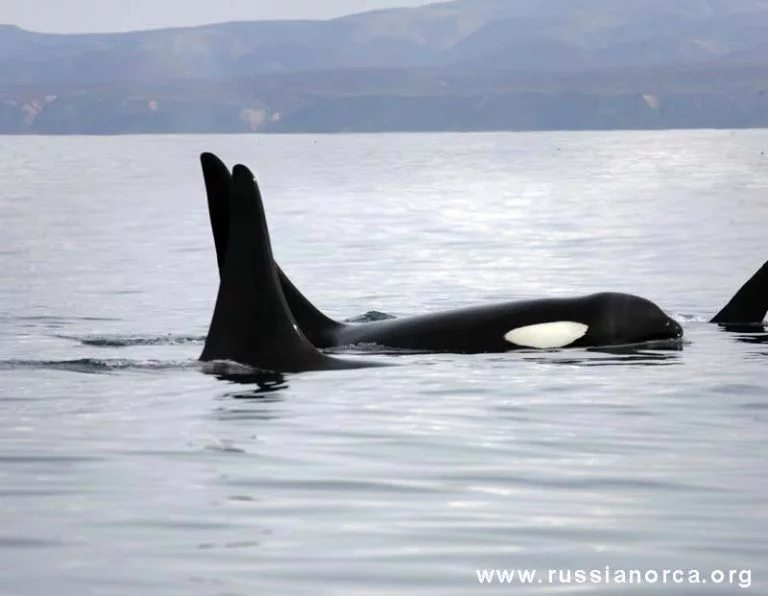
| Length | Males to about 10 m, females to about 8.5 m |
| Weight | Males over 10 tonnes |
| IUCN status | Data Deficient |
| Other names | Killer whale, blackfish |
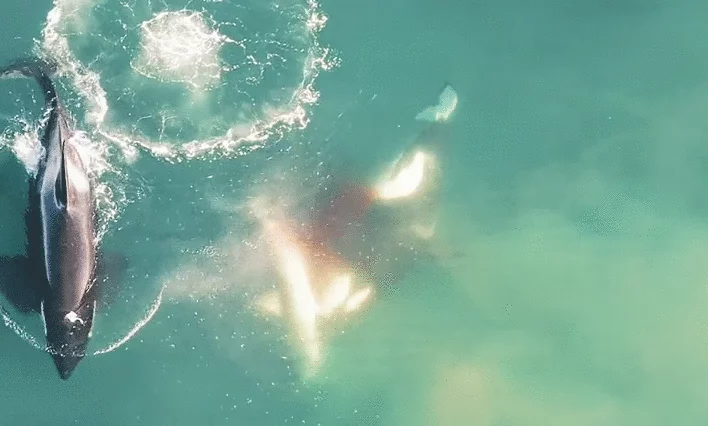
The largest dolphin by a wide margin, and the only one on this list that hunts other members of the group. Diet depends entirely on which population you are looking at: salmon, seals, whale calves, rays or sharks, with each type teaching its own techniques to its young.
The English name came from sailors who watched them hunt larger whales. The Latin is less settled than you will often read: some sources connect Orcinus to Orcus, the Roman god of the underworld, while Latin dictionaries give orca as a word for a large-bellied jar or cask. Take the underworld version with a pinch of salt.
Full detail is in our orca species profile.
Why so many of them are called whales
Every animal here belongs to Delphinidae, the oceanic dolphin family. The common names come from sailors who classified by size and colour rather than anatomy: anything big, black and blunt-headed was a whale, and several of them picked up the collective nickname blackfish, which is not a scientific grouping either.
The real dividing line is in the skull and the teeth. All of these have the single blowhole and the conical teeth of a toothed whale, and all of them sit closer to a bottlenose dolphin than to a humpback.
For the broader picture, see our dolphin facts guide.
Updated 25 October 2026: corrected the mass stranding record and the source of the orca etymology.


I never knew blackfish was an actual name for some of these. Thought it was just the documentary title.