
Commerson’s Dolphin: The Panda Dolphin of Patagonia
Cephalorhynchus commersonii 365406023, by Christoph Moning, CC BY 4.0, via Wikimedia Commons.
Commerson’s dolphin (Cephalorhynchus commersonii) is one of the most strikingly marked dolphins in the world, with a sharp black-and-white pattern that earns it the nickname the panda dolphin. It is small, fast, and limited to cold coastal waters in the southern hemisphere. The species is named after the French naturalist Philibert Commerson, who saw the dolphins in the Strait of Magellan in 1767. The French naturalist Lacépède gave the species its formal description in 1804.
Appearance and identification
Adults grow to around 1.5 m. The head, dorsal fin and tail flukes are black, with a brilliant white throat and body between them, and the boundary between the two colours is unusually clean.
This is one of the smallest cetaceans of any kind. A mature female caught off southern Patagonia measured 1.36 m and weighed 23 kg, and may be the smallest adult cetacean on record.
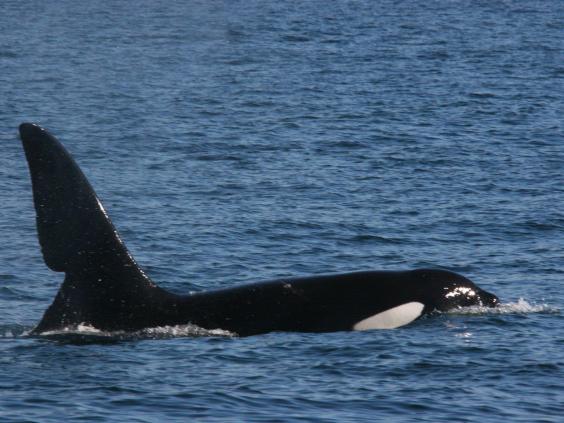
At a distance they look like miniature orcas, but the rounded body and the placement of the white give them away. There is also a way to tell the sexes apart at close range: the black patch on the white belly is shaped like a teardrop in males and is more rounded in females.
One detail that often surprises people is that Commerson’s dolphins are not born with the panda look. Calves are a plain grey to brownish-black, and the bold white areas develop only as the animal matures.
Range: two disjunct populations
There are two recognised subspecies, separated by a very great deal of open ocean. The principal one, C. c. commersonii, has the sharply delineated black-and-white pattern and lives inshore around the tip of South America: Puerto Deseado and other Argentine inlets, the Strait of Magellan, Tierra del Fuego and the Falkland Islands.
The second, C. c. kerguelenensis, was not discovered until the 1950s. It lives around the remote Kerguelen Islands in the southern Indian Ocean, is larger than its South American counterpart, and wears a softer dark and light grey pattern with a white ventral band instead of the crisp panda markings.
Roughly 8,500 km and about 130 degrees of longitude separate the two. Why the species is distributed this way is not known.
Behaviour
Commerson’s dolphins are relentlessly active. They swim fast at the surface, leap clear of the water, spin and twist as they go, surf breaking waves close to shore, and will bow-ride and chase fast boats. They are also known to swim upside down, which is thought to improve their view of prey below them.
Group sizes are typically 1 to 10 animals, occasionally up to 100. Like other Cephalorhynchus dolphins, a genus that now also takes in the hourglass dolphin, they use narrow-band echolocation clicks rather than the audible whistles most dolphins are known for.
Diet and life cycle
The diet is a mix of coastal and pelagic fish and squid, and the South American population supplements that with crustaceans. Individuals have been recorded entering the Santa Cruz River in Argentina to forage. Their preference for shallow water ties them tightly to coastlines, bays and river mouths, which is also why they are easy to watch from boats and sometimes from shore.
Females give birth to a single calf, usually during the southern hemisphere spring and summer between roughly October and March. Lifespan in the wild is modest for a dolphin, with individuals reaching around 18 years, although one captive animal was at least 33 at the time of death. A short coastal range and a fairly short life make local populations sensitive to sudden pressure such as a spike in net fishing.
Conservation status
Commerson’s dolphin is listed as Least Concern by the IUCN. Global population figures are not known, though the species is accepted to be locally common. The one hard number worth quoting is old and local: a survey in 1984 estimated 3,200 individuals in the Strait of Magellan.
The main human-caused threat is entanglement in inshore gillnets, because a dolphin that hugs the coast overlaps directly with coastal net fisheries. Climate change is reshaping the distribution of their prey, though the long-term consequences are not yet known. The remoteness of the Kerguelen population gives that group a measure of natural protection, since there is very little fishing pressure that far from any mainland.
Where to see them
In Argentina, boat trips from Playa Unión near Rawson and from Puerto Deseado find Commerson’s dolphins year-round, with peaks from April to November at Playa Unión and from September to April at Puerto Deseado. The Falkland Islands offer year-round chances, often from shore.
Punta Arenas in southern Chile and the channels of Tierra del Fuego host smaller groups, often seen on cruise itineraries through the Beagle Channel. Because Commerson’s dolphins willingly approach boats to bow-ride, sightings on these trips are common, and responsible operators let the dolphins come to the vessel rather than chasing them.
Read next
Frequently asked questions
Why is Commerson’s dolphin called the panda dolphin?
Because of its sharply divided black-and-white pattern, which resembles a giant panda‘s colouring.
Where do Commerson’s dolphins live?
Two disjunct populations, recognised as separate subspecies: the southern coasts of South America including Patagonia and the Falklands, and the remote Kerguelen Islands in the southern Indian Ocean.
Are Commerson’s dolphins endangered?
No. The IUCN lists them as Least Concern, though some local populations face gillnet pressure and there is no global population estimate.
How big do Commerson’s dolphins get?
Around 1.5 m. They are among the smallest cetaceans in the world: one mature female on record measured 1.36 m and 23 kg.
Can you swim with Commerson’s dolphins?
It is not promoted in any major dolphin-watching destination. Boat-based viewing is the norm and they often approach voluntarily to bow-ride.
Are Commerson’s dolphins born black and white?
No. Calves are a plain grey or brownish-black, and the bold white panda pattern develops only as the animal grows toward adulthood.
Continue exploring at our store
If this article sparked your interest, head over to the We Love Dolphins merchandise store for related reads and gear.
Updated 25 October 2026: corrected who formally described the species and where in Argentina to see it.


The panda nickname is perfect. Didn’t know there was a second, grey form all the way out at Kerguelen.