
Chinese White Dolphin: Facts, Pink Colour & Threats Guide
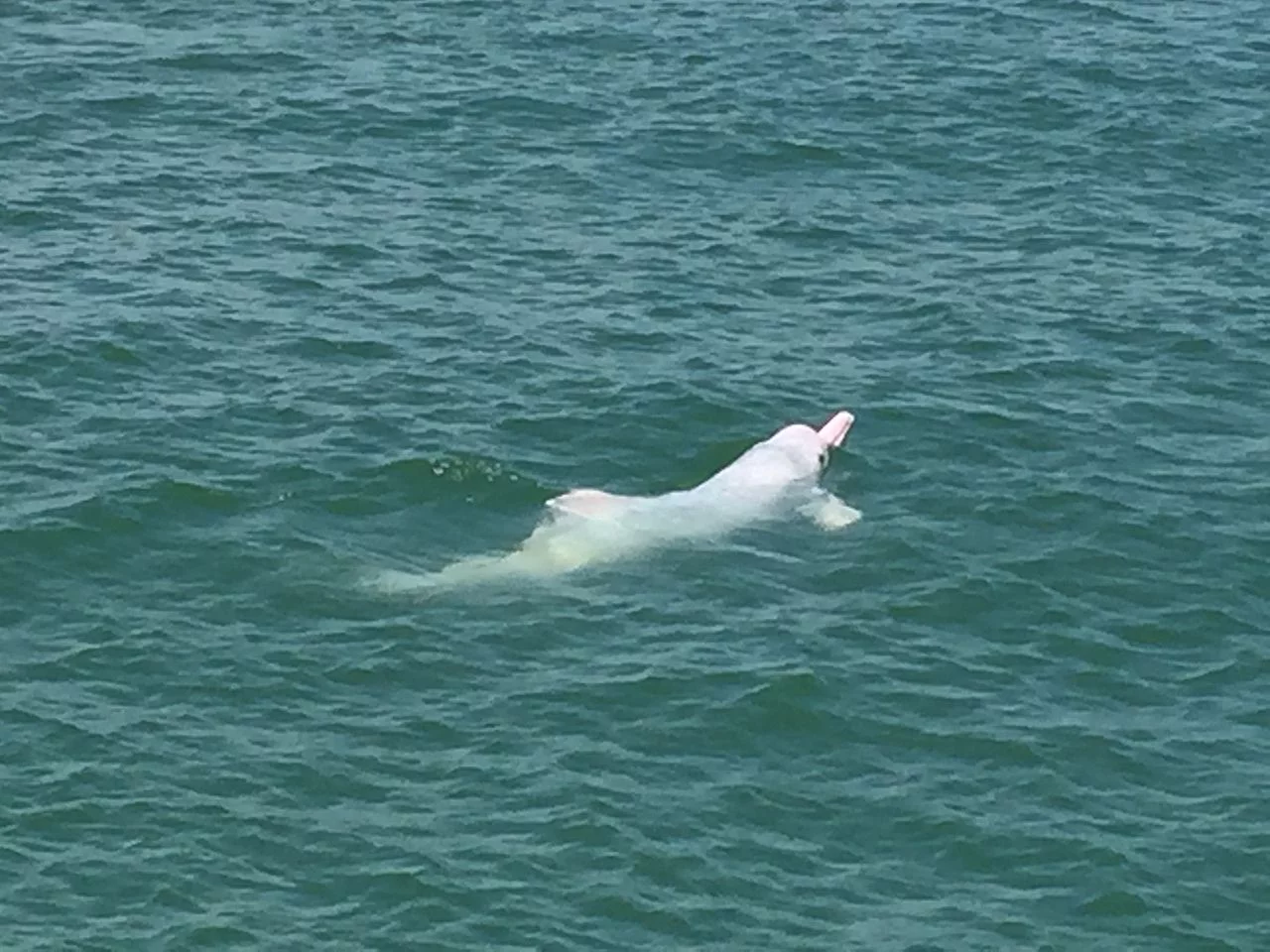
The Chinese white dolphin is famous for being pink. The pink is not a pigment, it is blood vessels showing through skin that has lost its grey pigmentation with age. Calves are born dark grey, juveniles are spotted, and adults can be brilliant pink, especially when excited. It is one of Hong Kong’s best-known wild animals, and one of the clearest measures of how badly the Pearl River estuary has been degraded.
Key facts at a glance
| Fact | Value |
|---|---|
| Common name | Chinese White Dolphin (Indo-Pacific humpback dolphin) |
| Scientific name | Sousa chinensis |
| Length | 2 to 3.5 m |
| Weight | 150 to 230 kg |
| Diet | Estuarine fish: croakers, anchovies, mullet |
| Habitat | Coastal and estuarine waters of southeast Asia |
| Lifespan | Up to around 40 years, aged by tooth layers |
| Population | Pearl River estuary about 2,500 including Hong Kong, the largest group left anywhere; Hong Kong waters about 40 (2021) |
| IUCN status | Vulnerable |
| Taxonomy | Artiodactyla | Delphinidae | Sousa |
Range and habitat
The species ranges from southern China across the Taiwan Strait and through southeast Asia. The animals off northern Australia were split off in 2014 as a separate species, the Australian humpback dolphin (Sousa sahulensis), so they no longer count towards Sousa chinensis numbers.
The Pearl River estuary holds the largest known population, put at about 2,500 animals, Hong Kong’s included, by Hong Kong’s Agriculture, Fisheries and Conservation Department. It is also the best studied and the most threatened. Hong Kong’s own share of that population has fallen hard: line-transect surveys counted 159 animals in Hong Kong waters in 2003 and 61 by 2013, and the government’s monitoring programme put the number at a record low of 32 in 2018 and about 40 in 2021.
Diet and hunting
Chinese white dolphins eat estuarine fish: croakers, anchovies, mullet. They hunt in the muddy, low-visibility water at river mouths, which makes them almost entirely dependent on echolocation rather than sight, and entirely dependent on estuaries that are also the most heavily built-on stretches of coast in the region.
Social structure
Groups are small, usually three to seven animals, and membership changes from day to day. Mother and calf stay together for three to four years. The Hong Kong animals have been followed for decades by Samuel Hung and the Hong Kong Cetacean Research Project, which identifies individuals by the pattern of nicks and scarring on the dorsal fin.
Threats and conservation
The Pearl River estuary is one of the most polluted, most heavily shipped and most reclaimed estuaries on Earth. Inside the dolphins’ habitat, Hong Kong has built an airport on reclaimed land at Chek Lap Kok, added a third runway to it, opened the 55 km Hong Kong-Zhuhai-Macao Bridge, and expanded its ports repeatedly. Underwater noise, vessel strikes, prey depletion and chemical contamination all stack on the same small population at once.
The IUCN Red List classifies Sousa chinensis as Vulnerable. That is a global rating, and it flatters the Hong Kong end of the range, where the local decline has been much steeper than the species-wide picture. Marine mammals recover slowly from this kind of pressure because they mature late and produce few calves, so a population losing adults faster than it replaces them takes decades to climb back even after the cause is removed.
What actually helps
For this species the useful levers are local and specific: enforced marine protected areas over the estuary habitat the dolphins actually use, limits on high-speed ferry traffic through it, and continued funding for the photo-identification work that lets anyone tell whether the population is still falling. Groups working directly on it include the IUCN SSC Cetacean Specialist Group, WWF Hong Kong, and the Hong Kong Dolphin Conservation Society.
For a deeper look at related dolphin species, see our other species profiles. To follow the conservation crises facing several populations covered here, browse our dolphin news archive. And if you want to go deeper into how dolphins live, hunt, and communicate, our dolphin information category is a good place to start.
Frequently asked questions
Why is the Chinese white dolphin pink?
The pink is not pigment. Adults lose the grey pigmentation they are born with, and the blood vessels underneath show through the pale skin. The colour deepens when the animal is active or excited, for the same reason a person flushes.
What is the scientific name of the Chinese white dolphin?
Sousa chinensis, in the family Delphinidae. It is also called the Indo-Pacific humpback dolphin, after the low hump the dorsal fin sits on in some populations.
How big does a Chinese white dolphin get?
Adults run 2 to 3.5 m long and 150 to 230 kg.
How many Chinese white dolphins are left?
About 2,500 in the Pearl River estuary, Hong Kong included, which is the largest surviving group. Hong Kong’s own waters hold a few dozen, down from 159 counted in 2003.
Is the Chinese white dolphin endangered?
The IUCN lists it as Vulnerable globally. The Hong Kong end of the range is in far worse shape than that global rating implies.
Sources and further reading
Updated 25 October 2026: corrected the Pearl River estuary estimate and its source, and added dated Hong Kong counts.


Oh my gosh I never knew of there being a pink dolphin I hope they can be saved and more will be born how sad they are dying out!
Whenever an animal disappears completely, we suffer a biodiversity loss. I hope this won’t happen to the Chinese White Dolphins.
Cool, a pink dolphin!
That is very sad. We need to preserve them.