
Northern Right Whale Dolphin: Facts, Pacific Range & Behaviour
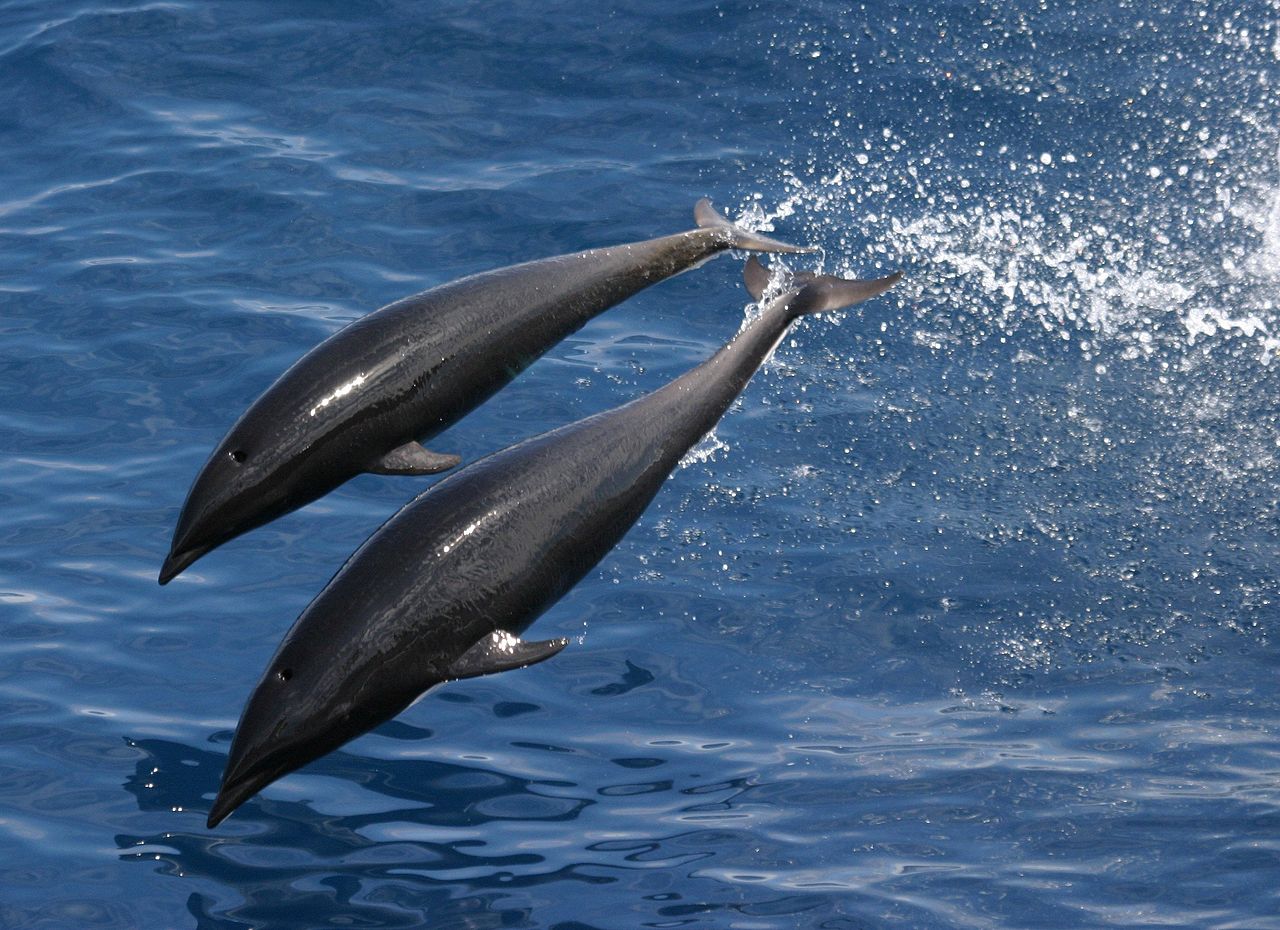
Most dolphins are recognised by their dorsal fin. The northern right whale dolphin has none at all. Its long black back and sharp white belly, running at speed just under the surface, look far more like a sea snake or a fur seal than a dolphin, and NOAA Fisheries notes it is the only dolphin in the North Pacific without a dorsal fin.
Key facts at a glance
| Fact | Value |
|---|---|
| Common name | Northern Right Whale Dolphin |
| Scientific name | Lissodelphis borealis |
| Length | 2.0 to 3.1 m |
| Weight | about 59 to 115 kg |
| Diet | Carnivore: squid, octopus, hake, lanternfish |
| Habitat | Deep temperate North Pacific |
| Lifespan | 42 years or longer |
| Population | about 68,000 across the North Pacific |
| IUCN status | Least Concern |
| Taxonomy | Artiodactyla | Delphinidae | Lissodelphis |
Where it lives
The species occupies deep temperate water in the North Pacific, roughly between 30 and 50 degrees north, from the outer continental shelf out into open ocean. That band takes in the waters off western North America from northern Baja California up to the Gulf of Alaska, off Kamchatka in Russia, and off Japan. It prefers water colder than about 19 degrees Celsius, and it will come close to shore where submarine canyons bring deep water in near the coast.
Distribution shifts with the seasons rather than with any long migration route: the animals move south through autumn and winter as the water cools, then north again in spring and summer.
There is a mirror-image species in the southern hemisphere. The southern right whale dolphin, Lissodelphis peronii, lives in cool temperate and subantarctic waters, and is generally larger with far more white on the underside.
Speed, herds and behaviour
Groups usually run to 100 or 200 animals, and occasionally as many as 3,000. They cruise at around 26 km per hour and can push to roughly 35 km per hour in short bursts, and they leap in long low arcs that can carry them more than six metres clear of the water. Near the surface they show very little of themselves, which is part of why herds at sea have been mistaken for fur seals and sea lions.
They generally keep away from vessels rather than bow-riding, although they will sometimes surf a boat’s wake, and they do so more readily when travelling in mixed groups with Pacific white-sided dolphins, Risso’s dolphins or short-finned pilot whales.
Diet
Squid, octopus and mid-water fish such as hake and lanternfish make up the diet. Dives last up to about six minutes, and the animals carry 37 to 54 pairs of small conical teeth in each jaw, the kind of dentition suited to gripping slippery prey rather than cutting it.
Reproduction and life cycle
Both sexes reach sexual maturity at around ten years old. Pregnancy lasts about a year and produces a single calf, usually in summer, with a minimum of two years between births. Lifespan runs to 42 years or more.
Threats and conservation
The IUCN Red List assessed the species as Least Concern in 2018, and NOAA scientists estimate around 68,000 animals across the North Pacific, of which roughly 26,000 sit in the California, Oregon and Washington stock.
That reassuring headline hides a brutal recent history. Through the 1970s and 1980s, high-seas driftnets set for squid and salmon by Japanese, Taiwanese and Korean fleets killed northern right whale dolphins in enormous numbers, with estimates running as high as 24,000 animals a year in the 1980s. Those fisheries were closed under an international moratorium that took effect at the end of 1992, and the species has had three decades of relief since. Entanglement in gillnets and purse seines still happens at lower levels.
Two other pressures are on NOAA’s list. The species is sometimes taken deliberately for meat and oil in the Dall’s porpoise harpoon drive fishery off Japan. And underwater noise from vessels, industry and military activity interferes with animals that depend on sound to feed and stay together.
How you can help
The driftnet story is the useful lesson here, because it is one of the few clear conservation wins in this family: a single dominant cause of mortality was removed by international agreement, and the killing stopped. Supporting the observer programmes and stock assessments that made the scale of that bycatch visible in the first place is the most direct thing a member of the public can do, along with backing the work of the IUCN SSC Cetacean Specialist Group and NOAA’s Office of Protected Resources.
For related species, browse our other dolphin species profiles, or start with our dolphin conservation guide for the wider picture.
Frequently asked questions
Why does the northern right whale dolphin have no dorsal fin?
The absence of a fin is a defining trait of the genus Lissodelphis, shared with its southern counterpart. It also explains the name: the smooth back recalls that of a right whale, which is likewise finless.
How big does it get?
Roughly 2.0 to 3.1 m and 59 to 115 kg. Males are generally larger than females.
How fast can it swim?
Around 26 km per hour as a cruising speed, with short bursts to roughly 35 km per hour.
How many are left?
NOAA estimates about 68,000 across the North Pacific, including roughly 26,000 in the California, Oregon and Washington stock.
Is it endangered?
No. The IUCN lists it as Least Concern. The main historical threat, high-seas driftnet fishing, was closed down at the end of 1992.
Sources and further reading
- NOAA Fisheries species page for the northern right whale dolphin (size, range, diet, reproduction, population, threats)
- IUCN Red List entry for Lissodelphis borealis, 2018 assessment
- NOAA Fisheries marine mammal stock assessment reports

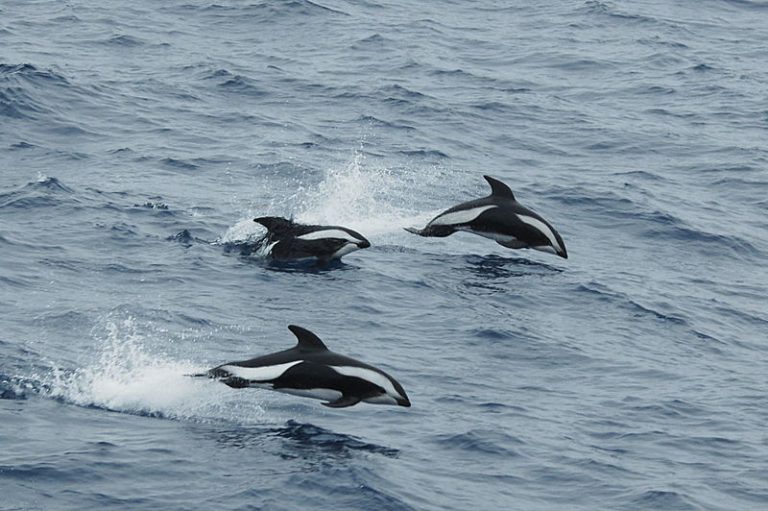

Saw a group off Monterey once and honestly thought they were seals at first. No fin at all. Really strange to watch.
Do the really big groups happen often, or is 3,000 a once in a lifetime thing?
Rare. Most groups are 100 to 200 animals. The very large ones turn up only occasionally.