
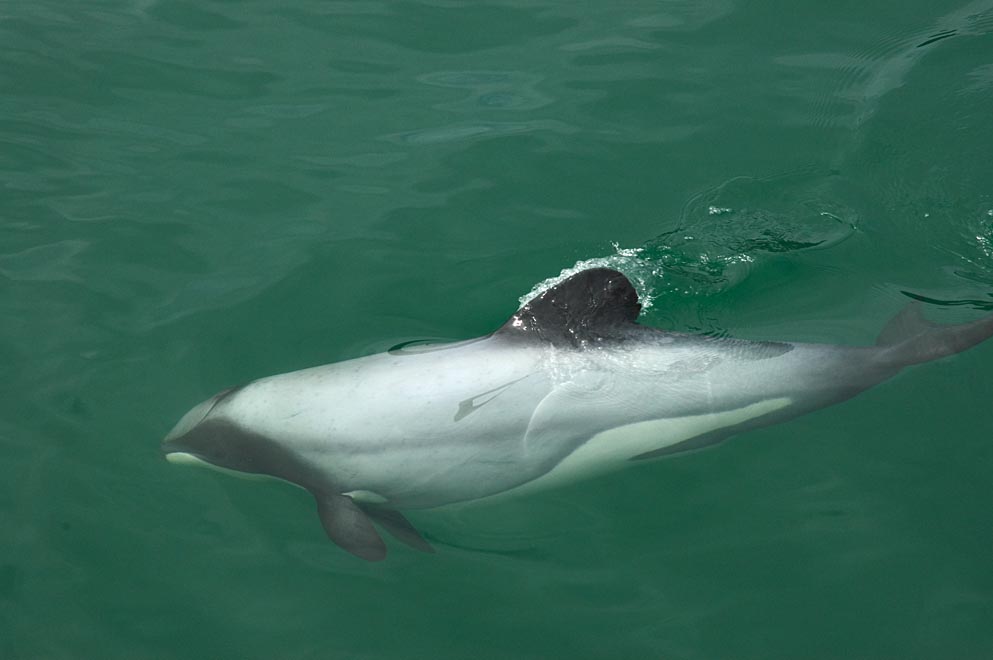
Hector’s Dolphin: Facts, Habitat & Conservation Guide
Hector’s dolphin is one of the smallest dolphins in the world and lives nowhere else on Earth except the coastal waters of New Zealand. It is also one of the rarest. Adults are about 1.5 m long, and the largest females reach about 1.7 m. The northern subspecies, the Maui dolphin, is on the absolute knife edge of extinction.
Key facts at a glance
| Common name | Hector’s dolphin |
| Scientific name | Cephalorhynchus hectori |
| Length | About 1.5 m as adults; the largest females about 1.7 m (DOC) |
| Weight | Up to about 50 kg; Maui up to about 65 kg (NOAA) |
| Diet | Small fish and squid |
| Habitat | Shallow coastal waters of New Zealand |
| Lifespan | At least 22 years |
| Population | South Island Hector’s about 14,800 (aerial surveys 2010 to 2015); Maui subspecies 54 (2020 to 2021) |
| IUCN status | Endangered (assessed 2008); Maui subspecies Critically Endangered (assessed 2023) |
| Taxonomy | Artiodactyla, Delphinidae, Cephalorhynchus |
Range and habitat
Two subspecies exist. The South Island Hector’s dolphin lives in shallow water around the South Island, with strongholds at Banks Peninsula, the West Coast, and the south. Aerial surveys between 2010 and 2015 put that population at about 14,800 animals (MacKenzie and Clement, 2016, as summarized in a 2021 review in Frontiers in Marine Science), with wide error bars either side of the estimate. The Department of Conservation rounds it to about 15,000 dolphins older than one year.
The Maui dolphin lives only along the west coast of the North Island, between Maunganui Bluff in the north and Whanganui in the south. A genetic capture and recapture survey in 2020 and 2021 estimated 54 individuals aged one year or older, with a 95 percent confidence interval of 48 to 66. That is the whole subspecies. A new survey ran in February 2025 and February 2026, and the Department of Conservation plans to publish its estimate in December 2026.
Both subspecies stay close to land, almost always inside the 100 m depth contour and usually in water shallower than 50 m. That habit is what makes them so easy to find and so easy to kill: their entire world overlaps with inshore fishing grounds.
Diet and hunting
Hector’s dolphins are generalist feeders that take prey under about 10 cm: red cod, ahuru, sprat, flatfish, and small squid. They hunt in shallow, turbid water where visibility is poor, so echolocation does most of the work.
Unlike almost every other dolphin, they have a rounded, paddle-shaped dorsal fin rather than a hooked one. It is the single most useful field mark for the species, and it is how researchers pick them out at sea from a moving boat.
Social life
Groups are small and fluid, averaging around four animals and rarely exceeding eight. There is no long-distance migration. Individuals hold small home ranges that can amount to only 30 km or so of coastline, which means a local population wiped out by nets is unlikely to be replaced from elsewhere.
Reproduction
According to NOAA Fisheries, sexual maturity comes at about 6 to 9 years, and females usually have a single calf every 2 to 4 years. Calves stay with their mothers for up to 2 years. With a maximum known age of at least 22 years, a female may raise only a handful of calves in her life.
That slow arithmetic is the whole conservation problem in miniature. A population this size cannot absorb extra deaths, because it cannot make new dolphins fast enough to replace them.
Threats and conservation
The single biggest threat is bycatch in set nets and trawl nets. Government estimates have repeatedly put fishery-related deaths above the level the population can sustain. For the Maui subspecies, one accidental death a year is too many.
Toxoplasmosis is the other confirmed killer. The parasite Toxoplasma gondii reproduces in cats, washes to sea in run-off, and has been found in a significant share of dead Hector’s and Maui dolphins examined by New Zealand researchers. It is an unusual case of a land-based disease reaching an endangered marine mammal.
Seabed mining proposals and seismic survey noise add further pressure. The campaign to widen set-net bans across both subspecies’ ranges has been running for two decades and is still being fought.
The Maui dolphin
The North Island dolphins were named as a separate subspecies, Cephalorhynchus hectori maui, in 2002, after genetic work by Baker, Smith and Pichler showed they had long been isolated from the South Island animals. The name comes from Te Ika-a-Māui, the Māori name for the North Island.
Protection has grown in steps. Commercial set-netting was banned from Maunganui Bluff to Pariokariwa Point in 2003, out to four nautical miles. The ban now reaches seven nautical miles along that coast, and the 2020 fishing rules made under the Hector’s and Maui dolphin Threat Management Plan extend set-net closures to 12 nautical miles in places. In 2012 the IUCN World Conservation Congress asked for more: a ban on gillnets and trawling out to the 100 m depth contour wherever Hector’s and Maui dolphins live, harbours included.
Disease adds to the pressure. Of the Hector’s and Maui dolphins examined between 2007 and 2018 that did not die in fishing gear, toxoplasmosis killed 9 of 31, two of them from Maui dolphin waters, according to the Department of Conservation. In an earlier study of carcasses, 61 percent carried the parasite’s DNA (Roe and colleagues, 2013).
Most sightings come from the coast around Raglan and the entrance to Manukau Harbour on calm summer days. With about 54 animals, any sighting is luck. The Department of Conservation asks people to report Maui dolphin sightings on 0800 DOC HOT, because every record helps map where the animals go.
How you can help
Support the New Zealand groups working directly on set-net closures and on the Maui dolphin in particular. Avoid seafood caught in inshore gillnets and trawls off New Zealand. If you visit Banks Peninsula, use operators that keep their distance rather than chase, and send your photographs to the photo-identification catalogues, because dorsal fin markings are how researchers track individuals across decades.
Frequently asked questions
What is the scientific name of Hector’s dolphin?
Cephalorhynchus hectori. The Maui dolphin is the North Island subspecies, Cephalorhynchus hectori maui. The genus also includes the Chilean dolphin of South America.
How big does Hector’s dolphin get?
Adults are about 1.5 m long, and the largest females reach about 1.7 m and 50 kg, according to New Zealand’s Department of Conservation. Males are slightly smaller. NOAA Fisheries gives maximums of about 1.5 m and 50 kg for Hector’s dolphins and about 1.6 m and 65 kg for Maui dolphins, so the Maui subspecies is the slightly larger one. It is one of the smallest dolphins in the world.
How many are left?
About 14,800 South Island Hector’s dolphins from aerial surveys between 2010 and 2015, and 54 Maui dolphins aged one year or older (95 percent confidence interval 48 to 66) from the 2020 to 2021 genetic survey. A new Maui estimate is due in December 2026.
Is Hector’s dolphin endangered?
Yes. The IUCN Red List classifies the species as Endangered (assessed 2008) and the Maui subspecies as Critically Endangered (assessed 2023).
What kills Hector’s dolphins?
Set nets and trawl nets first, toxoplasmosis second. Both are documented causes of death in animals recovered and examined in New Zealand.
Sources
- New Zealand Department of Conservation: Māui dolphin abundance estimate (2020 to 2021 and 2025 to 2026)
- New Zealand Department of Conservation: Hector’s dolphin
- New Zealand Department of Conservation: Māui dolphin
- Slooten and Dawson (2021): Delays in protecting a small endangered cetacean, Frontiers in Marine Science
- NOAA Fisheries: Hector’s dolphin
- IUCN Red List: Cephalorhynchus hectori
- IUCN Red List: Cephalorhynchus hectori maui
Updated 16 November 2026: linked the Hector’s and Maui population estimates to the Department of Conservation and the survey review, corrected the size, weight, lifespan and breeding figures to NOAA’s, added the IUCN assessment years, and added a sources list.

Took my niece to Akaroa a couple of summers ago and a few Hector’s came right up to the boat. So small, and that rounded fin is adorable.
How sure is the 14,800? Sounds very precise for something counted from a plane.
Fair question. It is a point estimate from aerial surveys, and the error bars either side are wide, so read it as a ballpark rather than a headcount.