
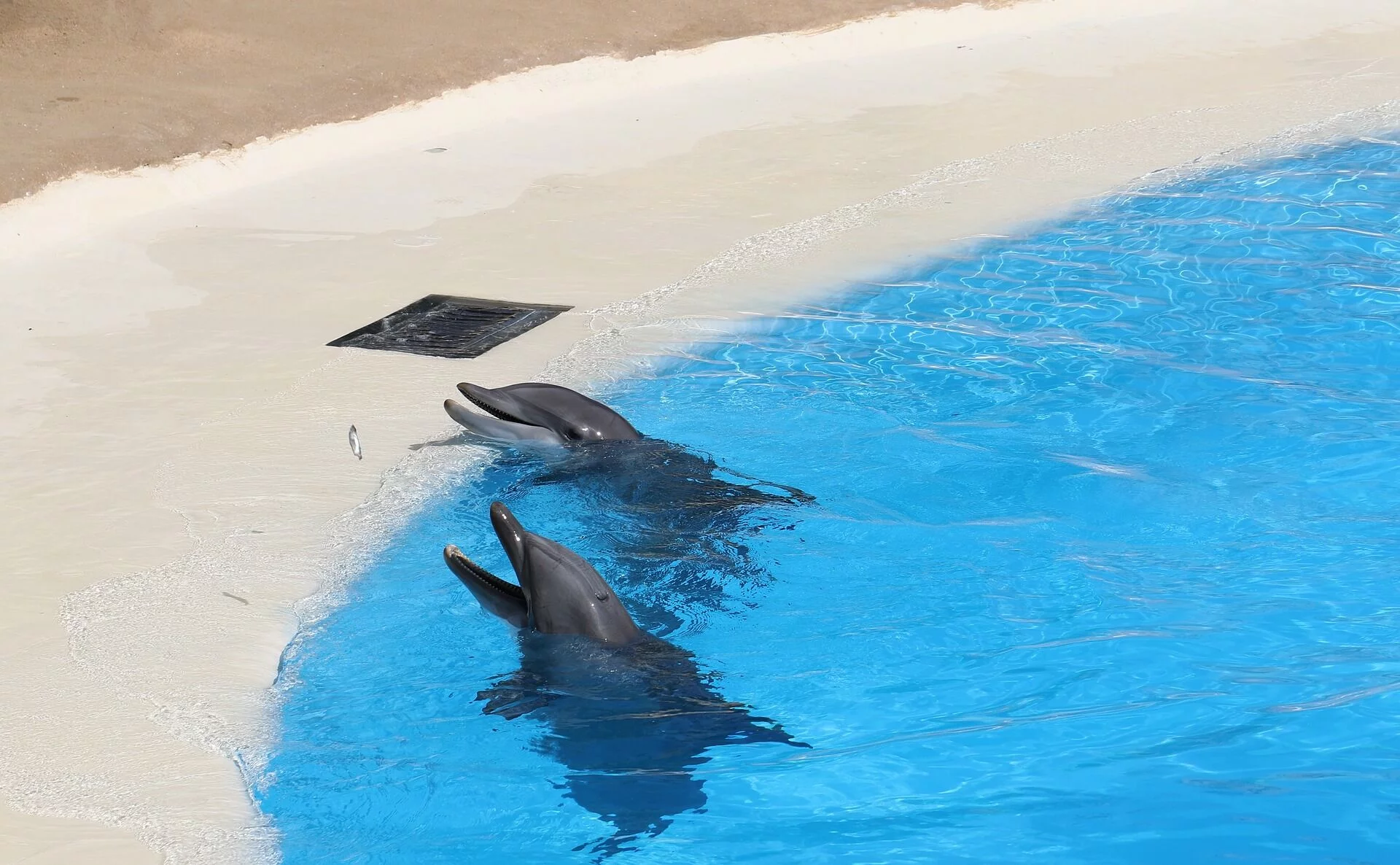
7 Signs Of Stress In Captive Dolphins
A dolphin in a tank cannot tell you it is struggling. It can only show you. These are the signs that show up again and again in captive dolphins and orcas, and what each one is actually telling you.
1. Collapsed dorsal fin
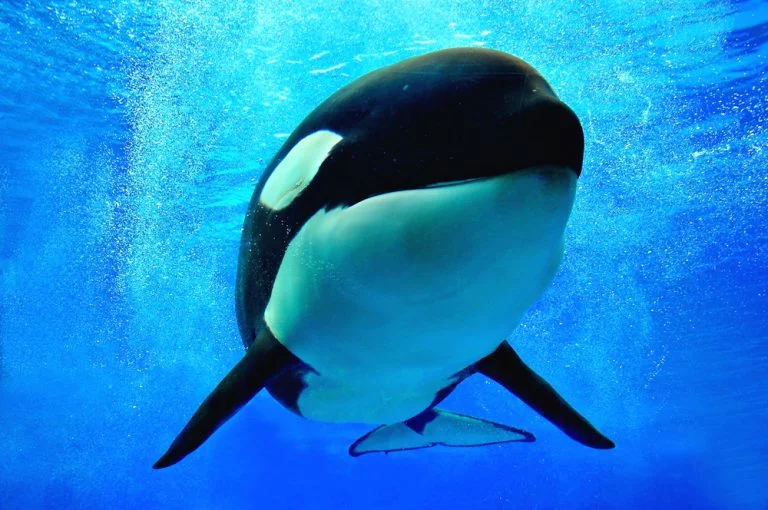
The most visible sign, and the one most argued over. A healthy wild orca’s dorsal fin stands upright. In captivity, the fin of an adult male almost always flops over.
Parks point out that collapse also happens in the wild, and it does. It is just rare, in the region of one percent of wild males, against something close to universal among captive adult males. The likely mechanism is mundane: a fin is collagen with no bone in it, held up partly by water pressure and blood flow. An animal that swims slowly in circles at the surface, in warm shallow water, for years, loses the support that keeps it rigid.
2. Broken and worn teeth
Captive orcas grind and chew on concrete walls and on the steel gates between pools. Teeth wear flat, crack, and expose the pulp. Many captive orcas have had teeth drilled out and are then flushed daily to keep the open holes from becoming infected.
Wild orcas wear their teeth too, in one specific case: the shark-eating offshore ecotype grinds them down on rough shark skin. That is wear from feeding. Chewing a wall is not.
3. Repetitive swimming
Circling the same loop for hours, floating motionless at the surface for long stretches between shows, repeating the same movement in the same corner. Zoo keepers call this stereotypic behaviour and it is well documented across confined intelligent animals, from big cats pacing to parrots plucking.
The reason it matters here is the size of the animal. A wild orca can cover a hundred kilometres in a day. The largest show pools are a few tens of metres across.
4. Aggression towards tank mates
Captive groups are assembled by the park, not by the animals. Individuals from different populations, sometimes different oceans, with different calls and no kinship, are put in a shared pool with no way to leave.
The result is raking, where one animal drags its teeth along another’s skin, and injuries serious enough to need veterinary treatment. In the wild a subordinate animal moves away. In a tank there is nowhere to go.
5. Regurgitation
Bringing food back up and then mouthing it again is recorded in captive dolphins and is not a normal wild behaviour. It is generally read as a boredom behaviour rather than an illness, which is why enrichment programmes exist at all.
6. Skin and other infections
Cetacean poxvirus produces the ring-shaped or pinhole lesions sometimes called tattoo skin disease, and it shows up in captive animals under stress. Fungal and bacterial infections are a leading recorded cause of death in captive cetaceans, and gastric ulcers are documented too.
Immune suppression under chronic stress is the plain explanation. An animal under long-term stress fights off less.
7. Aggression towards people
The clearest evidence that something is wrong is that captive orcas have killed trainers, and wild ones have never killed anyone. SeaWorld trainer Dawn Brancheau was killed by Tilikum in February 2010, and Tilikum had been linked to two earlier deaths. In November 2006, the orca Kasatka pulled trainer Ken Peters underwater twice during a show at SeaWorld San Diego. He survived.
Nothing comparable is on the record from the wild, where these animals have every opportunity and no interest.
What about lifespan?
The honest answer is more complicated than campaign material usually allows. Early captive orcas died young, and the average is still poor. But the oldest captive orca, Corky II at SeaWorld San Diego, is around 60. Lolita, taken from Puget Sound in 1970, died at the Miami Seaquarium in August 2023 aged 57. Amaya, SeaWorld San Diego’s youngest orca, died in 2021 aged six. Our list of 10 orca deaths in captivity at marine parks gives more cases.
So the claim that no captive orca passes 40 is simply wrong, and repeating it hands the parks an easy win. The case against tanks does not need it. Wild female orcas typically live about 50 years, some far longer, and lead their families for decades after they stop breeding. Nothing in a pool replaces that.
What you can do
Do not buy the ticket, and do not book the swim-with excursion. If you want to understand how the industry works, the 2013 documentary Blackfish is the obvious place to start, and our piece on the dolphin captivity industry covers the trade behind it.
Updated 25 October 2026: corrected Lolita’s age at death and the wild orca lifespan figure.


Thank you for the informative article.
It saddens me to see dolphins in captivity.