
Striped Dolphin: Facts, Range, Diet & Conservation Guide
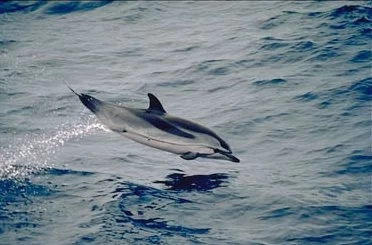
The striped dolphin is one of the most numerous dolphins on the planet and one of the hardest to get a good look at. It lives in deep warm water far from land, travels fast in big pods, and rarely comes to a boat. The name comes from the dark band that runs from the eye all the way back along the flank, a marking no other dolphin of its size carries.
Key facts
| Common name | Striped dolphin |
| Scientific name | Stenella coeruleoalba |
| Max length | 2.6 m (males), 2.4 m (females) |
| Max weight | around 160 kg |
| Diet | small mid-water fish and squid |
| Habitat | deep temperate and tropical seas worldwide |
| Lifespan | about 55 to 60 years |
| Population | global total in excess of two million |
| IUCN status | Least Concern (global assessment) |
| Taxonomy | Artiodactyla | Delphinidae | Stenella |
Range and habitat
Striped dolphins are a deep-water animal. They favour seas over 200 m and are found from the Atlantic coasts of Europe and North America right through the Mediterranean, across the tropical Atlantic, and on into the Indian and Pacific Oceans. In the Mediterranean they are the cetacean you are most likely to meet.
Pods usually run from 25 to 100 animals, though aggregations of over a thousand are not unusual where food is concentrated. Because the species keeps to open water and does not bow-ride readily, most of what is known about it comes from survey transects and from stranded animals rather than from close observation.
Diet and diving
The bulk of the diet is small mid-water fish, especially lanternfish, along with hake and squid. Most of it comes from the deep scattering layer, the dense band of small ocean life that rises toward the surface after dark, so feeding is largely a night-time business. Striped dolphins are capable divers and have been recorded working well below 700 m.
Behaviour
Pods are highly mobile and tend to split into subgroups by age and breeding status: juveniles in one cluster, breeding adults in another, resting animals in a third. They travel fast, often porpoising in tight ranks that break the surface together.
The species is also known for roto-tailing, a leap in which the animal spins about its long axis in the air. It is a striking move and one of the few behaviours that will identify a distant pod for you before you can see the stripe.
The Mediterranean die-off
Between 1990 and 1992 a morbillivirus epidemic tore through the western Mediterranean, and striped dolphins took the worst of it. More than a thousand carcasses were collected and examined. Dolphin morbillivirus was confirmed as the direct cause, but researchers linked the severity of the outbreak to organochlorine pollution, and to PCBs in particular, which build up in blubber and suppress the immune system. A survey in the summer of 1991 estimated about 117,900 striped dolphins in the western Mediterranean alone. That remains the figure most often quoted, so it is now a long way out of date.
Further morbillivirus outbreaks followed, including one in 2007, but with markedly lower mortality, which has been read alongside the gradual decline in organochlorine contamination since the 1990s.
Conservation
Globally the IUCN lists the striped dolphin as Least Concern, on the strength of a total population above two million. The Mediterranean animals are assessed separately from the global population and that assessment has been revised more than once, so check the current Red List entry before quoting a category for them.
The pressures that matter are bycatch in drift nets, contaminant load, and prey depletion. Japan still allows drive hunts for the species at Taiji, under a quota of 450 striped dolphins a season, and monitors counted at least 157 killed in the 2024 to 2025 season. As a long-lived predator near the top of the food web, it accumulates whatever the smaller animals below it have been carrying, which is why a global category of Least Concern is a poor guide to how any particular population is doing.
Read next
Test what stuck with the striped dolphin trivia challenge, or see how the species fits into the wider picture in our guide to where to see dolphins and the full dolphin species guide.
Updated 25 October 2026: corrected the date and area of the Mediterranean survey and updated the Japanese drive hunt, which is still running.


I remember reading about the big die-off in the Med in the early 90s. Has that population recovered since?
the stripe-eye-to-anus description always made me laugh as a kid, my brother thought i was making it up. it’s a really useful field-ID cue though, much clearer than dorsal fin shape.