Are Dolphins Endangered? It Depends on the Species
Ask whether dolphins are endangered and the honest answer is that it depends on the species. Some dolphins number in the thousands. A few number in the dozens. One, the baiji, has probably already gone.
There are dozens of dolphin species, so a single yes or no hides most of the story. Below are the clearest cases from each end of the scale, with the numbers the agencies publish.
Smallest populations: latest counts
These are the smallest dolphin and porpoise populations with a recent published count, from smallest to largest. Each row gives the year, the method and the people who did the counting, with a link to the report or announcement. A census tries to identify every animal, while a survey estimate comes with a range. Checked 16 November 2026.
| Population | Latest count or estimate | Survey year | Method | Who counted | Source |
|---|---|---|---|---|---|
| Vaquita, upper Gulf of California, Mexico | 7 to 10 different animals seen (67% probability); 6 to 8 in 2024 | September 2025 | Ship survey guided by acoustic detectors; observers agree how many different animals they saw. A minimum, not a full estimate | CONANP (Mexico’s protected areas agency) and Sea Shepherd, with IUCN and NOAA scientists | 2025 survey report |
| Chinese white dolphins (Indo-Pacific humpback dolphin), Hong Kong waters | 34 | 2023 | Vessel line-transect surveys in the four main survey areas | Agriculture, Fisheries and Conservation Department, Hong Kong | AFCD 2023 to 2024 monitoring report |
| Māui dolphin, North Island, New Zealand | 54 aged one year or older (95% confidence interval 48 to 66) | 2020 to 2021 | Genetic capture and recapture from small skin samples | University of Auckland and Oregon State University, for the Department of Conservation and the Ministry for Primary Industries | DOC abundance estimate |
| Irrawaddy dolphins, Mahakam River, Indonesia | 66 (range 65 to 67) | 2025 | Photo-identification boat surveys with capture and recapture models | Yayasan Konservasi RASI | RASI 2025 monitoring report |
| Southern Resident orcas, Pacific Northwest | 76 | 1 July 2026 | Photo-identification census of every animal | Center for Whale Research | 2026 census |
| Irrawaddy dolphins, Mekong River, Cambodia | 118 (official tally); one death confirmed in July 2026 | April 2026 | Running tally from river monitoring, raised as new calves are confirmed | Cambodia’s Ministry of Agriculture, Forestry and Fisheries, with the Fisheries Administration and WWF | AKP, 28 April 2026; July 2026 death |
| Irrawaddy dolphins, Chilika Lake, India | 159 (same as 2025) | January 2026 | Annual census of the lagoon | Odisha Forest, Environment and Climate Change Department (wildlife wing) | OrissaPOST report |
| Yangtze finless porpoise, China | 1,426 (1,249 in 2022) | 2025 | Basin-wide scientific survey | China’s Ministry of Agriculture and Rural Affairs | Institute of Hydrobiology, CAS |
| Indus river dolphin, Pakistan and India | 1,987 in Pakistan; 3 in India’s Beas River | 2017 (Pakistan); 2021 to 2023 (India) | Range-wide river surveys | WWF-Pakistan; Wildlife Institute of India | WWF-Pakistan; India survey report |
| Atlantic humpback dolphin, West Africa | Probably fewer than 3,000 in total | No range-wide survey | Scattered local counts of tens to low hundreds | NOAA Fisheries summary | NOAA Fisheries |
| Ganges river dolphin, India | About 6,324 (all but 3 of the 6,327 river dolphins counted in India) | 2021 to 2023 | Surveys covering more than 8,500 km of 28 rivers in eight states | Wildlife Institute of India, for Project Dolphin | Government of India (PIB) |
Two of these are not full counts. The vaquita figure is the number of different animals seen in the survey area, so the true total may be a little higher. A new abundance estimate from the 2025 acoustic data had not been published by the time of the August 2026 survey report. The Ganges figure covers India only, not Bangladesh or Nepal.
New counts are on the way. The Department of Conservation plans to publish a new Māui dolphin estimate in December 2026, and India began a second river dolphin survey in January 2026.
The table is free to download as a CSV or as a one-page printable (PDF), with the source link for every row.
Red List status by species
The IUCN Red List gives each species, subspecies or subpopulation a category, and each assessment has a date. Assessments are redone every few years, so the year matters. The year below is when the assessment was made; some were published a year later. Each year links to the assessment.
| Species or population | IUCN Red List status | Year assessed |
|---|---|---|
| Vaquita | Critically Endangered | 2022 |
| Baiji (Yangtze river dolphin) | Critically Endangered | 2017 |
| Māui dolphin (subspecies) | Critically Endangered | 2023 |
| Hector’s dolphin (species) | Endangered | 2008 |
| Atlantic humpback dolphin | Critically Endangered | 2017 |
| Yangtze finless porpoise (subspecies) | Critically Endangered | 2012 |
| Irrawaddy dolphin (species) | Endangered | 2017 |
| Irrawaddy dolphin, Mekong River subpopulation | Critically Endangered | 2023 |
| Irrawaddy dolphin, Mahakam River subpopulation | Critically Endangered | 2008 |
| Indo-Pacific humpback dolphin (species, includes Hong Kong) | Vulnerable | 2015 |
| Taiwanese humpback dolphin (subspecies) | Critically Endangered | 2017 |
| Ganges river dolphin | Endangered | 2021 |
| Indus river dolphin | Endangered | 2021 |
| Orca (species) | Data Deficient | 2017 |
| Common bottlenose dolphin | Least Concern | 2018 |
The Hector’s dolphin assessment dates from 2008, before the aerial surveys of 2010 to 2015, so read it alongside the newer counts. The Southern Resident orcas have no separate Red List assessment; they are listed as Endangered under the US Endangered Species Act. The Chilika Lake dolphins fall under the Irrawaddy dolphin species assessment.
Why one answer does not fit every dolphin
A species can be common in one ocean and nearly gone in another. The common bottlenose dolphin is the example most people know. NOAA Fisheries says bottlenose dolphins in the United States are not endangered or threatened under the Endangered Species Act, although they are protected under the Marine Mammal Protection Act.
Protection and abundance are different things, though. The same NOAA page lists five coastal bottlenose stocks in the western North Atlantic as depleted under that Act, including the Northern Florida Coastal and Central Florida Coastal stocks. A healthy species can still contain stocks that are in trouble.
For the full picture of what each species faces, see our guide to dolphin conservation.
Māui dolphin: one of the rarest dolphins
The Māui dolphin lives only on the west coast of New Zealand’s North Island, between Maunganui Bluff and Whanganui. A genetic survey in 2020 and 2021 estimated 54 dolphins aged one year or older, with a 95 percent confidence interval of 48 to 66. New Zealand’s Department of Conservation ranks the subspecies nationally critical.
NOAA Fisheries says both the Māui dolphin and the South Island Hector’s dolphin have declined mainly because of bycatch in gillnets. It listed the Māui dolphin as endangered under the Endangered Species Act in 2017.
Adults are about 1.5 m long, and the largest females reach about 1.7 m, according to the Department of Conservation. NOAA Fisheries gives Māui dolphins a maximum of about 65 kg. The animal looks the same as its southern relative. Our profile of Hector’s dolphin covers what the two share.
The Department of Conservation lists more than fishing for the Māui dolphin. Toxoplasmosis and other diseases, oil and gas exploration, boat strike, mining, tourism and noise all appear on its threat list. With so few animals, each of those pressures matters.
Hector’s dolphin: threatened, and far more numerous
The South Island Hector’s dolphin is the same species with a very different outlook. The Department of Conservation estimates about 15,000 individuals older than one year, based on aerial surveys from 2010 to 2015, and ranks it nationally vulnerable. NOAA lists the subspecies as threatened.
That is still a small number for an animal under steady pressure. NOAA notes that sexual maturity comes at about 6 to 9 years of age, and that low population growth rates add to the dolphins’ vulnerability. A population that breeds slowly takes a long time to recover from each loss.
Where these dolphins live adds to the risk. NOAA says Hector’s dolphins are typically sighted within about 20 nautical miles of the coast, in water less than 328 feet deep, and that they have relatively small home ranges. That puts them in the same waters as coastal fisheries.
Atlantic humpback dolphin: small and fragmented
This coastal dolphin ranges from Morocco to Angola. NOAA Fisheries describes its populations as small and fragmented, from the tens to the low hundreds of individuals, and says the species probably includes fewer than 3,000 in total.
NOAA names bycatch in artisanal gillnets as the primary threat and calls it widespread across the range. The species is listed as endangered under the Endangered Species Act.
The baiji: what extinction looks like
The IUCN Cetacean Specialist Group records that about 400 baiji lived in the Yangtze in 1980. Only 13 were counted in 1997 to 1999. The last verified reports date from November 2001 and May 2002.
A six-week survey in 2006 covered the whole historical range and found no evidence that the species survives. The group names unsustainable bycatch in local fisheries, together with habitat degradation, as the probable main driver. Our article asking whether the Yangtze river dolphin is extinct goes through that evidence.
The Yangtze still holds a related animal, the finless porpoise. It is a porpoise, not a dolphin, and our finless porpoise guide covers its numbers.
What the endangered cases share
- Fishing gear. Bycatch appears in the NOAA and IUCN accounts for the Māui dolphin, the Atlantic humpback dolphin and the baiji.
- Small ranges. The Māui dolphin and Atlantic humpback dolphin live in narrow coastal strips.
- Slow breeding. Hector’s and Māui dolphins mature at about 6 to 9 years, so they cannot rebuild a population quickly.
The pattern points to where help matters most. Coastal species with small ranges share their waters with the nets.
Across all whales, dolphins and porpoises, the IUCN Cetacean Specialist Group reports that 93 of 94 species have a Red List assessment. About one in four (26 percent) is threatened, 11 percent are Near Threatened, just over half are Least Concern and 11 percent are Data Deficient (Red List edition 2025-2).
If you follow a local dolphin population, tell us what you know about it in the comments.
Sources
- Cárdenas-Hinojosa and others: Vaquita Research Campaign 2025, report of the September vaquita survey (CONANP, IUCN, Sea Shepherd)
- Report of the 2026 campaign for visual observer training and photographing of vaquita (August 2026)
- Hong Kong AFCD: monitoring of Chinese white dolphins, 2023 to 2024 final report
- New Zealand Department of Conservation: Māui dolphin abundance estimate
- New Zealand Department of Conservation: Māui dolphin
- New Zealand Department of Conservation: Hector’s dolphin
- Yayasan Konservasi RASI: Pesut Mahakam monitoring surveys 2025
- Center for Whale Research: Southern Resident orca population, 2026 census
- Agence Kampuchea Presse: sixth Mekong River dolphin calf of 2026 (28 April 2026)
- The Star / Phnom Penh Post: Mekong Irrawaddy dolphin drowns in fishing gear (July 2026)
- OrissaPOST: Chilika Irrawaddy dolphin count steady at 159 (2026 census)
- Institute of Hydrobiology, Chinese Academy of Sciences: Yangtze finless porpoise count of 1,426 (2025 survey)
- WWF-Pakistan freshwater programme impact report, 2017 to 2022 (Indus river dolphin count)
- Deccan Herald: India has 6,327 riverine dolphins, says first survey
- Government of India, PIB: first riverine dolphin estimation report (March 2025)
- Government of India, PIB: second range-wide dolphin estimation begins (January 2026)
- IUCN SSC Cetacean Specialist Group: Red List status of cetaceans
- NOAA Fisheries: Hector’s dolphin
- NOAA Fisheries: Atlantic humpback dolphin
- NOAA Fisheries: Common bottlenose dolphin
- IUCN SSC Cetacean Specialist Group: Yangtze River dolphin (baiji)
- IUCN Red List assessments, linked by year in the status table above
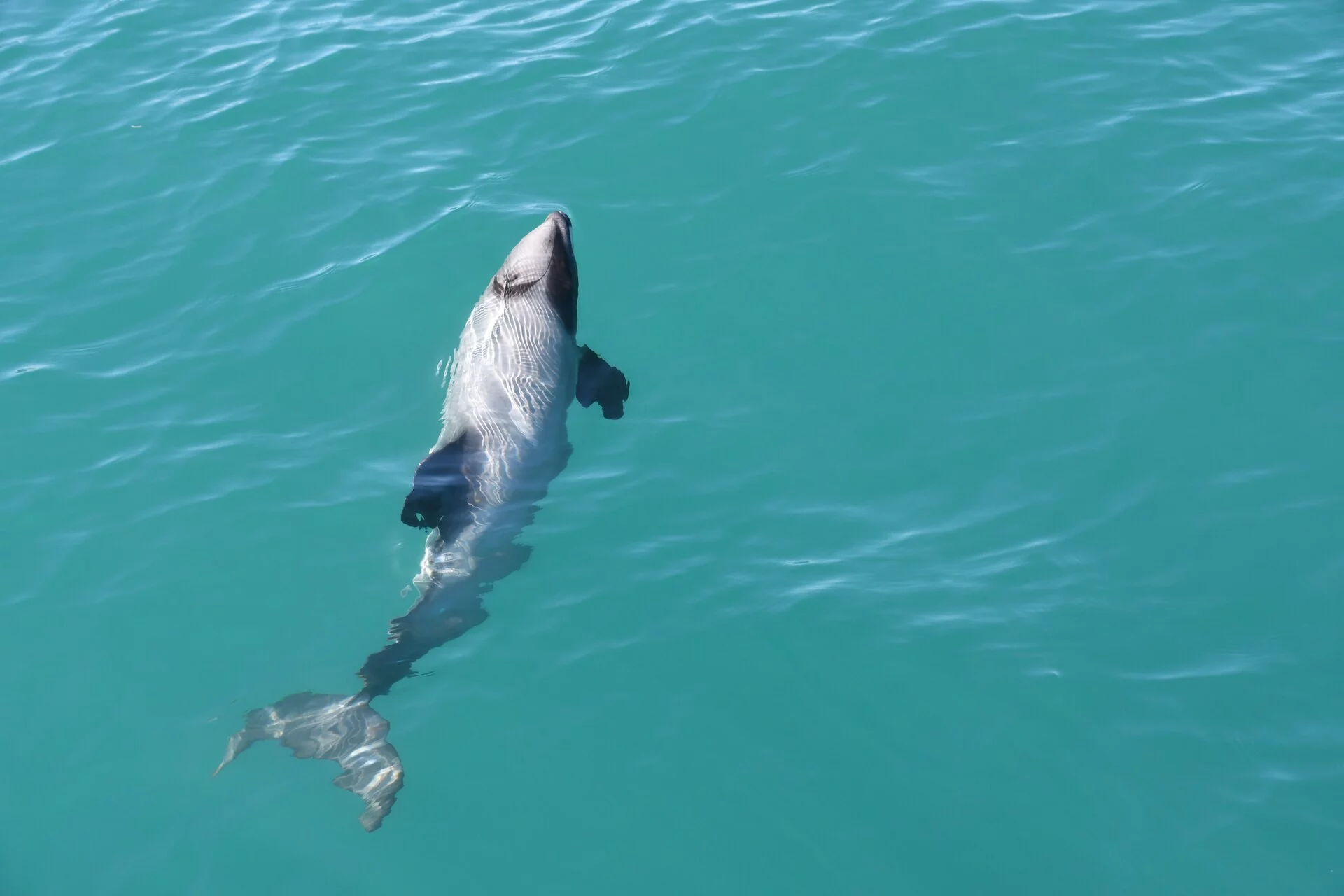
Photo: Julien Renoult, CC BY 4.0, via commons.wikimedia.org.
Updated 18 November 2026: added a CSV download and a one-page printable of the smallest populations table.
Updated 16 November 2026: added a table of the smallest dolphin and porpoise populations with each count’s year, method, counter and source, a Red List status table with assessment years, the 2020 to 2021 Māui dolphin estimate of 54, and the cetacean Red List totals.