
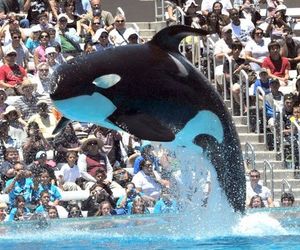
10 Orca Deaths In Captivity At Marine Parks
Animals die. That is not the argument. The argument is that captive orcas almost never die of old age, and the record of how they do die is public, dated and easy to check.
In the wild, female orcas typically live about 50 years and can reach at least 90, while males average about 30 and can reach at least 60, according to NOAA Fisheries. In marine parks, most of the animals below did not reach a third of that. Here are ten deaths that made headlines, with what is actually on the record for each.
Ten orca deaths in captivity
1) Moby Doll
Vancouver Aquarium. Captured 16 July 1964, died 9 October 1964, aged about five.
Collectors mounted a harpoon gun at East Point on Saturna Island, British Columbia, intending to kill an orca as a model for a sculpture. They hit one and it survived, so they towed it back to Vancouver and put it on display. The animal was named Moby Doll and assumed to be female. It was male.
Moby Doll refused food for about 54 days, circling the pen while keepers offered everything from salmon to horse hearts. He eventually began eating, took a substantial meal on 8 October, ate a single fish the next day, and drowned.
He was the second orca displayed in a public aquarium and the first to survive captivity longer than two days. Before him the species was widely written off as a bloodthirsty pest, and the public reaction to seeing one up close is generally credited with starting the change. Vancouver journalist Mark Leiren-Young wrote a book about it, The Killer Whale Who Changed the World, in 2016. The whale paid for the change with his life.
2) Sumar
SeaWorld San Diego. Born 14 May 1998, died 7 September 2010, aged 12.
Sumar was born at SeaWorld Orlando to Taima and Tilikum. Within months he was pulled from his mother, who had become aggressive toward him. He passed through the company’s Ohio park and reached San Diego in February 2001. He died of gastric torsion with intestinal volvulus, a twisted stomach and gut. Trainers described him as unusually easy-going with people and with other whales.
3) Kandu V
SeaWorld San Diego. Captured 12 October 1977 off Iceland, died 21 August 1989, aged about 15.
Kandu V died in front of an audience. During a live show she charged Corky II in what looked like a dominance dispute. The collision broke her jaw and severed an artery in her head. She bled from the blowhole with every breath and sank to the bottom of the pool around 45 minutes later. Two whales who would never have shared a home range in the wild were sharing a tank.
4) Kalina, the original Baby Shamu
SeaWorld Orlando. Born 26 September 1985, died 4 October 2010, aged 25.
Kalina was the first orca calf conceived and successfully raised in captivity, which made her a marketing landmark as well as a biological one. She had four calves of her own. She showed signs of discomfort during the day and died that evening of bacteraemia and septicaemia. Her death came within four months of Taima’s and Sumar’s, three orca deaths across SeaWorld parks in a single year.
5) Kyara
SeaWorld San Antonio. Born 17 April 2017, died 24 July 2017, aged 98 days.
Kyara was the last orca born under SeaWorld’s captive breeding programme, which the company ended in 2016. She was separated from her mother Takara after a run of health problems and died of an infection, possibly pneumonia. Pneumonia is the most common recorded cause of death in captive orcas.
6) Kasatka
SeaWorld San Diego. Captured 26 October 1978 off Iceland, died 15 August 2017, aged about 41.
Kasatka was the matriarch of the San Diego group: four calves, six grandcalves and two great-grandcalves by the time she died. She was also the first captive cetacean to conceive by artificial insemination. She had a long history of aggression toward trainer Ken Peters, biting at him in 1993 and 1999 and dragging him underwater twice during a 2006 show. She had incurable pneumonia from 2008 until her death nine years later.
7) Kiva
Marineland of the Pacific. Born June 1982, died 3 August 1982, aged 46 days.
Kiva was Corky II’s third calf. Corky did not nurse her, so keepers tube-fed the calf and then separated the pair when the mother handled her too roughly. Kiva died six weeks after birth. None of Corky’s calves survived infancy: one lived eleven days, one ten days, Kiva forty-six, the last about two months. Captive-born orca calves being rejected or injured by their mothers is a recurring pattern, and it is a hard fact to square with a breeding programme.
8) Vicky
Loro Parque, Tenerife. Born 3 August 2012, died 16 June 2013, aged about ten months.
Vicky was Kohana’s second calf and the second orca born at the park. Like her older brother Adan she was rejected by her mother straight after birth and hand-reared by staff. She was a favourite with trainers and visitors, and her death from intestinal problems ten months after a heavily publicised birth landed hard.
9) Taima
SeaWorld Orlando. Born 11 July 1989, died 6 June 2010, aged 20.
Taima died of placenta praevia while delivering her fourth calf. Neither she nor the calf survived. She was Sumar’s mother and Tilikum’s mate, and she had a documented history of attacking her own calves, two of whom were removed from her.
10) Tilikum
SeaWorld Orlando. Captured November 1983 at Berufjordur, Iceland, died 6 January 2017, aged 35.
Tilikum was taken at about two years old and spent 33 years in tanks. At 22.5 feet and roughly 12,500 pounds he was the largest orca in captivity, with a dorsal fin collapsed flat against his left side. He was involved in three human deaths: trainer Keltie Byrne at Sealand of the Pacific in 1991, trespasser Daniel Dukes at SeaWorld Orlando in 1999, and trainer Dawn Brancheau in 2010. That last death, and the 2013 documentary Blackfish, changed public opinion on orca captivity more than any campaign had. He sired 21 calves, and a number of his descendants are still in marine parks today.
SeaWorld ended orca breeding in 2016, so the animals in its tanks today are the last generation it will hold. That is a real change and it came from public pressure. Other operators, particularly in Asia, have not followed.
Continue exploring at our store
If this article sparked your interest, head over to the endangered status of dolphins guide and We Love Dolphins store for related reads and gear.
For the broader picture, see our full dolphin facts guide.
Updated 25 October 2026: corrected Moby Doll’s capture date and the wild orca lifespan figures.



These are wild animals and should be treated as such.