

Rise in Dolphin Deaths Due to War
The full-scale Russian invasion of Ukraine, which began on 24 February 2022, was followed by a sharp rise in dolphin and porpoise deaths in the Black Sea. Dead animals came ashore in unusual numbers in Ukraine, Turkey, Romania and Bulgaria, and researchers presented the pattern to the European Cetacean Society in April 2023 under the title “An unusually high number of cetacean strandings in the Black Sea, 2022: is it the consequence of war?”. The honest position on the total is that nobody has a firm one. Ivan Rusev of the Tuzly Estuaries National Nature Park, the most quoted source, estimated up to 50,000 cetacean deaths by October 2022 and more than 100,000 by July 2026. Both are extrapolations from strandings, because he assumes only about 5 percent of dead animals wash ashore.
For the broader picture, see our dolphin conservation guide.
The three cetaceans of the Black Sea
The Black Sea is home to just three cetacean species, each its own distinct subspecies adapted to this isolated, brackish sea:
- Black Sea harbour porpoise (Phocoena phocoena relicta), listed as endangered on the IUCN Red List.
- Black Sea bottlenose dolphin (Tursiops truncatus ponticus), also endangered.
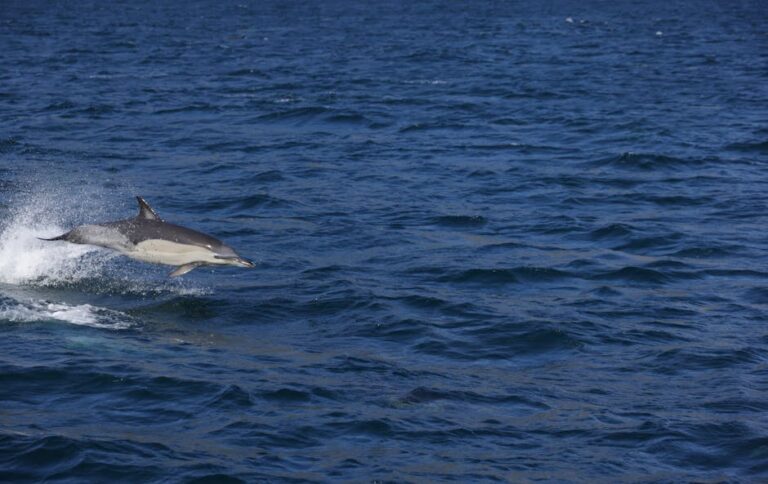
- Black Sea common dolphin (Delphinus delphis ponticus), listed as vulnerable.
All three were already under pressure before 2022. Harbour porpoises make up the majority of Black Sea strandings in most years, and they did again through the war years: the smallest and most coastal of the three has borne the heaviest recorded losses.
How military noise harms dolphins
Dolphins and porpoises are acoustic animals. They hunt and navigate by echolocation, sending out clicks and reading the returning echoes through a fatty organ in the forehead called the melon. Their world is built from sound, which is exactly why warfare in the water is so damaging.
Sonar from warships and submarines floods that acoustic world with noise. It can mask the faint echoes a dolphin relies on, effectively blinding the animal, and drive it to flee the source. Whales have been recorded stopping foraging when exposed to sonar, and a cetacean that cannot find food, or that abandons familiar waters, faces starvation and, in the cold Black Sea, hypothermia. Explosions add a second danger. The combination of loud noise that pushes animals into deep dives and blasts that trigger panicked rapid ascents can cause decompression injury, similar to the bends in human divers. Some stranded animals were also found with fresh blast injuries from the explosions themselves. Russia also keeps trained dolphins in pens at Sevastopol, as our piece on military dolphins and what they do explains.
Strandings, nets, and displacement
The effects reached around the whole sea, not just the war zone. Turkish and Bulgarian researchers both reported a rise in strandings from late February 2022, well away from the fighting, and Bulgarian conservationists recorded cetaceans entangled in fishing nets as displaced animals moved into unfamiliar water.
This is the chain of harm: noise drives dolphins away from their usual hunting grounds, they enter unknown territory where they do not know the hazards, and they end up drowning in nets or stranding on shore. A dolphin too busy fleeing a sound is also a dolphin that is not eating.
Why the Black Sea population is so fragile
The Black Sea is almost enclosed, connected to the Mediterranean only through the narrow Bosphorus. Its cetaceans cannot simply migrate elsewhere to escape danger. They are a closed, finite population that has already survived a brutal history: commercial dolphin hunting in the Black Sea continued into the 1980s and cut numbers severely. Bycatch in fishing gear, pollution, and disease have kept the population suppressed since. A sudden war-driven mortality spike lands on a population with very little resilience left, which is why conservationists have warned that prolonged conflict could push these subspecies toward local extinction.
Underwater noise is a year-round problem
The war made the Black Sea a dramatic case study, but underwater noise harms dolphins everywhere, every day. Cargo ship engines, seismic air guns used in oil and gas surveys, pile driving for offshore construction, and naval sonar all add to a steady acoustic fog across the world’s oceans. For an animal that finds its food and its family by sound, this chronic noise raises stress, masks communication between pod members, and can push whole groups away from important feeding areas. International bodies have begun treating ocean noise as a form of pollution in its own right, alongside chemicals and plastic. Quieter ship designs, slower speeds in sensitive areas, and seasonal limits on the loudest activities are all measures that can reduce the burden. The Black Sea tragedy is an extreme spike on a curve that never reaches zero.
What this means next
The Black Sea cetacean deaths are now part of the wider environmental accounting of the war, and Ukrainian authorities have cited them in ecocide allegations against Russia. Recovery depends first on the fighting ending and the sea quietening, then on the older threats of bycatch and pollution that never went away. Alongside the sonar there is chemical contamination, debris from drones and missiles, and the 2023 destruction of the Kakhovka Dam, which dumped a river’s worth of fresh water and pollutants into the north-west shelf where porpoises feed.
Continue exploring at our store
If this article sparked your interest, head over to the We Love Dolphins merchandise store for related reads and gear.
Updated 25 October 2026: updated the death toll estimates with Ivan Rusev’s figures for October 2022 and July 2026.

Awful. I never thought about what a war does to the animals in the sea.