
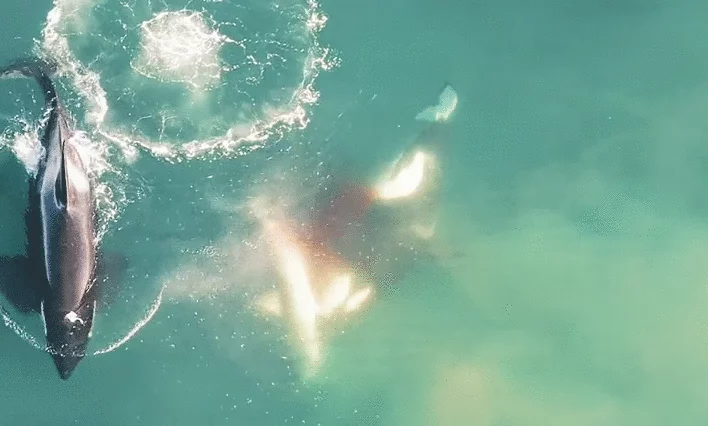
Video Of Orca Whales Killing a Great White
In May 2022 a drone filmed orcas killing a great white shark off South Africa, the first time the predation had been filmed from the air. Orcas had been seen killing a white shark before, off California’s Farallon Islands in 1997, but never recorded in this detail. It confirmed what scientists had suspected for years from the great white carcasses washing ashore with their livers removed: the killer is the orca. This page tells the story of the shark-hunting orcas, how they do it, and what it has done to South Africa’s great white population.
For the broader picture, see our dolphin conservation guide.
The footage that proved it
The clip is striking. It zooms in on a group of killer whales swimming together. Between two of them, a third orca surfaces with a shark in its grip, bites down, and drags the shark below. A second orca follows and takes the shark next. As the drone pulls back, the screen is left with a patch of murky, disturbed water.
This matters because the link between vanishing great whites and orcas had been a strong hypothesis without direct proof. The footage was captured around Mossel Bay in May 2022 and written up by researchers later that year. It turned a theory built on carcasses into something anyone could watch happen.
Port and Starboard: two orcas with a reputation
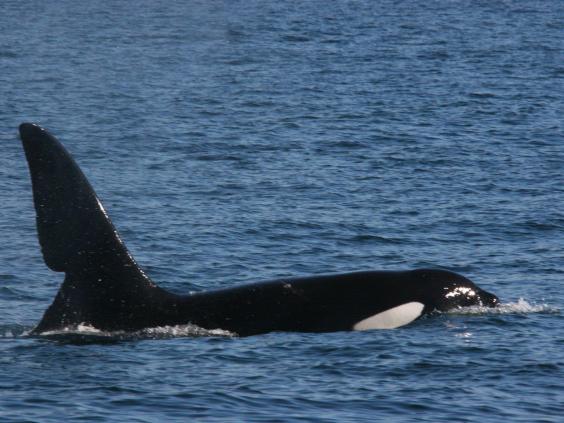
The hunting is not random. South Africa’s shark-killing orcas are a small group, and two individuals are famous enough to have names: Port and Starboard, named for their dorsal fins, which collapse to the left and right respectively. They were first reported near Luderitz, Namibia, in 2009 and have been linked to great white deaths along the South African coast ever since.
Great whites began washing up on South African beaches in 2015 with nothing but their livers taken. In 2017 at least seven great whites believed to have been killed by the pair were found, among them a well-known female that researchers had named Khaleesi. The orca filmed in the 2022 drone footage was Starboard, hunting alongside several others.
How orcas kill a shark and take its liver
This is one of the most precise predatory behaviours in the ocean. Around South Africa, orcas hunt white sharks in groups of two to six. They flip the shark belly up, which triggers a natural state called tonic immobility, a kind of paralysis that leaves the shark unable to fight back. The orca then opens the shark with a controlled bite, typically between the pectoral fins, and removes the fatty liver almost surgically.
The reason is energy. A great white’s liver is enormous and extremely rich in oil and lipids. For an orca maintaining a thick layer of blubber in cold water, a shark liver is concentrated fuel. The orca is not being wasteful. It is taking the single most nutritious organ in the animal and leaving the rest.
The sharks are fleeing
The most remarkable effect is on the sharks’ behaviour. Great whites are apex predators, used to being the most dangerous animal in their waters. Faced with orcas that hunt them, they have done something rarely seen in an apex predator: they have left. In False Bay, once a thriving great white site, sightings dwindled to near zero by 2020. When orcas appear, the sharks vacate the area, sometimes for weeks. The same pattern has been documented off California.
That has consequences beyond the sharks themselves. Great whites are the main predator of the local Cape fur seal population. Remove the sharks and the balance of the whole coastal food web can shift, which is why researchers are watching the situation closely rather than treating it as a curiosity.
Why this is so unusual for orcas
Orcas around the world specialise. Different populations, called ecotypes, eat very different prey: some hunt only fish, some only marine mammals, some focus on other sharks and rays. An orca’s diet is largely cultural, learned within its family group and passed down. What makes the South African shark hunters notable is how specific the technique is, and how a behaviour practised by a couple of well-known individuals has reshaped a coastline. It is a clear demonstration of how powerful learned behaviour is in these animals, and a reminder that orcas are not one uniform predator but many local cultures.
A reminder about the food chain
- No animal is truly at the top. The great white shark is an apex predator, but the orca preys on it. Apex status is local and conditional.
- Predation can be learned and spread. The shark-hunting technique appears in a small group of orcas and may pass between individuals, the way other orca hunting methods do.
- Behaviour, not just numbers, shapes ecosystems. The orcas did not need to kill every shark. Fear alone was enough to clear them out of False Bay.
So the next time you hear about a great white near a beach, it is worth remembering that the shark has predators of its own. To learn more about the hunter in this story, see our profile of the orca whale, the largest member of the dolphin family and one of the most capable predators on Earth.
Continue exploring at our store
If this article sparked your interest, head over to the endangered status of dolphins guide at the We Love Dolphins store for related reads and gear.
Updated 25 October 2026: corrected the claim that the 2022 footage was the first of orcas killing a white shark.


How did just a couple of orcas learn to do this? Did the others pick it up from them?
Nobody knows yet. The drone footage in the post shows Starboard hunting alongside several other orcas, so it may not stay a two orca habit for long.