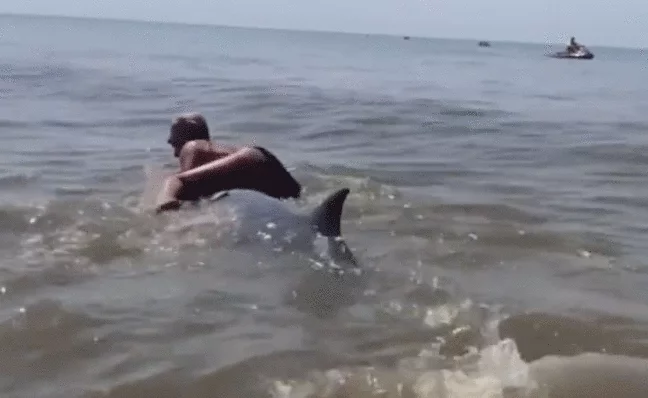
Topless Woman Tries to Ride a Beaked Whale
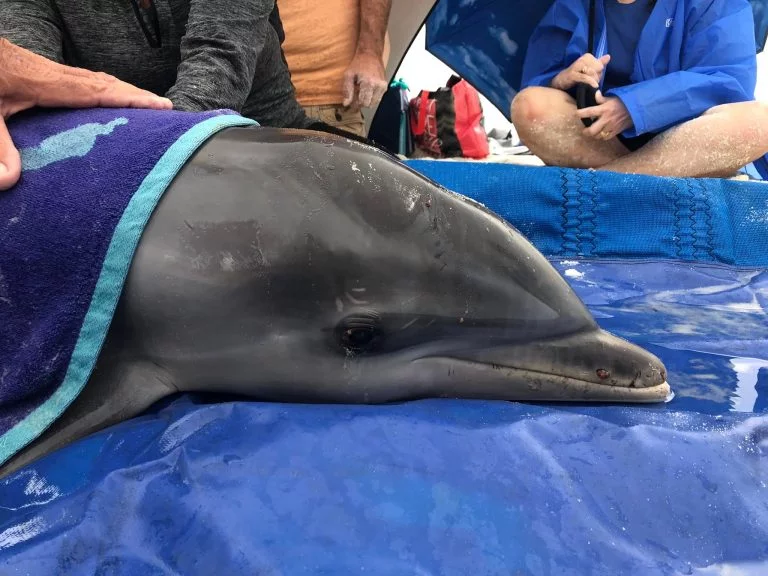
In July 2022 a video from Zandvoort, a beach resort on the Dutch North Sea coast, went round the internet. It showed a swimmer repeatedly trying to climb onto a stranded beaked whale in shallow water while other beachgoers told her to stop. Many reports called the animal a dolphin. Dutch reports and the rescue group SOS Dolfijn named it a spitssnuitdolfijn, a beaked whale, and other people on the beach had just pushed it back out to sea. Dutch police looked into whether an offence had been committed.
The legal question is interesting. The animal welfare question is not: you do not ride a wild dolphin, and the reason is worth spelling out.
Why a dolphin in the shallows is already in trouble
Wild dolphins belong in open, deeper water. A dolphin lingering in the shallows off a crowded bathing beach in the North Sea is usually there because something has gone wrong: it is sick, injured, disoriented, or separated from its group.
There is also a specific category of animal that turns up in these situations. Researchers call them solitary sociable dolphins: individuals that have lost their group and begin seeking out human contact. They are the most vulnerable animals of all, because the approachability that draws a crowd is what exposes them to boat strikes, harassment and well-meant interference.
Beaked whales live in deep offshore water, so one in the surf at Zandvoort was in serious trouble. It was not there for fun.
Four concrete reasons never to touch one
- It exhausts an animal with nothing left. A sick or stranded dolphin has no energy to spare. Being ridden, chased or crowded can be the difference between recovering and dying.
- It can seriously hurt you. A bottlenose dolphin has dozens of sharp conical teeth, a tail that can break bones, and no obligation to be friendly. People have been rammed and bitten.
- Disease moves both ways. Dolphins and humans can pass infections between species. Close contact is a health risk on both sides.
- It wrecks the rescue. An animal near shore often needs trained responders. A crowd grabbing at it makes a careful assessment far harder and can drive it back into danger.
What to do instead
- Keep your distance and stay calm. Do not chase, corner, touch or ride it. Let the animal control the encounter.
- Do not feed it. Feeding teaches a dolphin to associate people with food, which produces begging behaviour and, eventually, a dangerous animal. Our piece on feeding dolphins covers what goes wrong.
- Keep dogs and crowds back and get the noise down.
- Report it. In the Netherlands, SOS Dolfijn in Anna Paulowna is the national cetacean rescue and rehabilitation centre and runs a 24 hour response line. Elsewhere, call the coastguard or your national marine mammal rescue organisation.
Is it actually illegal?
In a lot of the world, yes. In the United States the Marine Mammal Protection Act of 1972 makes it illegal to harass, hunt, capture or kill a marine mammal, and harassment explicitly covers behaviour that disturbs an animal or disrupts what it would normally be doing.
In the European Union all cetaceans are strictly protected under the Habitats Directive, which is why Dutch police treated the Zandvoort case as a possible offence rather than a prank. The principle is consistent internationally: deliberately disturbing a wild dolphin is not a grey area, and wanting a photograph is not a defence. A Florida case, the dead baby dolphin found after an Instagram photo post, shows how US law treats it.
What we do not know
The woman reported herself to police the next day. She was arrested, questioned and released, on suspicion of breaching the Dutch Animal Welfare Act (Wet dieren), and police passed the case to the public prosecutor. SOS Dolfijn called it animal abuse. We have not found a report of how the case ended or what happened to the whale. If you know, leave a comment and we will update this page.
For the broader picture, see our dolphin conservation guide.
Updated 25 October 2026: corrected the species (a beaked whale, not a dolphin) and the crowd’s reaction, and added what happened to the woman afterwards.