
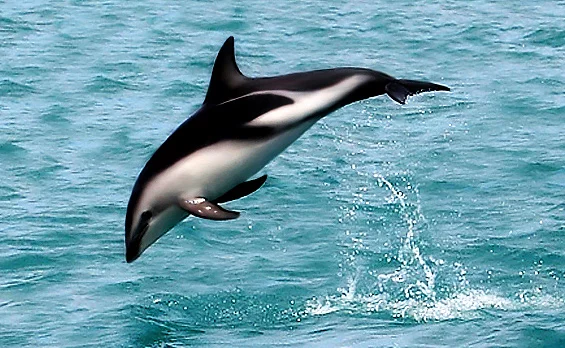
Dusky Dolphin: Facts, Range, Acrobatics & Behaviour
The dusky dolphin is the acrobat of the southern oceans. It lives in cool coastal water off New Zealand, southern South America and southern Africa, and it leaps more, and higher, than almost any other dolphin. In a big feeding group you can have a dozen animals airborne at once.
Key facts at a glance
| Common name | Dusky dolphin |
| Scientific name | Aethalodelphis obscurus, long known as Lagenorhynchus obscurus |
| Max length | About 2.06 m |
| Max weight | About 85 kg |
| Diet | Small schooling fish and squid |
| Habitat | Cool coastal shelf waters of the southern hemisphere |
| Lifespan | Around 26 to 30 years |
| Population | No global figure. New Zealand around 12,000, Argentina over 6,500 |
| IUCN status | Least Concern, but the Peruvian subspecies is Vulnerable |
| Taxonomy | Artiodactyla, Delphinidae, Aethalodelphis |
The name changed in 2025
If you have an older field guide it will call this animal Lagenorhynchus obscurus. Genetic work broke the old genus Lagenorhynchus apart, and in 2025 the dusky dolphin was moved to Aethalodelphis. Both names refer to the same dolphin, and you will see the old one in print for years yet.
Range and habitat
Dusky dolphins keep to the continental shelf and the cool upwelling currents that run along it. They do not migrate in the long-distance sense, but they move inshore and offshore with their prey and they dive to at least 130 m when they need to.
Three subspecies are recognised: an African form, Fitzroy’s dolphin off Argentina, and the Peruvian and Chilean form. The populations are genuinely separate. There is no continuous band of dusky dolphins around the southern hemisphere, just widely spaced pockets of cold water with a gap of open ocean between each one.
Kaikoura on New Zealand’s east coast is the best-known site in the world for them. Around 2,000 animals use the area, out of a national population of roughly 12,000, and the deep canyon that runs almost to shore is what concentrates them there.
Diet and hunting
Anchovy, sardine, hake and squid. What makes dusky dolphins worth watching is not the menu but the method. At dawn and dusk a group will drive a school of fish up against the surface and hold it there, taking turns to feed while the rest keep the ball tight. Hundreds of animals can be involved in a single coordinated push.
The leaping is probably part of this. Some of it is clearly social and some of it happens well away from feeding, but the noisy belly-flop landings during a hunt look like signalling, and possibly like herding, rather than play.
Social life
The Kaikoura animals have been studied since the 1980s, which makes them one of the better-documented dolphin populations anywhere. Group composition shifts through the day: large mixed aggregations offshore at night while feeding, smaller resting and nursery groups inshore by day. Researchers there also fixed suction-cup cameras to dusky dolphins, as our piece on the secret life of dolphins in a pod describes.
Individuals are not tied to one group. Tagged dusky dolphins have turned up hundreds of kilometres from where they were marked, which is why counting them at any one site tells you less than it appears to.
Threats and conservation
Globally the species is Least Concern. That rating does not describe what is happening in Peru.
Illegal hunting off Peru kills dolphins for human consumption and for shark bait. The Peruvian group Mundo Azul has estimated that 7,000 to 15,000 dolphins of several species are killed there each year for bait, and no separate figure exists for dusky dolphins. The Peruvian subspecies is separately assessed as Vulnerable because of it. It is one of the largest deliberate takes of any small cetacean anywhere, and it happens in a country where the hunt has been illegal since 1996.
Elsewhere the pressures are smaller and slower: gillnet bycatch, vessel noise, tourism disturbance at Kaikoura, and interference from mussel farms in New Zealand’s coastal bays. Warming of the South American upwelling systems is shifting the fish these dolphins depend on, and the consequences of that are not yet clear.
How you can help
The Peruvian take is the thing that matters most for this species, and it is driven by demand for cheap protein and shark-fishing bait rather than by anyone’s idea of a delicacy. Supporting the organisations documenting it, and the enforcement of Peru’s own ban, does more than anything you can do at Kaikoura. If you do go to Kaikoura, use an operator that keeps its distance and contributes sightings data.
Frequently asked questions
How big is a dusky dolphin?
Small. About 2 m at the top end and around 85 kg. Newborns are roughly 90 cm.
How long do dusky dolphins live?
Around 26 to 30 years, estimated mainly from growth layers in the teeth of stranded animals.
How many dusky dolphins are there?
There is no reliable global total. Regional surveys give roughly 12,000 in New Zealand waters and over 6,500 between Peninsula Valdes and Puerto Deseado in Argentina. Anyone quoting a worldwide number is extrapolating.
Are dusky dolphins endangered?
Not globally. The Peruvian subspecies is listed as Vulnerable, and it is the one taking the losses.
Where can I see them?
Kaikoura in New Zealand is the most reliable place in the world, year round. Peninsula Valdes in Argentina is the other well-known site. Kaikoura also makes our list of the top 10 places to see wild dolphins.
Sources and further reading
- IUCN Red List, dusky dolphin assessment and the Peruvian subspecies assessment
- New Zealand Department of Conservation, dusky dolphin pages
- Society for Marine Mammalogy, list of marine mammal species and subspecies
Updated 25 October 2026: corrected the Peru kill estimate, which covers several dolphin species, and fixed a broken size comparison.


Oh wow these dolphins are gorgeous!!
Kaikoura is on my list. Is there a best time of year to see them leaping?