

Yangtze Finless Porpoise: China’s Last Freshwater Cetacean
The Yangtze finless porpoise is what China has left. The baiji, the river’s dolphin, was declared functionally extinct after a survey in late 2006 failed to find a single animal. The porpoise is still there, in the same river, and for the first time in decades its numbers have stopped falling.
Key facts
| Scientific name | Neophocaena asiaeorientalis asiaeorientalis |
| Length | 1.4 to 1.7 m |
| Weight | 30 to 45 kg |
| Population | 1,426 in the 2025 survey |
| IUCN status | Critically Endangered (assessed 2012) |
| Range | Main Yangtze channel, Poyang Lake, Dongting Lake |
| Protection | First-class national protection in China since 2021 |
An animal with no fin
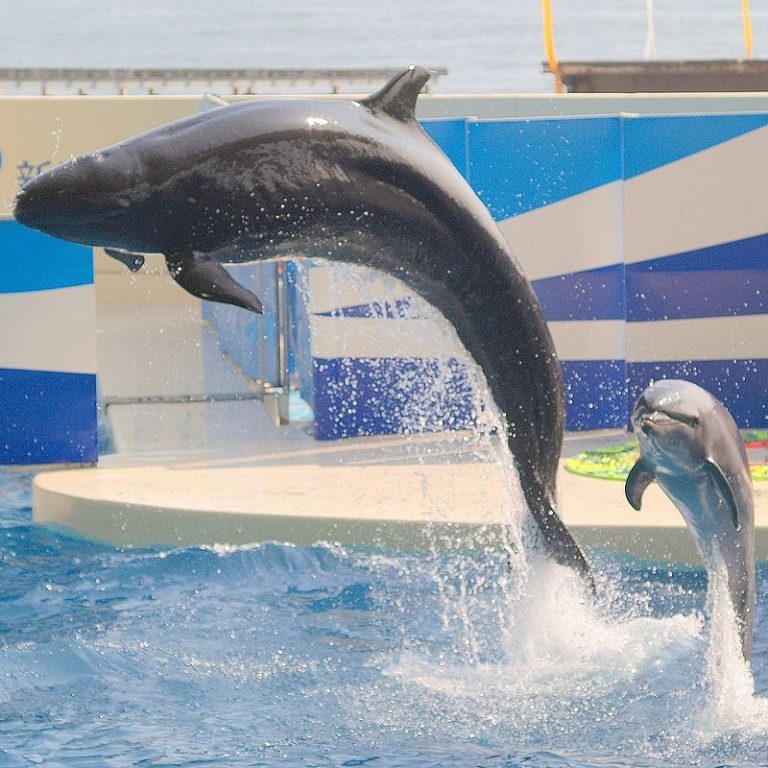
Dark grey to almost black, blunt-headed, beakless, and with no dorsal fin at all. In its place is a low ridge running from mid-back to the tail, covered in small tubercles. Calves ride on their mother’s back over that ridge in the first weeks of life, a habit shared with the baiji and rare elsewhere among cetaceans.
It is a porpoise, not a dolphin: family Phocoenidae, not Delphinidae. Its only other subspecies, the East Asian finless porpoise, lives in coastal water around Japan, Korea and China. A separate species, the Indo-Pacific finless porpoise, ranges from China west into the Indian Ocean. This is the only one that spends its whole life in fresh water.
Where it lives and what it eats
The main Yangtze channel and two connected lakes, Poyang and Dongting. Within that it favours river bends, confluences and lake mouths, the places where current and depth push prey together.
Diet is small river fish, including tapertail anchovy, gobies and young carp, plus freshwater shrimp, taken on short dives of a few metres in water too muddy to hunt by eye alone. Small groups feed together, particularly along eddy lines.
They are shy animals. No leaping, no bow-riding, just a brief surfacing and an audible breath before they are gone. Groups are usually two to five, and mother and calf are the tightest unit in the population.
The numbers, decade by decade
- Early 1990s: about 2,700
- 2006: around 1,800
- 2012: 1,045
- 2017: 1,012
- 2022: 1,249
- 2025: 1,426
The 2025 figure and the early 1990s figure come from China’s Ministry of Agriculture and Rural Affairs, as reported by the Institute of Hydrobiology, Chinese Academy of Sciences. The 2006, 2012, 2017 and 2022 counts are the ministry’s survey results as reported by Global Times. The 2022 survey ran from September to October and found 595 porpoises in the main river, 492 in Poyang Lake and 162 in Dongting Lake.
The 2022 count was the first increase ever recorded for the subspecies, and the 2025 survey found a second. It is a small rise on a very small base, and the honest reading is that the collapse has been halted rather than reversed.
What actually changed
China’s ten-year fishing ban on the Yangtze, phased in from 2020 and covering the main river from 2021, removed both the nets that drowned porpoises and the competition for the fish they eat. Protection was tightened in Poyang and Dongting at the same time, and in 2021 the subspecies was raised to first-class national protection, the strictest category the country has.
Alongside that sit the semi-natural reserves. Tian-e-Zhou, an old oxbow lake cut off from the main river, was stocked with five animals in the early 1990s and has been built up to something close to its estimated capacity of about 100. He-wang-miao is a later and much smaller reserve. Between them they are the insurance policy if the river population fails, and the Wuhan Institute of Hydrobiology has bred second-generation animals in captivity. The ministry says China now has five conservation zones for porpoises moved from degraded habitat, holding more than 150 animals, with more than 10 calves born a year. Its action plan aims for about 1,700 wild porpoises by 2030 and 2,000 by 2035.
What has not changed
Sand mining and river engineering still degrade the habitat, shipping still generates constant noise and occasional collisions, and pollution still runs into the system. The Three Gorges Dam altered downstream hydrology in ways researchers are still working through.
Drought is the newer worry. The 2022 Yangtze drought dropped water levels in Poyang and Dongting to a point that stranded porpoises in shrinking pools, and a river population has nowhere else to be.
Frequently asked questions
How many Yangtze finless porpoises are left?
1,426 in the 2025 survey, up from 1,249 in 2022 and 1,012 in 2017. That is the second increase in a row. The subspecies is still Critically Endangered on the IUCN Red List.
Is it a dolphin?
No, a porpoise. Different family, blunter head, spade-shaped teeth rather than conical ones, and in this case no dorsal fin.
How is it different from the baiji?
The baiji was a river dolphin and is functionally extinct. The finless porpoise is a porpoise, is still here, and is the focus of the conservation effort that came too late for the baiji.
The animal it replaced is covered in our piece on whether the Yangtze river dolphin is extinct.
Sources
- Institute of Hydrobiology, Chinese Academy of Sciences: Fishing ban revives Yangtze finless porpoises (2025 survey, 1,426)
- Global Times: 2022 survey count of 1,249 and earlier surveys (March 2023)
- IUCN Red List: Neophocaena asiaeorientalis asiaeorientalis
Updated 16 November 2026: linked the 2025 count of 1,426 and every earlier survey figure to its source, added the IUCN status with its assessment year, the conservation zone numbers and the 2030 and 2035 targets, and a sources list.
finally some good news from the Yangtze. the oxbow lake reserves sound like they really helped.
They did. The reserves gave the porpoises a backup population, and the fishing ban on the main river took away the nets that drowned them.