
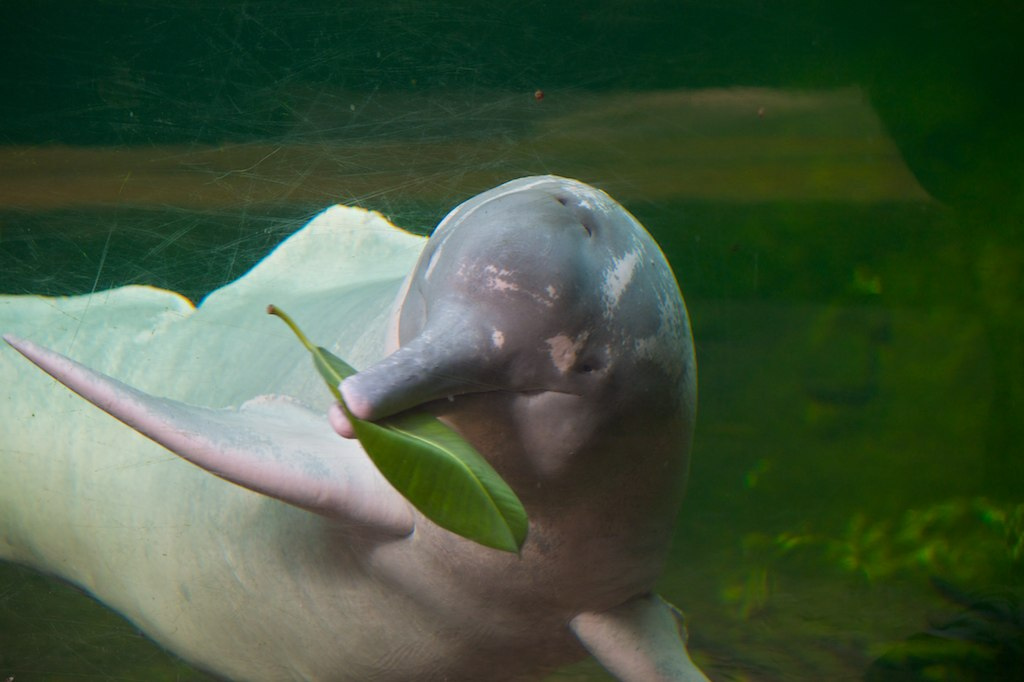
Amazon River Dolphin (Boto): Facts, Pink Colour & Habitat
The Amazon river dolphin, locally called the boto, is the largest river dolphin on Earth. Adult males turn pink. They live in the flooded forests of the Amazon and Orinoco basins, swim between tree trunks during the wet season, and appear in indigenous Amazonian mythology as shapeshifters who come out of the river at night.
Key facts at a glance
| Common name | Amazon river dolphin (boto) |
| Scientific name | Inia geoffrensis |
| Length | Males up to about 2.55 m (average 2.32 m); females up to about 2.18 m (average 2.0 m) |
| Weight | Males up to about 207 kg (average 154 kg); females up to about 154 kg (average 100 kg) |
| Diet | Carnivore: fish, crustaceans, river turtles |
| Habitat | Amazon and Orinoco river basins |
| Lifespan | Poorly known in the wild; captive animals recorded to about 30 years |
| Population | No reliable global total |
| IUCN status | Endangered (assessed 2018) |
| Taxonomy | Artiodactyla | Iniidae | Inia |
Range and habitat
The species ranges from the Andes foothills of Peru, Colombia and Ecuador to the Atlantic mouth of the Amazon, plus the whole Orinoco system. The Society for Marine Mammalogy list recognises two subspecies, Inia geoffrensis geoffrensis and the Bolivian boto, Inia geoffrensis boliviensis. It does not recognise a third, Orinoco subspecies, and has not yet accepted the Araguaian boto (Inia araguaiaensis), proposed as a separate species in 2014. Millions of years earlier the same region held a giant river dolphin known from a skull found in Peru, which was not closely related to the boto.
Botos move with the annual flood cycle. During high water they push deep into flooded forest to hunt, threading between submerged trunks. During low water they retreat to the main channels and to confluences where fish concentrate. That seasonal shuttle is unusual among cetaceans and it is the reason a dam or a drained channel can cut a population off in a way that never happens at sea.
For a question-and-answer look at the colour that makes this animal famous, see our piece exploring the pink mystique of the Amazon river dolphin.
Diet and hunting
Botos in the central Amazon have been recorded eating more than 50 species of fish from more than 20 families (Handbook of the Mammals of the World), including armoured catfish that few other predators can crack. They also take crustaceans, river turtles and occasionally small caimans. Unlike most dolphins their cervical vertebrae are not fused, so they can turn the head roughly 90 degrees, which matters a great deal when you hunt inside a submerged forest rather than in open water.
Water in the Amazon carries so much sediment that eyesight is close to useless for much of the year. The boto works by echolocation and by touch, sweeping stiff sensory bristles on the rostrum through mud and leaf litter to find prey it cannot see.
The object-carrying display
Wild males have been documented carrying floating objects in the mouth, usually branches or lumps of clay, and thrashing them at the surface. The behaviour is understood as socio-sexual: it appears aimed at attracting females and at competing with other males. The closest parallel is in Australian humpback dolphins, whose adult males present marine sponges to females, a display described in 2017. The boto’s version is one reason a river dolphin most people have never seen keeps turning up in the behavioural literature.
Threats and conservation
The IUCN moved the boto to Endangered in 2018. Four pressures do most of the damage.
- Deliberate killing for bait. Botos are butchered to bait traps for piracatinga, a scavenging catfish. A study on the Japura River in 2010 and 2011 found dolphin bait in about a third of the piracatinga fishing events it recorded, though the number of dolphins killed is unknown. Brazil prohibits taking, harassing or killing the species, but under-reporting makes enforcement difficult.
- Mercury from illegal gold mining, which concentrates up the food chain and has been measured in dolphin muscle and in milk.
- Dams, which fragment river populations that cannot go around them.
- Bycatch in gillnets, which is widespread across the range.
Heat and drought are now a direct threat too. In September and October 2023, during a record drought, 209 pink and grey river dolphins died in Lake Tefé in the Brazilian Amazon, roughly 15 percent of the lake’s dolphins. The deaths came as the lake reached a record 41°C, beyond the tolerance limit of most Amazonian aquatic animals (Mongabay). A 2025 study led by Ayan Fleischmann of the Mamirauá Institute measured daytime water temperatures above 37°C in five of 10 central Amazon lakes (Fleischmann et al. 2025).
On 24 October 2023, river dolphin range countries meeting in Bogotá, Colombia, signed the Global Declaration for River Dolphins. Its goals are to halt and reverse the decline of every river dolphin population and to build a network of protected, well-managed river habitats. By January 2024 nine countries had signed, and five, including Peru, were still pending, according to Mongabay.
There is no credible global population figure for this species, and that absence is itself a problem: without a baseline it is hard to prove a decline quickly enough to act on it. The monitoring programmes running in reserves such as Mamiraua in Brazil exist partly to fix that.
How you can help
Support the organisations working inside the range rather than generic ocean charities: WWF Brazil, the IUCN SSC Cetacean Specialist Group, and the Brazilian and Colombian research institutes that run the boto surveys. Refuse attractions that keep river dolphins in tanks. And if you travel in the Amazon, avoid the tour operators that feed wild botos to guarantee a sighting, because habituated animals end up closer to boats, nets and people who mean them harm.
For related species see our other dolphin profiles, and for the wider picture see our dolphin conservation guide.
Frequently asked questions
What is the scientific name of the Amazon river dolphin?
Inia geoffrensis, in the family Iniidae. It is not closely related to the marine dolphins in the family Delphinidae.
How big does an Amazon river dolphin get?
Males reach about 2.55 m and 207 kg, averaging 2.32 m and 154 kg. Females reach about 2.18 m, averaging 2.0 m and 100 kg (Animal Diversity Web). The Handbook of the Mammals of the World gives the same maximum weights, 207 kg for males and 154 kg for females. Measurements of wild botos at the Mamirauá Reserve found males on average 16 percent longer and 55 percent heavier than females (Martin and da Silva 2006). That makes it the largest of the river dolphins.
Why are Amazon river dolphins pink?
The colour deepens with age and is strongest in adult males. Calves are grey. We cover the competing explanations in our separate piece on the pink boto.
How many Amazon river dolphins are left?
Nobody knows. There is no reliable global estimate, only local survey work. The IUCN lists the species as Endangered on the strength of documented declines and the scale of the threats rather than a headcount.
Are Amazon river dolphins blind?
No. That is the South Asian river dolphin, which has no crystalline lens. Botos can see, but in water this turbid they rely mostly on echolocation and touch.
Sources and further reading
- IUCN Red List entry for Inia geoffrensis (2018 assessment)
- WWF river dolphin programmes
- IUCN SSC Cetacean Specialist Group
- Martin and da Silva 2006, Sexual dimorphism and body scarring in the boto
Updated 25 October 2026: corrected the subspecies list, the piracatinga bait figure and the claim that no other cetacean shows a similar display.
Updated 16 November 2026: added the 2023 Lake Tefé die-off and the October 2023 Global Declaration for River Dolphins, settled the size and weight figures, and linked the sources.



I love dolphins and the information you provide on this blog is very informative. I learn something new every time I visit.
Very interesting. Thanks for the info.