The Pink Amazon River Dolphin: Facts and a 10 Question Quiz
The Amazon river dolphin turns bright pink, one of very few dolphins that do, and it lives nowhere near the sea. Found in the freshwater rivers and flooded forests of South America, it is the largest of all river dolphins and one of the strangest animals in the cetacean family. Below is a profile of the boto, followed by a ten question quiz.
Meet the Amazon River Dolphin
The Amazon river dolphin, Inia geoffrensis, is also known as the boto or the pink river dolphin. It is a freshwater species that spends its whole life in rivers. Adult males reach about 2.55 m and up to about 207 kg (Handbook of the Mammals of the World), and are noticeably larger than females, which is unusual: in most dolphins the sexes are closer in size or the female is bigger.
What makes the boto unmistakable is its colour. Calves are born grey and the skin can shift towards pink with age. The shade varies with age, activity and water temperature, and adult males are typically far pinker than females. One explanation is scar tissue: males fight each other, and repeated scarring leaves the skin rosy. An excited animal can flush a deeper pink much as a person blushes.
A Body Built for Flooded Forests
The boto does not look or move like an ocean dolphin, because it evolved for a completely different world.
- Unfused neck vertebrae, which let it turn its head almost 90 degrees. Ocean dolphins have stiff necks. A boto needs to weave between submerged tree trunks.
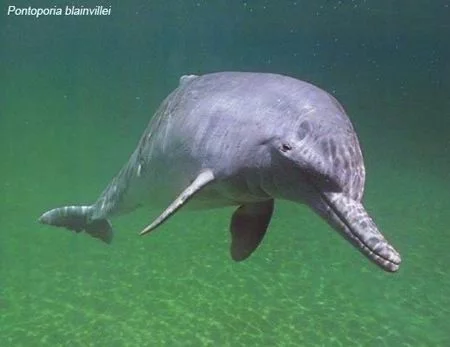
- A long, slender snout with two types of teeth, useful for cracking armoured catfish and shelled prey.
- Small eyes and weak eyesight. In sediment-heavy water, vision is close to useless, so the boto relies on echolocation.
- A low ridge instead of a tall dorsal fin, and large paddle-like flippers for slow, precise manoeuvring.
During the wet season the rivers burst their banks and flood the surrounding forest. Botos follow the water in, swimming between the trees to hunt prey that other predators cannot reach.
Range, Diet, and Behaviour
Amazon river dolphins occur in six South American countries: Bolivia, Brazil, Colombia, Ecuador, Peru and Venezuela. They live in the Amazon and Orinoco systems, including main channels, tributaries, lakes and seasonally flooded forest.
They eat more than 50 species of fish, including catfish and piranhas, along with freshwater crabs and small river turtles, which is one of the broadest diets of any dolphin. Unlike the large tight pods of ocean dolphins, botos are usually seen alone or in pairs, and rarely in groups of more than about eight. Larger gatherings of up to 35 animals have been recorded where food is concentrated.
Conservation: An Endangered Species
The IUCN assessed the Amazon river dolphin as Endangered in 2018. A great many pages online, including an earlier version of this one, still call it Vulnerable, which is out of date. The main threats are:
- Habitat loss and fragmentation, especially from dams that cut rivers into isolated sections.
- Pollution, including mercury from illegal gold mining, which accumulates in the fish the dolphins eat.
- Accidental capture in fishing nets.
- Deliberate killing, historically for use as bait in the piracatinga catfish fishery.
The boto also holds a particular place in Amazonian culture. Local stories tell of the dolphin turning into a charming man at night to seduce villagers, folklore that for generations gave the animal a measure of protection, since harming one was thought to bring bad luck.
Test Yourself: Amazon River Dolphin Trivia
Ten questions, answers underneath each one.
Question 1: What is the scientific name of the Amazon river dolphin?
Answer 1: Inia geoffrensis
Question 2: In how many countries is the Amazon river dolphin found?
Answer 2: Six
Question 3: Roughly how long can an adult male get?
Answer 3: About 2.55 m, or 8.4 feet
Question 4: What is the boto’s most distinctive colouring?
Answer 4: Pink
Question 5: What habitats do Amazon river dolphins use?
Answer 5: The murky waters of the Amazon and Orinoco systems, including flooded forest
Question 6: Name three threats to the species.
Answer 6: Habitat loss from dams, pollution including mining mercury, accidental capture in nets, and killing for bait
Question 7: What do they eat?
Answer 7: More than 50 fish species including catfish and piranhas, plus crabs and small turtles
Question 8: Are Amazon river dolphins usually alone or in large pods?
Answer 8: Usually alone or in pairs, rarely in groups larger than about eight
Question 9: What is the conservation status of the Amazon river dolphin?
Answer 9: Endangered, assessed by the IUCN in 2018
Question 10: Which sex is typically pinker?
Answer 10: Males
Why the Boto Matters
The boto is a top predator, which makes it a readable indicator of river health: when boto numbers fall, the freshwater ecosystem underneath them is usually in trouble too. Protecting the boto means protecting the rivers, fish and flooded forests of an entire continent. To explore more species and behaviour, see our full dolphin facts guide and our dolphin conservation guide.
Dolphin Trivia: More Question and Answer Games
- Orca trivia
- Common bottlenose trivia
- Amazon river dolphin trivia
- Striped dolphin trivia
- Spinner dolphin trivia
- Baiji trivia
Updated 25 October 2026: corrected the claim that it is the only pink dolphin.
Updated 16 November 2026: corrected the adult male boto’s maximum weight from 185 kg to 207 kg and linked it to the Handbook of the Mammals of the World.