Dolphins in Greek Mythology: From Apollo to Dionysus
Dolphins run right through ancient Greek myth, religion and art. They turn up on coins, in temple sculpture, on the prows of warships, and in stories about gods, poets and pirates. Here is a tour of the best-documented references.
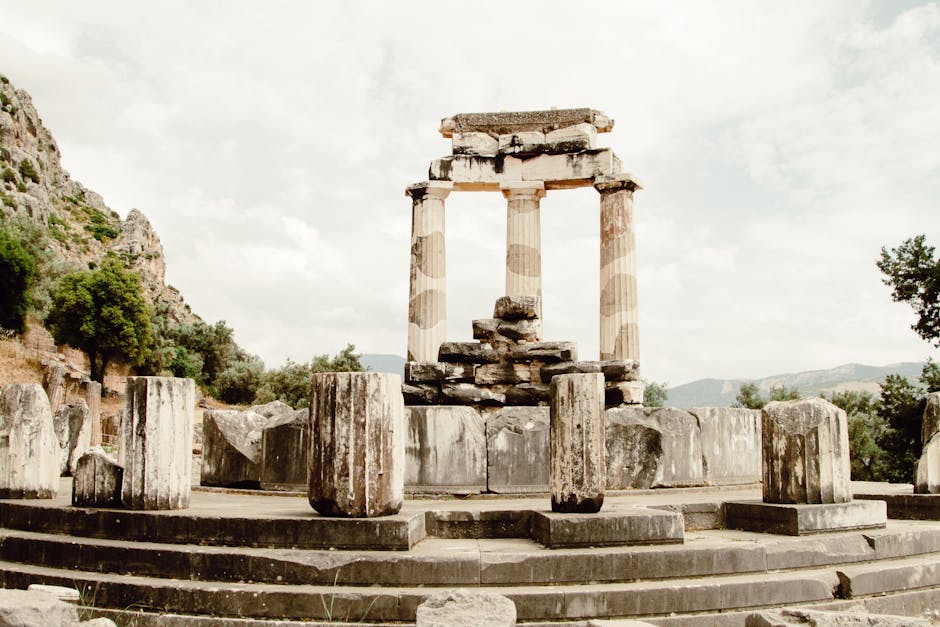
Apollo and Delphi
In the Homeric Hymn to Apollo, the god takes the form of a dolphin and leads a shipload of Cretan sailors to the site of his future oracle. The name Delphi and the Greek word for dolphin, delphis, sit together in that story.
Apollo’s dolphin epithet was Apollon Delphinios, and several Greek cities kept shrines to that aspect of the god.
Dionysus and the pirates
In the Homeric Hymn to Dionysus, Tyrrhenian pirates capture the young god intending to sell him into slavery. He reveals what he is, the crew go over the side in terror, and the sea turns them into dolphins.
That myth underpins a persistent Greek idea: that dolphins were once people, and are owed something because of it.
Coinage
Dolphins appear on coins from Syracuse, Tarentum, Olbia and a long list of other Greek and Greco-Roman cities. The Tarentine stater shows the young Taras riding a dolphin, a design the city used for centuries.
Sometimes the dolphin is a religious emblem, sometimes a civic badge marking a port city, and sometimes a reference to a local story about a boy carried by a dolphin.
Famous dolphin stories
Arion of Methymna, a poet of the seventh century BC, was thrown overboard by the crew of the ship carrying him home and, according to Herodotus, was picked up by a dolphin drawn to his singing and carried to shore at Taenarum.
The Romans kept collecting the same kind of story. Pliny the Elder, in the Natural History, tells of a dolphin in the Lucrine Lake in the reign of Augustus that attached itself to a poor boy travelling from Baiae to school at Puteoli, and carried him across the water. A separate account of a dolphin and a boy at Hippo in North Africa is mentioned briefly by Pliny the Elder and told in full by his nephew, Pliny the Younger, in a letter to the poet Caninius Rufus.
Dolphins in Greek thought
Aristotle got the biology substantially right in the Historia Animalium. He recorded that dolphins bear live young, breathe air through a blowhole, nurse their calves, and sleep at the surface with the snout above water. European zoologists would take until the eighteenth century to catch up with him.
Symbolically the dolphin sat with rescue, with the passage of souls, and with the boundary between the seen and the unseen world. It is a helpful animal in almost every story it appears in, which is not something Greek myth extends to many creatures.
Read next
- dolphin facts guide
- famous dolphins in history
- where to see wild dolphins today
- 25 dolphin tattoo ideas
Frequently asked questions
Why do dolphins appear so often in Greek mythology?
Greek seafaring brought people into contact with dolphins constantly, and the myths absorbed that: transformed humans in the Dionysus hymn, protective sea spirits in the Arion story.
What is the connection between Delphi and dolphins?
The Greek for dolphin is delphis, and the Homeric Hymn to Apollo has the god leading sailors to the oracle site in dolphin form. His epithet Apollon Delphinios records the same tradition.
Did Aristotle know dolphins were not fish?
Yes. In the Historia Animalium he recorded that they give live birth, breathe air, nurse their young and sleep at the surface, and he treated them as distinct from fish on those grounds.
Who was Arion?
A Greek poet of the seventh century BC. Herodotus records that he was thrown overboard and carried to shore by a dolphin drawn to his singing.
Are dolphins still important in modern Greek culture?
Yes. The dolphin remains a folk symbol on the Greek coast and a conservation focus, particularly in the Hellenic Trench and the Aegean.
Updated 25 October 2026: corrected the sources for the Hippo dolphin story.