
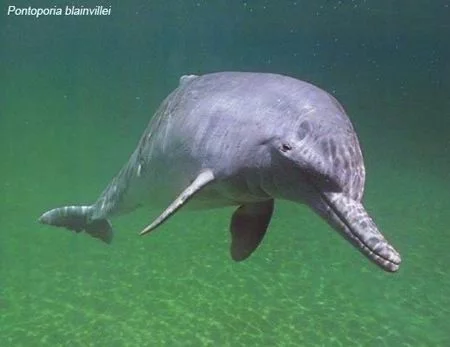
La Plata Dolphin (Franciscana): Facts, Habitat & Threats
The La Plata dolphin, known locally as the franciscana, is a river dolphin that never sees a river. It belongs to the same broad group as the Amazon and Ganges dolphins, yet it is the only one of them that lives in the sea and in saltwater estuaries. It is also tiny, and it carries the longest beak relative to body length of any cetacean alive.
Key facts at a glance
| Fact | Value |
|---|---|
| Common name | La Plata Dolphin (Franciscana) |
| Scientific name | Pontoporia blainvillei |
| Length | up to 1.6 m (males), up to 1.8 m (females) |
| Weight | up to about 50 kg |
| Diet | Carnivore: small fish, squid, octopus |
| Habitat | Shallow coastal Atlantic: southern Brazil, Uruguay, Argentina |
| Lifespan | up to about 20 years |
| IUCN status | Vulnerable (2017 assessment) |
| Other listings | CITES Appendix II; CMS Appendix I and II |
| Taxonomy | Artiodactyla | Pontoporiidae | Pontoporia |
A river dolphin in the sea
The franciscana sits in the Inioidea, the group that contains the Amazon river dolphin and its relatives, and it is the only member that has made its living in coastal salt water rather than in fresh water. Its range is a narrow strip of the western South Atlantic, running from Espirito Santo in Brazil south along the coasts of Uruguay and Argentina.
It is a shallow-water animal. Off the Brazilian coast it is typically recorded in water between about 8 and 30 metres deep, and it favours the turbid water near river mouths where visibility is close to nil. Genetically separate management units are recognised along the range, and they are treated as distinct populations for conservation purposes.
The range runs from around Itaunas in Espirito Santo, Brazil, at about 18 degrees south, to Peninsula Valdes in Argentina at about 42 degrees south, and the species stays within about 30 km of shore. Conservation planning divides it into four Franciscana Management Areas: FMA I in southeast Brazil (Espirito Santo and Rio de Janeiro), FMA II from Sao Paulo to Santa Catarina, FMA III covering Rio Grande do Sul and Uruguay, and FMA IV in Argentina.
That beak, and what it is for
In older adults the beak can account for as much as 15 percent of total body length, which is the highest ratio of any cetacean. It carries a formidable number of small teeth, between 48 and 61 on each side of each jaw, running to well over 200 in total. That combination, a long narrow snout crowded with fine teeth, is a grabbing tool built for small, quick prey: small fish, squid and octopus taken close to the seabed. In water that murky, echolocation is not an optional extra. It is the only sense doing useful work.
Stomach contents name the fish: anchovy, croakers, hake and weakfish, with squid and shrimp making up the rest. Most foraging happens near the bottom, and dives are short, typically under 90 seconds.
Behaviour
This is not a showy dolphin. Groups are small, the animals surface undramatically, and they do not approach boats. That reticence, combined with the cloudy water they live in, is why so much less is known about franciscana behaviour than about the coastal bottlenose dolphins that share parts of the same coast. The Guiana dolphin overlaps with it in southeast Brazil too.
Reproduction and life cycle
The franciscana runs a much faster life history than most dolphins. Both sexes reach sexual maturity at around two to three years old, though some populations take up to five. Gestation is 10 to 11 months, calves are born at 70 to 75 cm, and weaning happens at about a year. Females follow a roughly two-year reproductive cycle, and in one well-studied Brazilian population most births fell between September and February, the austral spring and summer. Lifespan tops out around 20 years.
Breeding early and often should make a species resilient. It has not been enough here, which tells you how heavy the losses are.
Threats and conservation
The IUCN Red List classifies the franciscana as Vulnerable. The dominant threat is not in dispute: large numbers are killed as incidental catch in coastal gillnets. The largest documented catches in the 1970s were in Uruguay, and catches in recent decades have also been high in southern Brazil and Argentina. Scientists in all three countries have asked for international help in raising the profile of the problem.
Pollution compounds it. Plastic debris and synthetic material have been found in the stomach contents of franciscanas, although whether that is causing measurable harm to the population has not been established.
We have not found a reliable global population estimate for this species, and the annual bycatch figures that circulate online rarely come with a traceable source. If you know of a current published estimate, leave a comment and point us at it. We would rather print a sourced number than a confident one.
How you can help
Gillnets are the whole story for this species, and gillnets are exactly the gear type that sits outside most consumer-facing labelling schemes. Pressure on artisanal and coastal net fisheries in Brazil, Uruguay and Argentina, and support for the acoustic deterrent and gear modification trials being run there, is the intervention that matters. The franciscana is listed on both Appendix I and Appendix II of the Convention on Migratory Species, which gives the three range states a shared framework to work inside.
Acoustic pingers fitted to artisanal gillnets have been trialled in Argentina, where they reduced franciscana bycatch, but uptake has been patchy because the devices cost money that small-boat fisheries do not have. The species has never done well in captivity, so there is no captive population to fall back on.
For related species, see our other dolphin species profiles, or our dolphin conservation guide for the wider picture.
Frequently asked questions
Is the franciscana a river dolphin or a marine dolphin?
Both, in a sense. It belongs to the river dolphin group Inioidea by ancestry, but it lives in coastal salt water and estuaries, and it is the only member of that group that does.
How big is a La Plata dolphin?
Males reach about 1.6 m and females about 1.8 m, at up to roughly 50 kg. It is one of the smallest dolphins in the world.
How long does it live?
Up to about 20 years, which is short for a dolphin. It also matures unusually early, at two to three years old.
Where does it live?
The coastal Atlantic of southeastern South America, from Espirito Santo in Brazil south through Uruguay to Argentina, usually in water between about 8 and 30 metres deep.
Is the La Plata dolphin endangered?
It is listed as Vulnerable by the IUCN. Bycatch in coastal gillnets is the main driver.
Sources and further reading
- IUCN Red List entry for Pontoporia blainvillei
- Convention on Migratory Species species page for Pontoporia blainvillei (Appendix I since 1997, Appendix II since 1991)
- Reeves, Smith, Crespo and Notarbartolo di Sciara, Dolphins, Whales and Porpoises: 2002 to 2010 Conservation Action Plan for the World’s Cetaceans, IUCN
Updated 25 October 2026: removed a Guanabara Bay decline figure that belongs to the Guiana dolphin, not the franciscana. We also merged our franciscana dolphin guide into this profile, adding the range limits, the four management areas, the named prey and the pinger trials.


Very interesting!
Yet another fascinating species that I have never heard of.
So interesting and they’re so cute! I hope to see a dolphin in person some day!