
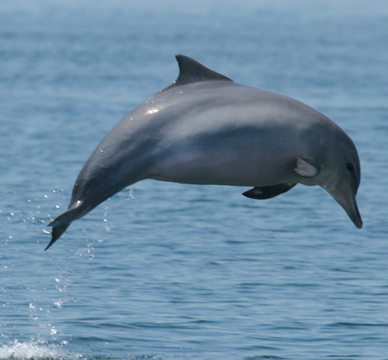
Guiana Dolphin: Facts, Habitat & Conservation Guide
The Guiana dolphin is the coastal, saltwater member of the genus Sotalia. Its only close relative is the tucuxi, a freshwater dolphin of the Amazon basin, and the two were treated as one species until genetic and morphological work separated them in the 2000s. Despite the shared river country, neither is related to the Amazon river dolphin, which belongs to a completely different family. The Guiana dolphin’s real claim to fame is stranger than any of that: it is one of the very few mammals known to hunt by electroreception.
Key facts at a glance
| Common name | Guiana dolphin |
| Scientific name | Sotalia guianensis |
| Max length | Around 2.1 m |
| Max weight | Around 120 kg |
| Diet | Carnivore: small fish, shrimp, squid |
| Habitat | Coastal and estuarine waters of Central and South America |
| Lifespan | 30 years or more, with individuals documented past 40 |
| Population | No range-wide estimate; counts are local and fragmented |
| IUCN status | Near Threatened |
| Taxonomy | Artiodactyla | Delphinidae | Sotalia |
Range and habitat
Guiana dolphins run along the Atlantic coast of Central and South America, from Honduras and Nicaragua south to southern Brazil. They stick to bays, estuaries, and shallow coastal water, usually within about 10 km of land and strongly favouring depths under 30 m. That is a narrow band of habitat, and it happens to be exactly the band where ports, cities, and coastal fisheries sit.
Hunting with electricity
The diet is small fish, with shrimp, squid, and crabs filling in. More than sixty fish species have been recorded, most of them under 20 cm. Groups of two to six hunt cooperatively in the surf zone and inside estuaries, occasionally gathering into much larger feeding aggregations.
The interesting part is how they find prey in muddy estuary water where echolocation gets noisy. Rows of small pits on the rostrum, left over from the whiskers a calf is born with, hold sensory structures that detect the weak electric fields given off by living fish. Electroreception is common enough in sharks and rays but almost unknown in mammals: the platypus and the echidna have it, and the Guiana dolphin evolved its version quite separately. A 2023 study showed that bottlenose dolphins can also sense weak electric fields, so the ability may be more widespread among toothed whales than once thought.
Social life
Groups are small, typically two to six animals. They breach and spy hop readily but tend not to approach boats, which makes them harder to study than a bow riding species. In the Cananeia estuary in Brazil, researchers have recorded them feeding around fishermen’s fixed traps in ways that help both sides. Brazil’s best-known partnership of this kind, where dolphins drive mullet towards cast-net fishers at Laguna, involves Lahille’s bottlenose dolphins instead. Photo identification studies in Sepetiba Bay and Babitonga Bay have followed named individuals for more than two decades.
Threats and conservation
The IUCN lists the Guiana dolphin as Near Threatened, and it is on CITES Appendix I. Bycatch in coastal gillnets is the biggest single killer, and because the species never leaves the inshore strip, there is nowhere for it to go to avoid the gear.
Estuary pollution is the second problem. Mercury, PCBs, and other persistent contaminants concentrate in exactly the enclosed bays this dolphin prefers, and the Sepetiba Bay population near Rio de Janeiro is among the most contaminated cetacean groups ever measured. Port expansion along the Brazilian coast adds a third pressure by cutting local populations off from one another, and small isolated groups recover badly from anything.
Frequently asked questions
What is the difference between a Guiana dolphin and a tucuxi?
Habitat and size. The Guiana dolphin (Sotalia guianensis) is marine and coastal and roughly twice the mass of the tucuxi (Sotalia fluviatilis), which lives in the fresh water of the Amazon basin. They were treated as one species until genetic work in the 2000s split them.
Can dolphins really sense electricity?
The Guiana dolphin can. Sensory pits on its beak pick up the weak electric fields produced by fish, which is useful in the murky estuary water it hunts in.
Where do Guiana dolphins live?
Coastal and estuarine waters from Honduras and Nicaragua down to southern Brazil, almost always within about 10 km of shore. In southern Brazil it shares the coast with the La Plata dolphin, or franciscana.
Is the Guiana dolphin endangered?
It is listed as Near Threatened, one step below the threatened categories. Gillnet bycatch and estuary pollution are the reasons it sits there rather than at Least Concern.
Sources and further reading
- IUCN Red List entry for Sotalia guianensis
- Czech-Damal and colleagues, 2012, on passive electroreception in the Guiana dolphin
- Society for Marine Mammalogy taxonomy list
Updated 25 October 2026: corrected the cooperative fishing example, which belongs to bottlenose dolphins at Laguna, and updated the electroreception research.

Fascinating info.
A dolphin that senses electric fields like a shark does? That should be the headline. Never heard that before.