How Dolphins Breathe: Blowhole, Lungs and Oxygen
A dolphin spends its whole life in water, yet it cannot breathe it. Every breath goes through one opening on top of the head, and a dolphin has to come up to use it. Each trip to the surface is short, and the whole system is built around making it count.
In a standard description of dolphin anatomy, a breath is an upward blast of stale air out of the blowhole, sometimes visible in cold air, followed by fresh air drawn into the lungs. That sentence hides a lot of engineering. Here is what happens in each part.
The blowhole is a sealed nostril
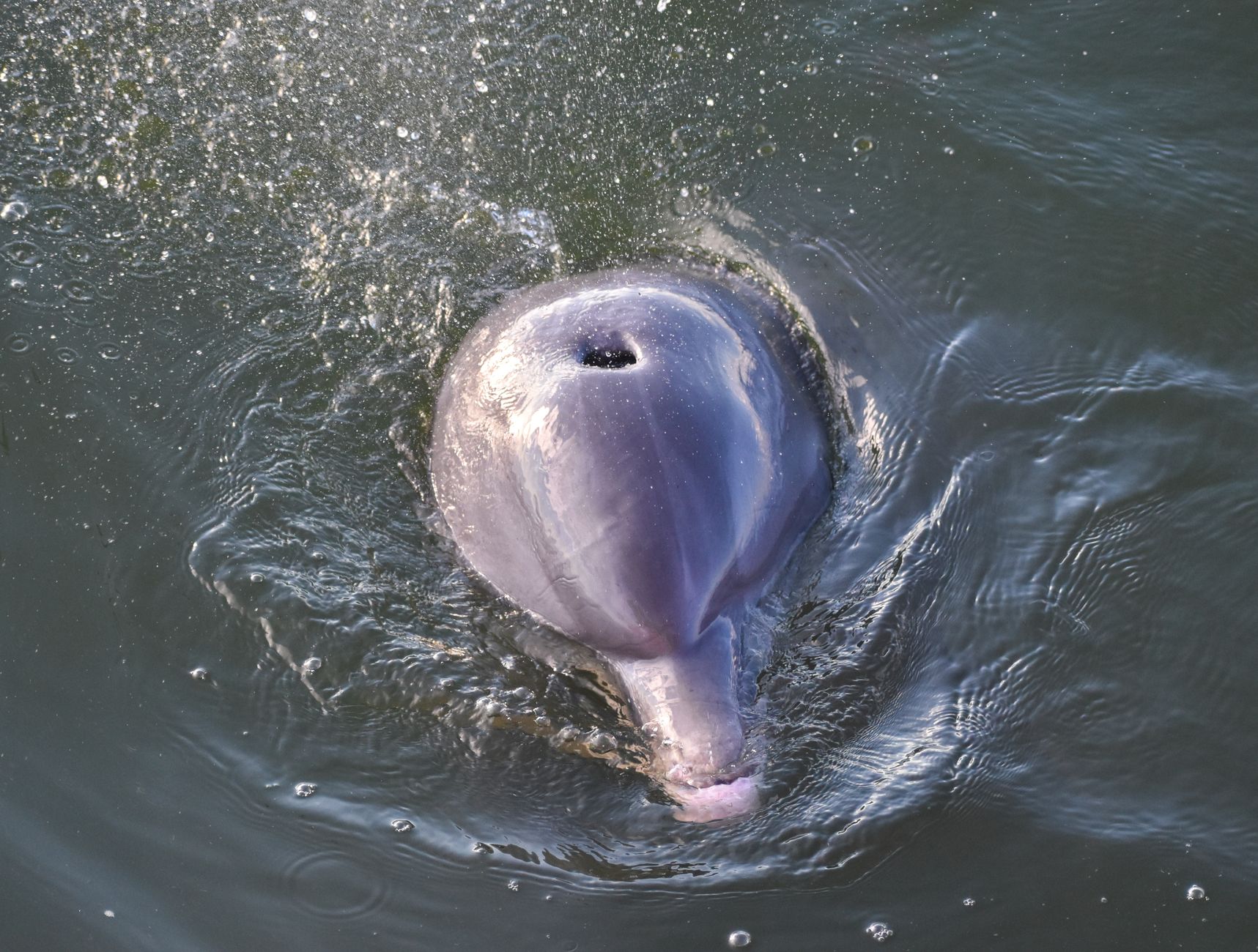
A dolphin’s nose moved to the top of its head over evolutionary time, so the nostril sits where the animal breaks the surface first. A dolphin has one blowhole, not two like a baleen whale. It is closed by default. A plug of tissue keeps it shut underwater, and muscles open it only when needed.
The Wikipedia article on the blowhole describes the control this way: the muscles holding the nasal plug are relaxed while the animal is submerged, and when it comes up for air those muscles contract, the blowhole opens, and exhalation and inhalation happen. The seal is the default and the opening is the effort.
The same region has a second job. Dolphins make sounds with nasal air sacs located just below the blowhole, so the airway that handles breathing also feeds the whistles and clicks covered in our posts on signature whistles and echolocation.
What one breath looks like
Exhale comes first, then inhale. Researchers studying belugas and false killer whales counted a normal breath as one that began with an exhalation followed by an immediate inspiration. In that same study the expiratory flow averaged about 30% higher than the inspiratory flow. The air leaves faster than it arrives, which fits the quick puff you see at the surface.
The pace of breathing depends on what the dolphin is doing. National Geographic says bottlenose dolphins surface often to breathe, two or three times a minute. Measurements from tested dolphins vary with the setting. In a 2018 study of four wild dolphins near Bermuda, the average was 5.9 breaths a minute during trials. The authors compared that with earlier studies of resident Sarasota dolphins, which found about 2.9 breaths a minute. The authors suggest diving habits and stress may both move the number, so treat any single figure as a snapshot, not a rule.
NOAA Fisheries describes resting bottlenose dolphins as moving slowly in tight groups with intervals of methodical breathing. That matches what watchers see from a boat: a calm, regular rhythm while the pod rests, and shorter gaps when the animals are active.
Big breaths, few of them
A dolphin does not breathe like a land mammal of the same weight. A 2020 study in Frontiers in Physiology notes that, once body mass is accounted for, marine mammals generally breathe less often and move a larger volume of air per breath. The study adds that marine mammals tend to have more compliant lung tissue and a rib cage that lets the alveoli compress and collapse without apparent trauma. In plain terms, the lungs can be squeezed at depth and recover.
For bottlenose dolphins, the Bermuda study measured a tidal volume of about 23 ml per kilogram of body mass. That was the same as in coastal dolphins, which suggests the basic breathing pattern is shared across populations even when the dive habits differ.
Storing oxygen instead of air
A lungful of air is only part of the supply. Dolphins also store oxygen in blood and muscle. The same overview says their blood and muscle hold oxygen using hemoglobin and myoglobin, and that they carry twice as much myoglobin as hemoglobin. It also says some dolphins can selectively slow their heart rate to conserve oxygen.
Blood chemistry changes with lifestyle. The Bermuda team found that offshore dolphins had a hematocrit, the share of blood made of red cells, of 56%, against a range of 30 to 49% in shallow-diving bottlenose dolphins. The authors link the higher value to greater oxygen storage and longer aerobic dives. Lung size looks different. The paper notes that deep divers may have relatively small lungs, because less air at depth means less nitrogen taken up into the body.
Breathing while asleep
A dolphin has to keep breathing while it rests, so it sleeps half a brain at a time. A review in Nature and Science of Sleep says unihemispheric sleep lets dolphins, eared seals and manatees keep the benefits of sleep, breathing, thermoregulation and vigilance, and that for cetaceans it is the only way to sleep.
There is also a backup. In dolphins under human care, a tail kick reflex keeps the blowhole above the water if necessary, so respiration carries on without waking the animal. Our post on how dolphins sleep without drowning covers the sleep side in more detail.
When breathing goes wrong
Because every breath crosses the surface, anything that harms the lungs hits a dolphin hard. NOAA notes that bottlenose dolphins in areas affected by the 2010 Deepwater Horizon oil spill were found to have an impaired stress response, lung disease and reproductive failure, among other conditions. Our post on dolphin strandings: causes and rescue covers what happens when a dolphin ends up out of the water.
Not every question has an answer yet. Most breathing data comes from a small number of animals, often in managed care, and the studies themselves caution about the variation between individuals. Expect the numbers above to be refined.
Have you watched a dolphin surface from a boat or shore, and counted the breaths? Tell us what you saw in the comments.
Sources
- Dolphin, Wikipedia
- Blowhole (anatomy), Wikipedia
- Bottlenose dolphin, National Geographic
- Resting Metabolic Rate and Lung Function in Wild Offshore Common Bottlenose Dolphins, Frontiers in Physiology, 2018
- Comparative Respiratory Physiology in Cetaceans, Frontiers in Physiology, 2020
- Unihemispheric sleep and asymmetrical sleep, Nature and Science of Sleep, 2016
- Common bottlenose dolphin, NOAA Fisheries