Dolphin Senses: Taste, Smell and Electric Sense Explained
A dolphin has no nose to speak of, a mouth that may barely register salt, and a face covered in sensors that people only discovered in this century. Most guides to dolphin senses stop at sound. The less famous senses are stranger, and the research on them is still arguing with itself.
This guide covers what the evidence says about taste, smell, touch, electric sense and sight. Where scientists disagree, I say so.
Smell: the sense most toothed whales have lost
Start with the blank spot. A 2026 genetic study by Springer, McGowen and Gatesy opens with a blunt line: living toothed whales are the only extant mammals that lack anatomical features associated with olfaction. A bottlenose dolphin has no olfactory nerves and no olfactory lobe in its brain, and its blowhole stays shut underwater, so there is no sniffing route anyway (Wikipedia’s bottlenose dolphin entry summarises the anatomy).
The more interesting question is how the loss happened. One idea says the common ancestor of all toothed whales lost smell in one go. The 2026 team checked three olfaction genes in 65 toothed whale species, 14 baleen whales and 28 outgroup species. No damaging mutation was shared by every toothed whale. Fifty-four of the 65 toothed whales carried at least one gene-disabling mutation. All 11 species with none were beaked whales.
The authors conclude that smell faded gradually across the toothed whales, then switched off completely in separate lineages. Dolphins are one of those lineages. For a deeper look at how their ancestors got to the water, see our guide to how dolphins evolved from land mammals.
Taste: a sense that researchers still disagree about
Taste is where it gets messy. A 2025 paper in Communications Biology reviewed earlier genetic work and noted that sweet and bitter receptor genes have been disabled in cetaceans. Those earlier studies led some researchers to conclude that salty is the only taste a dolphin could sense.
The same team then tested the salty idea. Working with bottlenose dolphins and beluga whales in human care at the Oceanogràfic in Valencia, they offered sodium-containing and sodium-free stimuli. The animals showed no behavioural difference between the two. The paper also found that a salt-sensing gene called SCNN1D is a pseudogene in cetaceans, meaning it no longer works. Their reading is that this sodium sensor may have become pointless in salty seawater.
The authors still call the question open: whether cetaceans have a functional gustatory system and can taste sodium remains controversial. Wikipedia’s bottlenose dolphin entry lists four tastes (salty, sweet, bitter and sour) but adds that this has not been well studied. Treat any single confident number of dolphin tastes with suspicion.
The urine study: taste used for recognition
Even with a reduced palate, taste does something. In 2022, Bruck, Walmsley and Janik tested bottlenose dolphins in Science Advances. Dolphins could tell water from urine, and they could tell urine from familiar dolphins from urine of strangers.
Then the team paired a recording of a dolphin’s signature whistle with a urine sample. When the whistle and the urine came from the same animal, the dolphins investigated the spot for longer than when they came from different animals. The authors say this shows dolphins recognise other individuals by taste alone, and can link taste with sound.
That result sits neatly beside our post on signature whistles and whether dolphins have names. A whistle works like a label, and the urine study suggests the label points to the same individual whether the dolphin hears it or tastes it.
Touch and the electric sense
Here the surprise comes from the Guiana dolphin. In 2012, Czech-Damal and colleagues reported that hairless pits on the rostrum, called vibrissal crypts, work as electroreceptors. These pits are the remains of whisker structures that nearly all mammals have.
The test used one male Guiana dolphin. It detected weak electric fields down to 4.6 microvolts per centimetre, which the paper calls comparable to the sensitivity of the platypus. A 2013 review adds that the only mammals known to have electroreception are the platypus, the echidnas and the Guiana dolphin. Both the platypus and the dolphin use it to find prey when visibility is poor or when digging in the substrate.
One caution. The measurement came from a single Guiana dolphin, so how widely other dolphin species share this sense is not settled.
Sight and sound: the senses we already know
Sound still does the heavy lifting. NOAA notes that bottlenose dolphins use passive listening and high frequency echolocation to locate prey. Our explainer on how dolphin echolocation works covers the mechanics.
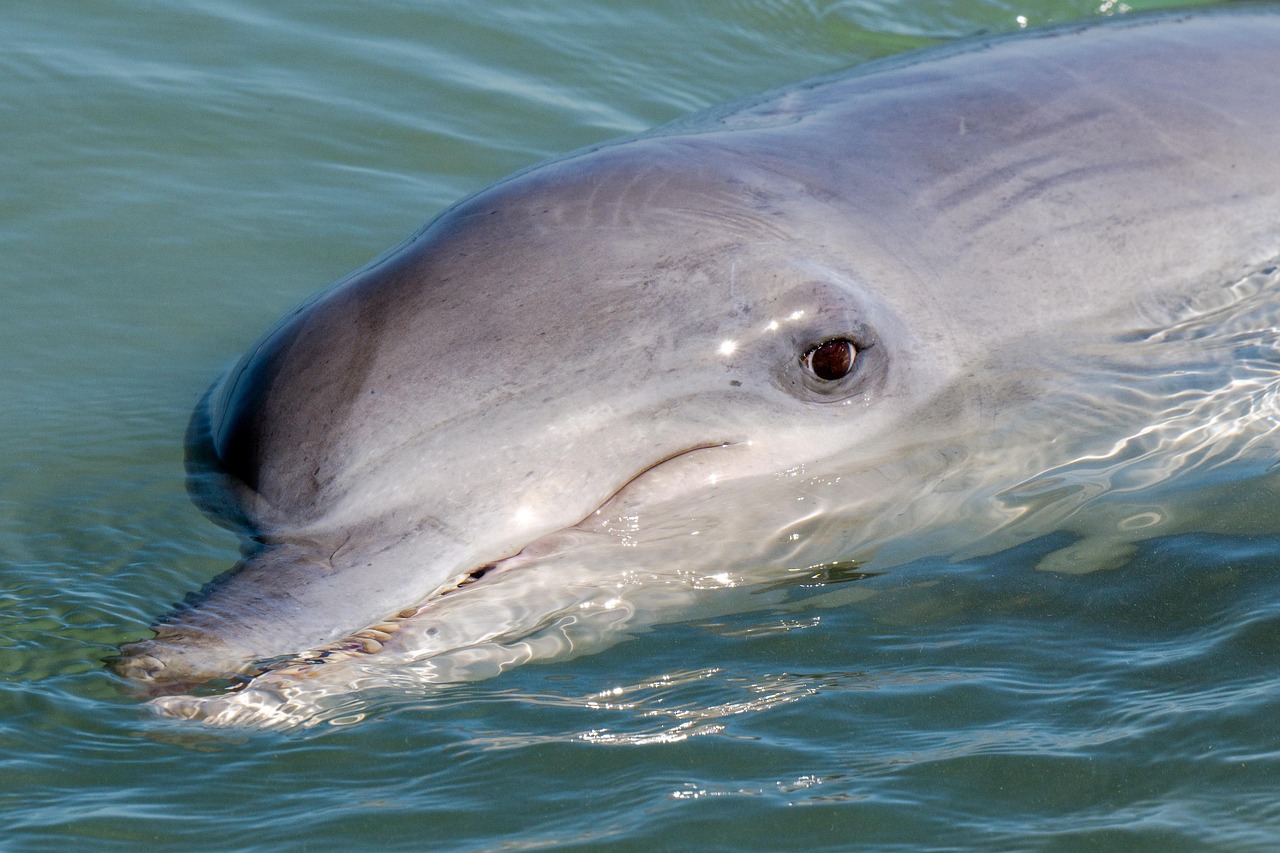
Vision is better than its reputation. The eyes sit on the sides of the head, with a reflective layer behind the retina that helps in dim light. The horseshoe-shaped pupil helps with focus in air and in water so a dolphin sees well in both (see the senses section of the Wikipedia entry).
What this means when you meet a dolphin
- Smell: almost certainly none, and the anatomy backs that up.
- Taste: limited, and scientists disagree on how limited.
- Taste for recognition: real, at least for urine from known dolphins.
- Electric sense: proven in the Guiana dolphin, unproven for most other species.
- Sound and sight: the main tools for hunting and for keeping a group together.
A dolphin is not a sniffing, tasting animal in the way a dog is. It builds its picture of the world from sound first, then sight, then a few quiet senses we are only starting to measure.
If you know of research on dolphin senses that I missed, add it in the comments.
Sources
- The evolutionary path of the epithelial sodium channel δ-subunit in Cetartiodactyla points to a role in sodium sensing (Communications Biology, 2025)
- Molecular Evidence for the Parallel Evolution of Anosmia in Multiple Odontoceti Clades (Genes, 2026)
- Cross-modal perception of identity by sound and taste in bottlenose dolphins (Science Advances, 2022)
- Electroreception in the Guiana dolphin (Sotalia guianensis) (Proceedings of the Royal Society B, 2012)
- Passive electroreception in aquatic mammals (Journal of Comparative Physiology A, 2013)
- Common Bottlenose Dolphin, NOAA Fisheries
- Bottlenose dolphin, Wikipedia
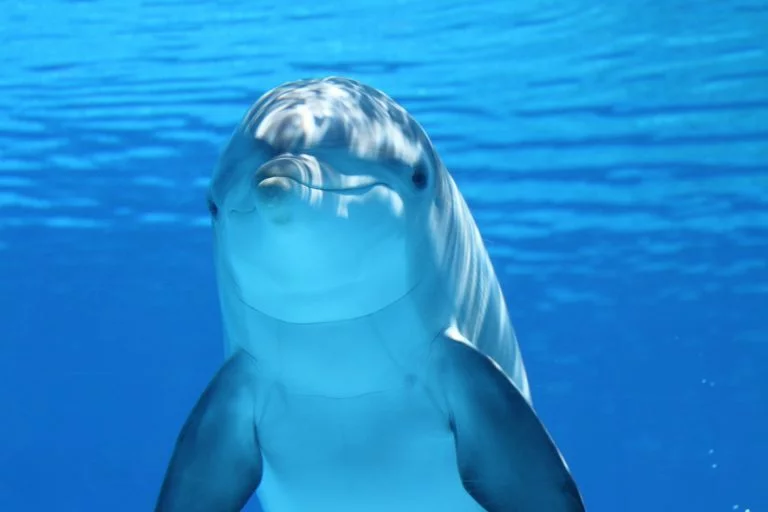
Photo: xiSerge, Pixabay Licence, via pixabay.com.