
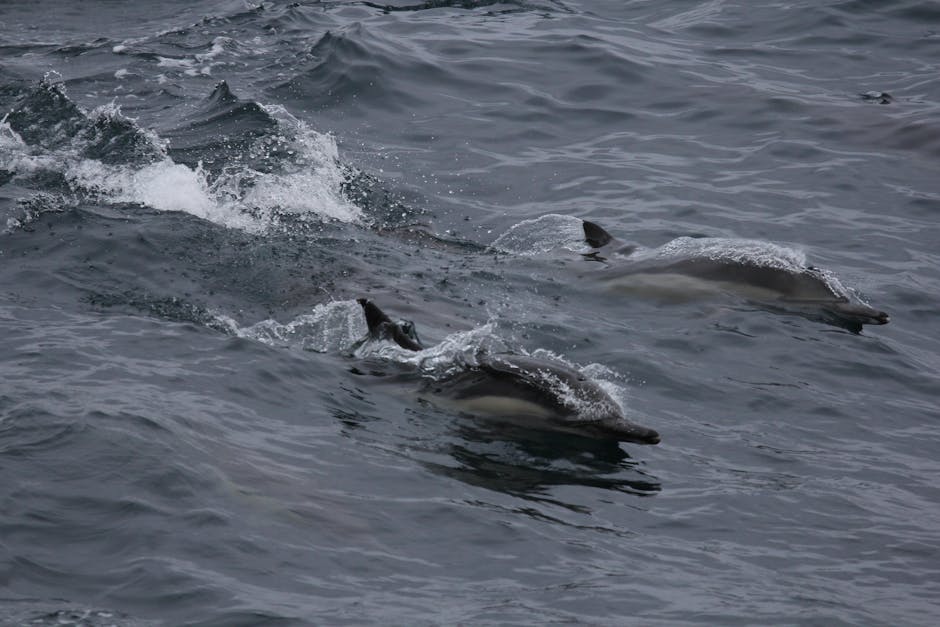
Pacific White-Sided Dolphin: Pod Dynamics in the North Pacific
The Pacific white-sided dolphin is the one you are most likely to meet on a cool-water whale watching trip from British Columbia, southeast Alaska or California. Fast, noisy, endlessly airborne, and often in numbers that make counting pointless.
Key facts
| Scientific name | Aethalodelphis obliquidens, long known as Lagenorhynchus obliquidens |
| Length | 2.3 to 2.5 m |
| Weight | 90 to 150 kg |
| Lifespan | Around 40 to 45 years |
| Range | Cool North Pacific, Bering Sea to southern California and across to Japan |
| IUCN status | Least Concern |
The name changed in 2025
Older books put this animal in Lagenorhynchus. Genetic work broke that genus up, and in 2025 the Pacific white-sided dolphin and the dusky dolphin were moved into a new genus, Aethalodelphis. Same dolphin, new label, and the old name will stay in print for years.
What it looks like
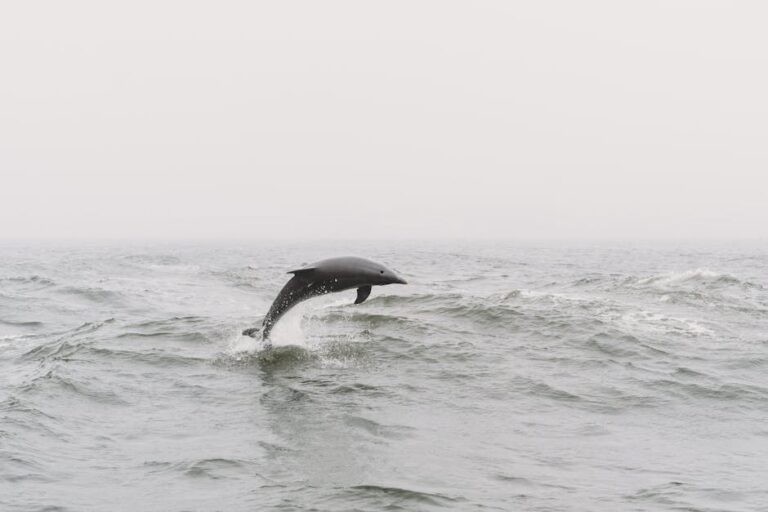
Dark grey back, white belly, and pale grey stripes that sweep from behind the eye back along the flank. The giveaway is the dorsal fin: tall, strongly hooked, and two-tone, dark at the front with a pale trailing section.
Its closest look-alike, the dusky dolphin, never shares water with it. One is North Pacific, the other Southern Hemisphere, so location settles the identification before the markings do.
Range
From the Bering Sea down the Aleutians, through the Gulf of Alaska, British Columbia, Washington, Oregon and California, and westward to northern Japan by way of the Kuril Islands. It is a shelf and shelf-edge animal that does not enter tropical water.
Pods and super-pods
Groups run from a handful of animals to over a thousand. The large aggregations mix readily with other species, particularly northern right whale dolphins and Risso’s dolphins, and they turn up alongside feeding gray and humpback whales wherever herring or krill is thick enough to be worth crowding.
Bow-riding, leaping and somersaulting are constant. Off coastal British Columbia they feed in coordinated lunges on schooling fish, which is the behaviour most trips are actually watching without realising it.
Diet
Anchovy, sardine, hake, herring, mackerel and squid, with the balance shifting by region. Market squid is a staple off California; herring and pollock dominate further north. Dives are short and shallow, usually under 100 m, because schooling prey does not require anything deeper.
Reproduction
Females mature at around nine to eleven years and have a single calf every three to five years, with calving peaking in summer in the temperate part of the range. Mother and calf stay tight for the first year, after which the calf works its way into the wider group.
Threats
The historical disaster was the high-seas driftnet fishery, which killed tens of thousands of them through the 1980s. The UN moratorium on large-scale driftnets, agreed in 1991 and in force from the end of 1992, ended most of that.
The species is Least Concern today, which is a statement about numbers rather than about safety. Coastal gillnets still take animals off Japan and the US west coast, and persistent pollutants and shipping noise sit underneath as slower problems.
Where to see them
Monterey Bay, the Strait of Juan de Fuca, Johnstone Strait and the Inside Passage are the reliable North American sites, and the seas off northern Japan hold them on the other side of the ocean. Winter into spring is the better window in the south of the range.
Frequently asked questions
Are Pacific white-sided dolphins endangered?
No. They are listed as Least Concern and remain abundant, though gillnet bycatch continues.
Are they the same as Atlantic white-sided dolphins?
No. Different species, different ocean. They were both lumped into Lagenorhynchus historically, and genetic work has since separated the group into several genera.
How big do they get?
2.3 to 2.5 m and 90 to 150 kg, so about the size of a large bottlenose dolphin but slimmer.
Its southern counterpart is covered in our dusky dolphin profile.


Saw a big group of these from the ferry in BC this summer. They were everywhere for about ten minutes.