

Spin the Wheel of Knowledge: A Trivia Quiz on Spinner Dolphins
The spinner dolphin earns its name in the most spectacular way possible. It launches clear of the water and rotates its whole body about its long axis, and a single leap can carry as many as seven full turns. Only its close relative, the Clymene dolphin, spins in the same way, and with fewer turns. Below is a profile of the species, what is known about why it spins, and a ten-question quiz at the end.
The spinning acrobat of the tropics
The spinner dolphin, Stenella longirostris, is a small slender member of the oceanic dolphin family found in warm seas around the world. Its trademark move is the aerial spin: the animal rushes upward, breaks the surface, corkscrews through the air, then crashes back down, often repeating the whole thing several times in quick succession. Two to seven rotations per leap have been recorded, with the count depending on how fast the dolphin is swimming and how fast it is turning as it leaves the water.
Why an animal would spend that much energy on it is not settled. Researchers have put forward several overlapping explanations:
- Shedding hitchhikers. The hard slap of re-entry may knock loose remoras and other clinging parasites.
- Acoustic signalling. A spinning, splashing dolphin makes a burst of noise other pod members can hear, which may carry information about position or intent.
- Courtship and play. Young animals spin more, and the behaviour tends to spread through a group once one starts.
The likeliest answer is that it does several of these jobs at once rather than one.
Size, shape and colouring
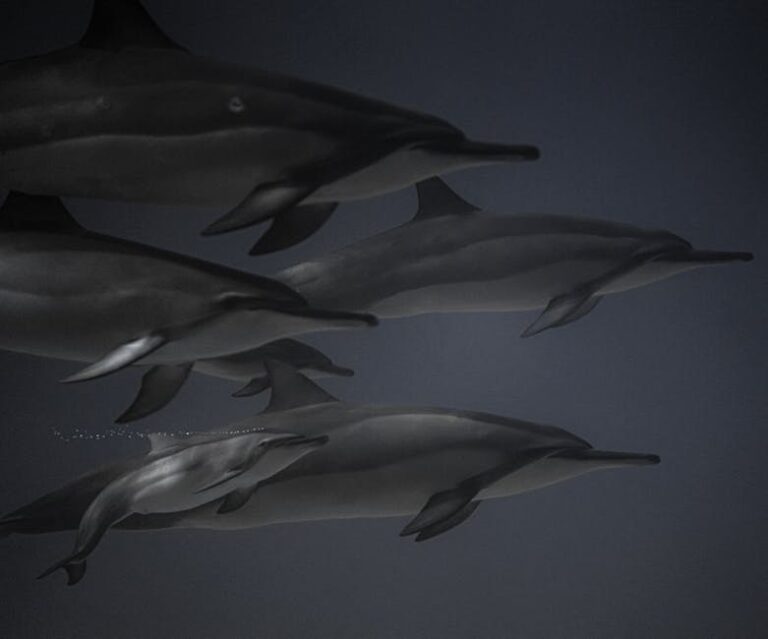
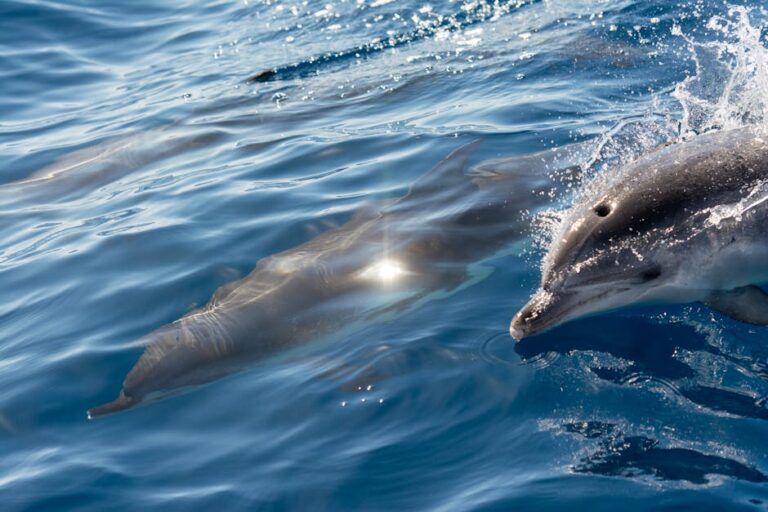
Spinner dolphins are among the smaller dolphins. Adults measure roughly 1.3 to 2.35 m (about 4 to 7.5 feet) and weigh anywhere from 23 to 79 kg (about 50 to 175 pounds), so a big adult is not far off three times the weight of a small one. The beak is exceptionally long and thin, which is what the species name longirostris, long-snouted, refers to.
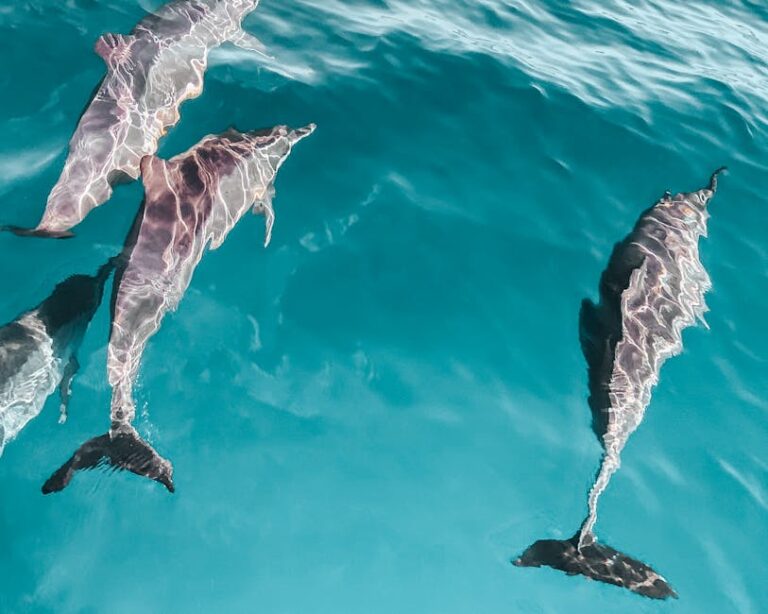
Colouring follows a three-part pattern called countershading: dark grey along the back, paler grey along the sides, and a white or cream belly. It is camouflage. From above, against the dark ocean, the back disappears. From below, against the bright surface, the belly does. The same trick is used by most open-water hunters and by plenty of the animals they hunt.
A day in the life
Spinner dolphins run on a strict daily clock. By day they gather in calm sheltered water, typically shallow sandy bays and lagoons, and rest there for four or five hours. Resting for a dolphin is not sleep as we know it: they shut down half the brain at a time so they can keep surfacing to breathe.
At dusk the pattern flips. The pods move offshore into deep water to hunt small fish, shrimp and squid, most of it drawn from the deep scattering layer that rises toward the surface after dark. They feed through the night and are back in the bays by morning. Everything about their conservation follows from that timetable.
Big pods, loud conversations
Spinner dolphins are intensely social and their groups can be enormous, sometimes running into the hundreds or beyond. Membership is fluid, with animals joining and leaving in the pattern researchers call fission-fusion, and family groups also associate well outside their immediate pod.
Holding a group like that together needs a lot of signal: clicks for echolocation, whistles for contact and identification, and a constant running commentary of body language, including the spins, slaps and leaps visible from the surface.
Conservation status
The IUCN lists the spinner dolphin as Least Concern, but that is not the whole story. From the 1950s onward, purse-seine tuna fishing in the eastern tropical Pacific killed hundreds of thousands of spinner dolphins, because yellowfin tuna swim beneath dolphin pods and fleets set their nets around the dolphins to find the fish. Over roughly three decades it took out something like half the eastern population, which is still classed as depleted under the US Marine Mammal Protection Act. Dolphin-safe standards were introduced in response.
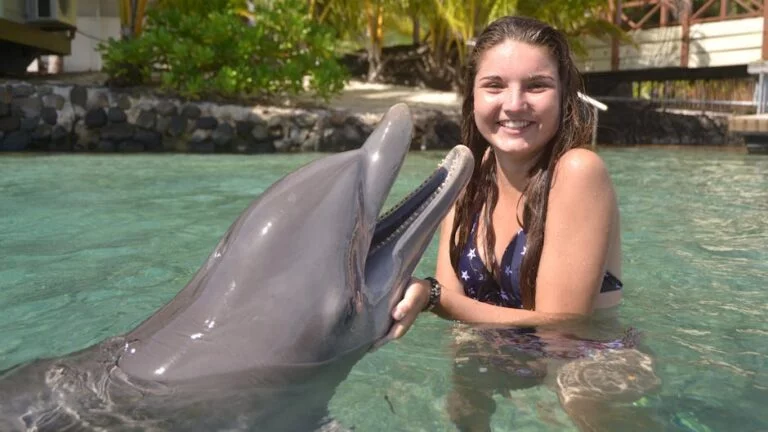
The current pressure is tourism. Because the resting bays are predictable, swim-with operations can crowd them during exactly the hours the animals need to be left alone. Protection now centres on marine protected areas and approach rules that keep those bays quiet.
Test yourself: spinner dolphin trivia
Ten questions, answers directly underneath each one. No peeking.
Question 1: How long is a typical adult spinner dolphin?
Roughly 1.3 to 2.35 m, or about 4 to 7.5 feet.
Question 2: Why do spinner dolphins spin?
It is not settled. The leading ideas are shedding parasites, acoustic signalling, and courtship or play.
Question 3: Where are spinner dolphins found?
Tropical and subtropical seas worldwide.
Question 4: What is a group of spinner dolphins called?
A pod.
Question 5: What do they eat?
Small fish, shrimp and squid, taken at night in deep water.
Question 6: How many spins can one leap contain?
Two to seven.
Question 7: What is the body colour pattern called?
Countershading: dark grey back, pale grey sides, white belly.
Question 8: What is the species’ IUCN status?
Least Concern, though the eastern tropical Pacific stock is listed as depleted in the United States.
Question 9: How do they communicate?
Clicks, whistles and body language.
Question 10: What is the main modern threat?
Disturbance of the daytime resting bays by tourism, on top of the historical tuna fishery mortality.
More than a pretty jump
Protecting spinner dolphins means protecting the quiet bays they sleep in, not only the open water they hunt in. If you want the behaviour in more depth, read our spinner dolphin behaviour guide, and for the rules that now govern getting close to them, see protecting spinner dolphins in Hawaii.
Updated 25 October 2026: corrected the claim that no other dolphin spins and the scale of tuna fishery deaths.
Watched a pod off Lanai once on an early morning boat. Could have stayed out there all day.
seven turns in one leap sounds unreal. is that common or just the record?
Seven is the top end of what has been seen. Most leaps have fewer turns than that.
10/10! my daughter and I watched a pod off the Kona coast for ages. one little one kept trying half spins like it was still learning.