
White Killer Whales: Legend, Myth, Or Real?
An all-white killer whale sounds like something from a sailor’s tall tale. Then a research team in the western North Pacific photographed one, and the story stopped being a legend.
Iceberg
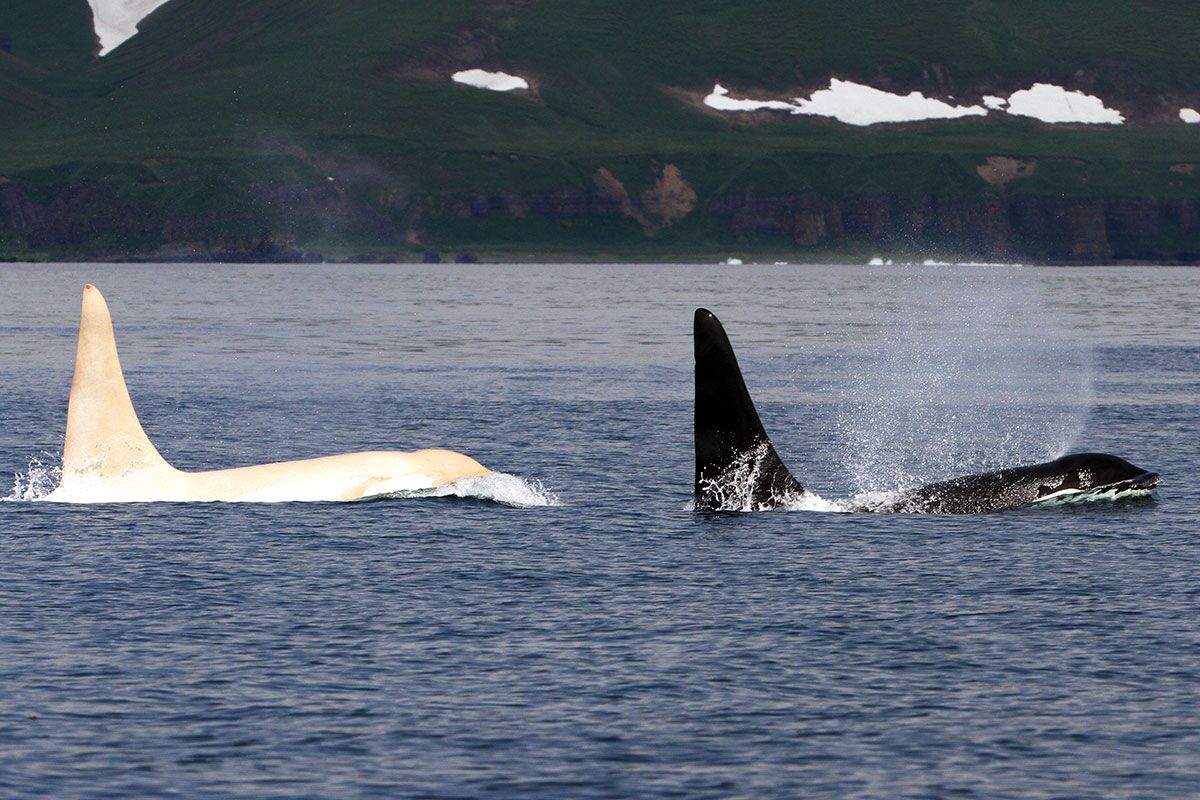
In August 2010, researchers from the Far East Russia Orca Project were working near the Commander Islands in the Bering Sea when a two-metre white dorsal fin came up beside the boat. The animal beneath it was an adult male orca, entirely white. They named him Iceberg.
The project is co-founded by Alexander Burdin and Erich Hoyt, and the sighting was made public in 2012. Iceberg was not seen for several years afterward and was assumed dead, until the team photographed him again with his pod in 2016. He also appears in our roundup of famous killer whale videos and the stories behind them.
Albino, or just white?
This is still open. FEROP has not been able to get a tissue sample from Iceberg, so nobody has confirmed whether his colouring is albinism, which prevents pigment production entirely and typically comes with pink unpigmented eyes, or leucism, a partial loss of pigment that leaves the eyes normal. Iceberg has some colour behind the dorsal fin, which does not sit easily with true albinism. Until somebody gets a sample, both explanations remain on the table.
He is not the only white orca on record. Scientists have suggested Iceberg may be the same animal as a white whale seen off Alaska in 2000 and again in 2008. In 2016 five white killer whales were reported together in the region, which is a startling number for something this rare.
Chimo, and why white is not usually good news
A white orca had been studied in captivity long before Iceberg. Chimo was caught at Pedder Bay in the Salish Sea in 1970 and kept at Sealand of the Pacific in Oak Bay, British Columbia. She died in 1972 of complications from Chediak-Higashi syndrome, a genetic disorder linked to her albinism that suppresses immune function and shortens life. She was the first albino orca captured and closely examined, and her case is the reason researchers do not treat a white orca as simply a pretty variant.
Recessive pigment disorders surface more often in populations with restricted gene flow, which is why a cluster of white animals in one region raises questions about inbreeding rather than just delight. Iceberg himself appears healthy and reached adulthood, which Chimo never did.
Why we might be seeing more of them
Two explanations compete, and they are not mutually exclusive. One is that something about this population really has changed. The other is that observation has changed: drones, satellite imagery, long lenses and a research team working the same waters season after season will find things that a century of passing ships did not. Reports of white orcas may well have existed before and simply never made it into the record.
Which of those is right matters, because one version is a curiosity and the other is a warning sign. The answer probably arrives with the first biopsy sample.
Continue exploring at our store
If this article sparked your interest, head over to the endangered status of dolphins guide and We Love Dolphins store for related reads and gear.
For the broader picture, see our full dolphin facts guide.



I didn’t know that Albinism occured more frequently when mammal populations were inbred!
This is amazing but I wonder whether this is just an artic sub-species.
It could also be related to their diet, perhaps?