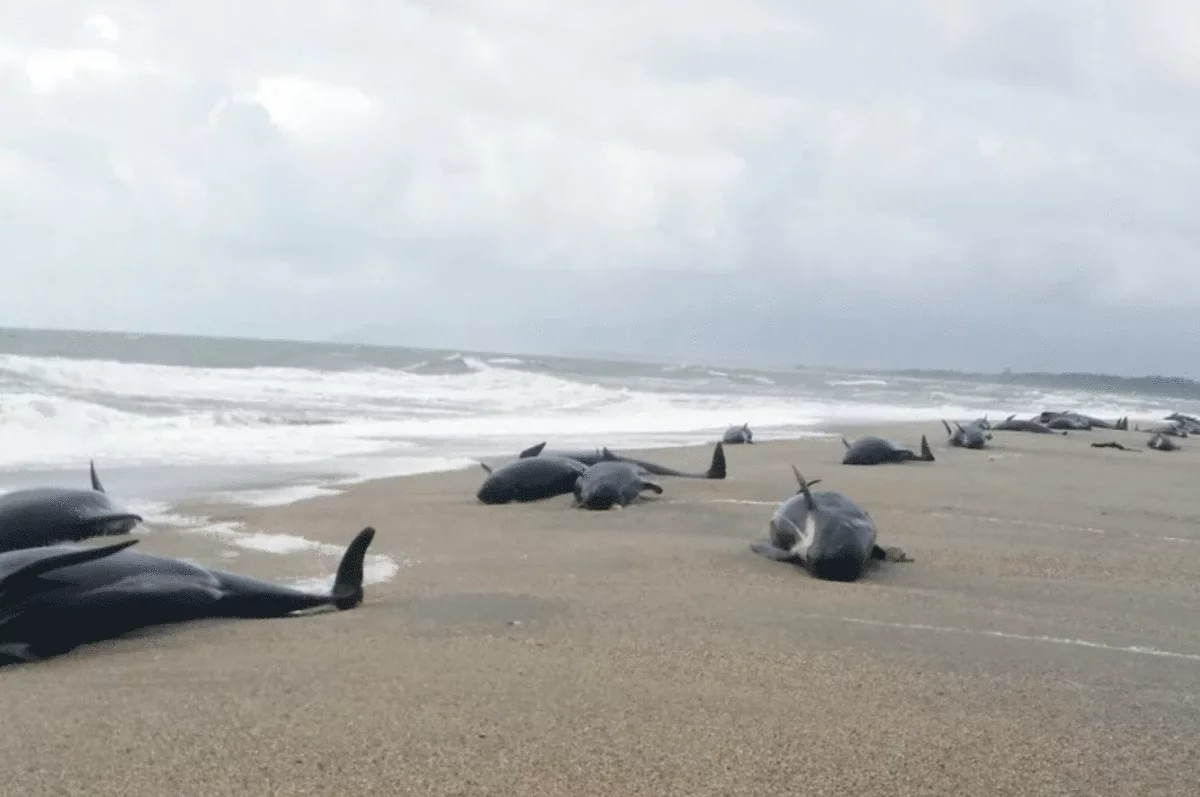
477 Pilot Whales Stranded in New Zealand
In October 2022 close to 480 pilot whales came ashore in New Zealand’s Chatham Islands across two strandings three days apart, and none survived. The first group beached on Chatham Island itself, the second at Waihere Bay on Pitt Island. No refloat was attempted at either site. This page records what happened and why the response was so different from a mainland stranding.
For the broader picture, see our dolphin conservation guide.
What happened, and when
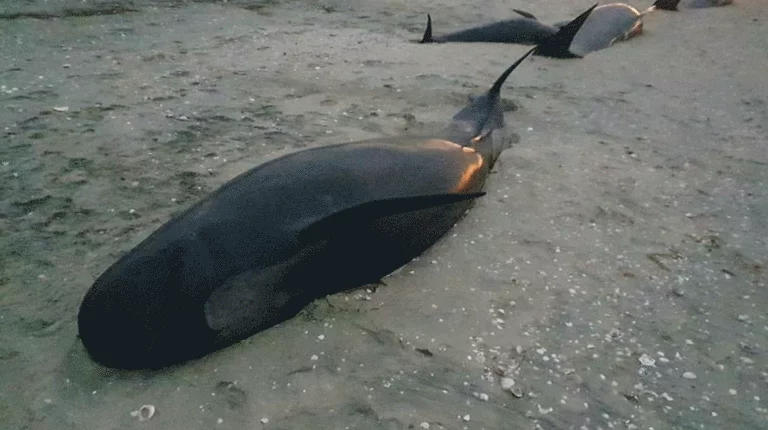
The Department of Conservation reported roughly 240 pilot whales stranded in the northwest of Rekohu, also called Wharekauri or Chatham Island, on Friday 7 October 2022. Some were dead when found and the rest were euthanised. On Monday 10 October a second group of almost 240 stranded at Waihere Bay on Rangihaute, also called Rangiauria or Pitt Island. All of those died too. The Department of Conservation said all the stranded whales died, and AP put the total at 477, with 232 at Tupuangi Beach on Chatham Island and 245 at Waihere Bay.
Where the Chatham Islands are
The Chathams lie roughly 800 km east of New Zealand’s South Island, out in the Pacific. They are among the most isolated inhabited places in the country, with a small population spread across a handful of islands, and that isolation is central to the story. A mass stranding on a mainland beach can draw hundreds of trained volunteers within hours. One this far offshore cannot. Getting enough people, equipment and veterinary support out there quickly is not realistic, and a stranded pilot whale does not have days to spare.
The decision not to refloat
The hardest part of the event was the choice not to try. Dave Lundquist, Technical Advisor Marine at the Department of Conservation, said whales are not actively refloated at the Chatham Islands because of the risk of shark attack, both to the people doing the work and to the whales themselves, and that euthanasia was the kindest option available.
It reads badly and it is meant to. But a refloat with no realistic chance of success, into shark-rich shallows, is not a rescue. The whales that were still alive were in poor condition and were euthanised rather than pushed back out.
A stranding hotspot with a long record
Strandings are not unusual here. The Department of Conservation notes that the largest recorded at the Chathams involved an estimated 1,000 whales in 1918. The 2022 event sits inside a pattern that goes back more than a century, not outside it.
Part of a bad run in 2022
It did not happen in isolation either. Two and a half weeks earlier, on 21 September, about 230 pilot whales had stranded at Macquarie Heads on the west coast of Tasmania, where only 32 were refloated. Days before that, 14 sperm whales were found dead on King Island off northern Tasmania. Losing another 477 in the Chathams made that September and October a grim stretch for pilot whales across the southern hemisphere.
Why pilot whales strand in such numbers
Nobody can fully explain mass strandings. Pod cohesion, shelving seabeds that scatter echolocation clicks, and a single sick animal leading healthy ones ashore all come up repeatedly, and we set out the mechanisms in our guide to why dolphins strand and in the account of the Macquarie Heads stranding, where several marine scientists were quoted on it at the time.
What the Department of Conservation reported for this particular event was narrower: either a lead whale turning off course with the pod behind it, or the whole group feeding too close in and being caught by the tide. Both fit what is known about the species. Neither has been established as the cause.
Long-finned pilot whales in southern waters
The animals involved in southern hemisphere strandings are usually long-finned pilot whales, Globicephala melas: dark, heavy-bodied, with a bulbous forehead and a low swept-back dorsal fin. Adults reach roughly 6 to 7 m and travel in pods of anywhere from a few dozen to several hundred. They hunt squid in deep water. An animal that lives in very large, deep-diving, tightly bonded groups is exactly the kind that strands catastrophically when something goes wrong.
What an event like this tells us
Losing 477 whales in four days is significant, and repeated events on this scale do register in regional numbers over time. The Chathams case is also a reminder that rescue is not always on the table, and that the humane call and the heroic one are not always the same call. Our piece on the Farewell Spit stranding explains why one New Zealand beach traps pilot whales again and again. For more on the species, see our pilot whale profile, which, despite the name, covers one of the largest members of the dolphin family.
Updated 25 October 2026: corrected the death toll to 477, with no survivors, from the Department of Conservation and AP.