
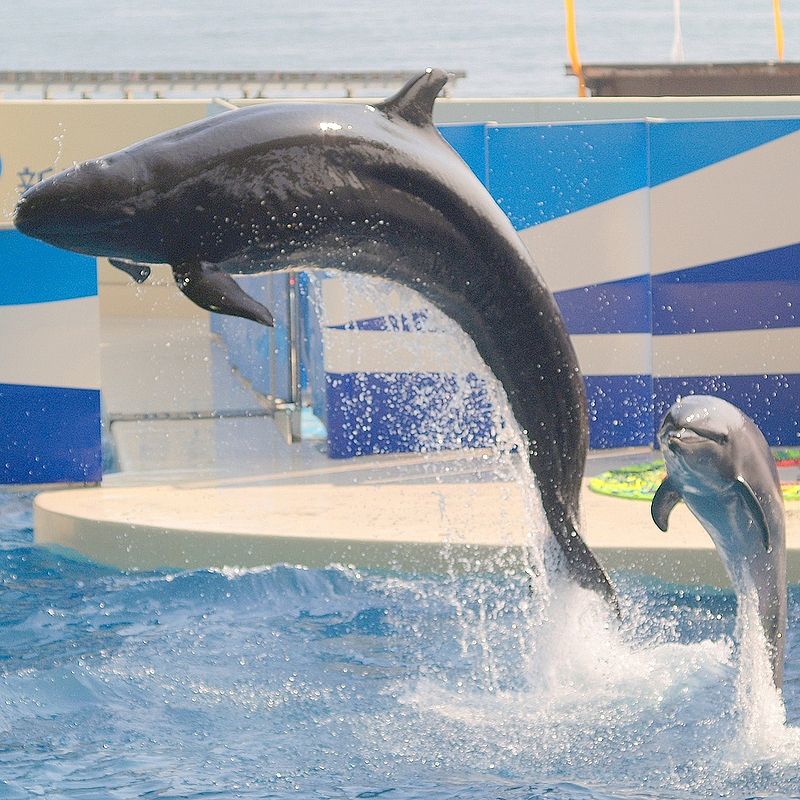
False Killer Whale: Facts, Diet, Habitat & Conservation
The false killer whale is one of the largest members of the dolphin family and one of the least understood. It is named for the resemblance of its skull to that of the true killer whale, not for any behavioural similarity. It lives in deep water far from shore, and it is best known for two habits: mass stranding, and passing food around the whole group.
Key facts at a glance
| Fact | Value |
|---|---|
| Common name | False Killer Whale |
| Scientific name | Pseudorca crassidens |
| Max length | 6 m (males); 4.5 to 5 m (females) |
| Max weight | up to about 1,360 kg (large adults, NOAA) |
| Diet | Carnivore: large pelagic fish and squid |
| Habitat | Deep tropical and warm temperate oceans worldwide |
| Lifespan | up to about 63 years (females) and 58 years (males) |
| Population | No reliable global estimate. Hawaiian insular population about 139 (2022) |
| IUCN status | Near Threatened |
| Taxonomy | Artiodactyla | Delphinidae | Pseudorca |
Range and habitat
False killer whales live in tropical and subtropical oceans worldwide, and NOAA Fisheries describes them as generally occupying deep water offshore rather than the coast. They travel in stable social groups, usually 10 to 20 animals, though aggregations of several hundred have been recorded. At sea they often turn up alongside bottlenose dolphins and pilot whales. In captivity a false killer whale and a bottlenose have even bred, producing the wholphin.
Around the main Hawaiian Islands lives a genetically distinct insular population, estimated at 139 animals in 2022. It has been listed as endangered under the US Endangered Species Act since 2012, and it is the only false killer whale population anywhere with that level of legal protection. A separate Hawaii pelagic population numbers roughly 2,100 in Hawaiian waters, estimated from ship surveys in 2002, 2010 and 2017.
Diet and hunting
The diet is dominated by large pelagic fish, including mahi mahi, wahoo and tuna, plus squid. What makes this species unusual is not what it eats but how it divides the catch. Prey sharing between adults has been observed repeatedly: an animal that has taken a large fish will tear off pieces and pass them to others in the group. Sharing food with adults who are not your offspring is rare in mammals outside primates.
That same appetite for large fish creates the species’ biggest problem with people. False killer whales take fish and bait directly off fishing lines, a behaviour known as depredation, which is how animals end up hooked or entangled in the Hawaii longline fishery.
Social structure and stranding
Social bonds in this species are unusually broad. They run not only between mother and calf but across the whole group, which is exactly why mass strandings are so severe here. If one animal ends up disoriented in shallow water, the rest tend to follow it rather than leave it. The largest recorded event was in 1946 at Mar del Plata, Argentina, where more than 800 animals came ashore.
Reproduction and life cycle
Gestation runs to roughly 15 months, and females reach sexual maturity somewhere between 8 and 11 years old. In at least one studied population, calves arrive about seven years apart. That is a very slow rate of replacement, and it is the reason a small population like the Hawaiian insular group cannot absorb extra deaths. Lose a handful of breeding females and the arithmetic does not recover for decades.
Threats and conservation
The IUCN Red List classifies the species as Near Threatened globally. NOAA Fisheries is blunt that the broad pelagic distribution of most populations makes a global population estimate impractical, so treat any single worldwide figure you see quoted with caution.
The Hawaiian insular population is the case that is actually well measured, and the picture there is poor. Aerial survey sightings indicate it declined at an average of about 9 percent a year through at least the early 2000s. A 2025 NOAA study, using photo identification from 1999 to 2022, estimated 139 whales in 2022 and a decline of about 3.5 percent a year over the last decade of that period. The cause is not settled, though fishery interactions are thought to be part of it, particularly before 1990 when longline fishing was more common in nearshore Hawaiian waters.
The practical measures that matter for this species are the unglamorous ones: gear modifications that reduce hooking and entanglement in longline fisheries that overlap its range, and the long-term monitoring that makes a decline visible early enough to act on.
How you can help
Two things are worth your attention here. Fishery interactions are the documented threat to this species, so pressure on how tuna and swordfish are caught, and on the observer coverage that makes bycatch visible in the first place, is the lever that moves. And the organisations doing the actual monitoring work, including the NOAA Office of Protected Resources and the IUCN SSC Cetacean Specialist Group, are worth supporting.
For related species, see our other dolphin species profiles. For the wider conservation picture, our dolphin conservation guide is the place to start.
Frequently asked questions
What is the scientific name of the false killer whale?
Pseudorca crassidens. It sits in the family Delphinidae, which makes it a dolphin rather than a whale, despite the name.
How big does a false killer whale get?
Males reach about 6 m. Females are smaller, at roughly 4.5 to 5 m. NOAA Fisheries gives up to about 1,360 kg (3,000 lb) for large adults.
How long does a false killer whale live?
NOAA Fisheries gives up to about 63 years for females and 58 years for males.
How many false killer whales are left?
Nobody knows the global total, and NOAA says the species’ offshore distribution makes estimating one impractical. The well-measured populations are the Hawaiian insular group, estimated at 139 animals in 2022, and the Hawaii pelagic group at roughly 2,100, from ship surveys in 2002, 2010 and 2017.
Is the false killer whale endangered?
Near Threatened globally on the IUCN Red List. Separately, the main Hawaiian Islands insular population is listed as endangered under the US Endangered Species Act.
Why do false killer whales mass strand?
Their social bonds extend across the whole group, so animals follow a disoriented individual into shallow water instead of abandoning it. More than 800 came ashore together at Mar del Plata in Argentina in 1946.
Sources and further reading
- NOAA Fisheries species page for the false killer whale (size, lifespan, population status, ESA listing)
- IUCN Red List entry for Pseudorca crassidens
- Society for Marine Mammalogy taxonomy list
Updated 25 October 2026: corrected the maximum weight and the Hawaii pelagic population figure, and updated the Hawaiian insular population to the 2022 estimate.



What an incredible species. All dolphins are great.
The food sharing is my favourite part. Tearing off bits of a fish and passing them round to adults that aren’t even their calves. So generous.