
Our Top Family Dolphin Movies of all Times
Family dolphin films nearly all run the same shape: an injured or stranded dolphin, a child who will not give up on it, and a release back to open water. That formula has done more to shape how people picture bottlenose dolphins than any documentary. Here are the ones worth a family movie night, with the real history behind each. For the wider list, including documentaries, see the 10 most popular dolphin movies of all time.
The films that started it
Flipper (1963)
Directed by James B. Clark. A twelve-year-old boy called Sandy Ricks nurses a wounded dolphin back to health in the Florida Keys, against his fisherman father’s wishes. It did well enough to launch a television series that ran from 1964 to 1967.
Flipper was played by a female dolphin named Mitzi, born in 1958 and trained at the Santini Porpoise School. She died in 1972. Five different dolphins were used across the series that followed, and their trainer, Ric O’Barry, later turned against the captivity industry entirely and founded the Dolphin Project in 1970.
Flipper (1996)
Written and directed by Alan Shapiro, with Elijah Wood as a boy sent to spend the summer with his uncle, played by Paul Hogan. Expecting a dull summer, he meets a dolphin instead. The remake adds a pollution plot the original did not have, which dates it neatly to the mid-nineties.
The Day of the Dolphin (1973)
Mike Nichols directing George C. Scott, based on Robert Merle’s 1967 novel. A scientist teaches dolphins to speak English, and they are then stolen and used in an assassination plot. It picked up two Academy Award nominations, for Best Original Score by Georges Delerue and for Best Sound.
Much darker than the rest of this list. Save it for older children.
Friendship and adventure
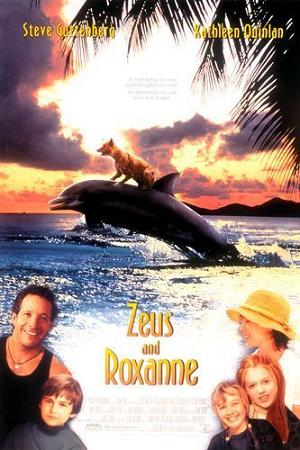
Zeus and Roxanne (1997)
Directed by George T. Miller. A dog and a dolphin become friends, and their owners, a music composer played by Steve Guttenberg and a marine biologist played by Kathleen Quinlan, are dragged along behind them. Gentle and low-stakes, which makes it the right pick for younger children who find the rescue dramas too much.
Eye of the Dolphin (2007)
Directed by Michael Sellers, starring Carly Schroeder as Alyssa, a troubled teenager sent to the Bahamas to live with the father she barely knows, a dolphin researcher played by Adrian Dunbar. The wild dolphin she befriends is what repairs the relationship.
Beneath the Blue (2010)
The sequel, also known as Way of the Dolphin, written by the same writer and starring Paul Wesley, Caitlin Wachs and David Keith. The plot turns on dolphin deaths linked to military sonar testing.
That premise is not invented. Naval mid-frequency sonar has been connected to mass strandings of beaked whales more than once, including seventeen cetaceans in the Bahamas in March 2000, where the US Navy accepted responsibility, and fourteen beaked whales in the Canary Islands in September 2002, stranded within hours of sonar being switched on during an exercise.
The true story
Dolphin Tale (2011) and Dolphin Tale 2 (2014)
Both are built on the real life of Winter, a bottlenose dolphin found on 10 December 2005 in Mosquito Lagoon, Florida, at around two months old, tangled in a crab trap line. The line cut off the blood supply to her tail and it disintegrated.
A team led by prosthetist Kevin Carroll spent eighteen months building her a prosthetic tail. The hardest part was not the tail but the interface: they developed a gel sleeve, the WintersGel prosthetic liner, to stop the attachment destroying her skin, and that gel has since been used in human prosthetics.
Winter lived at the Clearwater Marine Aquarium, played herself in the films, and died there on 11 November 2021 aged sixteen. The first film was shot at the aquarium and around Pinellas County, so what you see on screen is the real facility.
One documentary worth adding
Dolphins (2000)
An IMAX documentary directed by Greg MacGillivray, narrated by Pierce Brosnan with music by Sting, nominated for the Academy Award for Best Documentary Short Subject. It follows researchers working on dolphin communication, and features bottlenose, dusky and Atlantic spotted dolphins.
Because it shows animals in open water rather than tanks, it works well straight after one of the dramas. The contrast does the teaching for you.
Getting more out of movie night
- Pair a film with one real fact afterwards. After Dolphin Tale, that wild male bottlenose dolphins live around 40 to 45 years and females often past 50 is a good one.
- Use The Day of the Dolphin with older children as a way into animal welfare and research ethics.
- Follow a drama with a documentary, so the difference between a scripted dolphin and a real one is obvious. Our list of the best dolphin documentaries is a good place to pick one.
If your family wants to keep going, our piece on dolphin intelligence is the natural next read.
Updated 25 October 2026: corrected the bottlenose lifespan figure.



I have never seen this movie. Sounds good.
I am a big fan of dolphin movies, especially Dolphin Tale.
I enjoyed Dolphin Tale 2 too.
I loved Dolphin Tale!
I love God who made Dolphins.
I love the movie flipper and like the tv series flipper
I remember dolphin tail, its worth seeing again!
I have never seen these movies but I am glad that the dolphins are getting more attention!!!
That was good movie Dolphin tale. it was nice he got a new tail